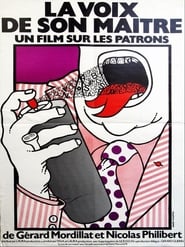
His Master's Voice (La voix de son maître)
Download English Subtitle
Release info
Tags
English subtitle preview
The first 200 lines.
His Master's Voice
I think La voix de son maitre, "his master's voice", is an awful title.
For a hundred reasons, of which I'll give you a select few.
Firstly, it takes a well-known expression which is tired,
even hackneyed.
And that expression includes the word "master"
which is singularly inapt.
It immediately conjures up the image of a dog.
We all like dogs. But in every language in the Western world,
the term "dog" has negative connotations.
"Master" does seem inapt, and we'll look at the dog issue and why.
What does it say about the people who chose this title
without even realising, perhaps?
But the word "master" is a hackneyed cliché from the 19th century.
The anarchists' "Neither god nor master".
That's the human rather than the animal aspect,
and it doesn't apply to 20th century CEOs in the same way.
There's something else insidious about the choice of the word "master".
It reeks of certain late 19th century philosophical theories.
Regarding the dog, you can't help but think of a dog,
and what does a dog do? Listens to his master's voice
and obeys, if he's well trained!
You can't expect a title, be it a few words or a few lines,
to faithfully represent a work. You can ask that it be authentic,
i.e. a person reading the title has an idea what the work may be.
Chief Executives , The Management
You could have a 3-page title.
The way I see it, this film is trying to describe a category of person
which is generally referred to in France as " Ies patrons".
And if it were called Les Patrons, some might take it pejoratively,
some might see the 19th century aspect, as you said,
but I still think it's the most honest,
it's not a pun, a spoonerism or a side-step,
and I would definitely go with that as my title suggestion: Les Patrons.
I like the term " patron", and I'll tell you why:
it's the simplest, humblest, most ordinary term.
Show me a machine operative who would say, "Yes, chief executive."
It just wouldn't happen.
It's a ridiculous idea.
The downside of " patron" is that it comes with emotional baggage.
You often hear people, in the United States and other countries,
saying, "Yes, boss." Yes, Boss ?
I'll tell you why I don't like the word "patron".
It's the etymology. " Patron" comes from "pater",
the paterfamilias and the excessive power that once represented.
There used to be the family, and the city.
The business emerged as a new intermediary,
distanced from the family.
Nowadays a family can't control a business, unless it's very small.
Once you have medium and large businesses,
a business becomes a distinct social entity,
and thus " patron" is inapt to describe us, modem chief executives.
By that token we should change the word "father"
because fathers today are not the same as 25 years ago!
Do you feel any more able than I do to pinpoint the moment in your career
when you became a patron ?
Because our career as managers is an ongoing process.
You start off an engineer, then assistant engineer to whatever,
and at a certain point you become president of a small subsidiary
or general manager.
But personally I never suddenly felt anointed or that I was a patron
on the day I was given that responsibility.
We know nothing of the ideals of ironmasters, for example,
who went on to start businesses, but are now unknown.
We want to know, and it's up to us to define them, without denying the past,
by defining what we are today.
That's why I thought of The New Political Animal
because I think chief executives, not patrons , but chief executives,
the people with the responsibilities,
are destined to explain, to persuade,
rather than saying, "I'm the boss!"
In the New Political Animal idea, is there anything to pursue other than...
"The New Animal" is not enough, and "political" is a confusing adjective.
Or maybe, like mountaineers: Conquistadors of the Possible .
The idea of conquest, of sport, a job that's out of the ordinary...
But "of the possible": the day-to-day, enabling people to make a living.
And also, with the idea of conquest comes the idea of pleasure,
and it must be said that one of the best things
about being a chief executive is the pleasure of doing the job.
It's a new style of leadership, a new style of man,
and I think it's a film which is forward-looking
rather than describing 19th century entrepreneurs.
So is there an adjective which could improve the Les Patrons idea?
That does have a pejorative aspect. A lot of patrons don't like the word.
You can't be the boss and not like decisions,
so I suggest, for humour, The Men Who No Longer Say, "I'm the Boss!"
to break with the past, and perhaps to say that we are a different animal,
with a taste for risks, for persuasion.
And, what's more, a taste for taking risks with no escape route.
We have no safety net. In the private sector, anyway.
The Players ? The Winners ?
- The Winners ! Not bad... - The Winners .
It may be a something of a gut reaction,
but I remember, quite a few years ago now,
I was not yet 30 and I had the honour of managing a machine factory
at Saint-Ouen in northern Paris,
and I remember my joy and pride
the first time a worker on the milling machine line turned to me
and said, " Patron, what should I do with the such-and-such sprocket
in the gearbox?"
I felt neither embarrassed nor hurt.
I'll say it again: I took that short, simple word,
from a man who had turned to ask me for help,
who wanted advice from a man he thought knew more than him,
I took it the same way as the word "master".
Clearly there are slave masters,
but there's also "master" in the sense of a teacher,
someone who is there to help you learn,
and in that short, friendly word "patron",
I felt both a bit of affection, perhaps a bit of suggestion.
And if the word "patron" has both meanings,
the monster who feeds on the sweat of the people
but also someone who is a bit like...
I'll go with paternalism. A bit like a father.
Well, I choose the second sense.
And I am proud and happy when people call me that
in that short, pleasant formulation, "Good morning, patron."
I've always been worried,
when I go into a factory,
about the sort of anonymity.
I see the workers at work, I go to look at a new investment,
a new set-up,
and I see the men and women working,
I go past, talking to my engineers, who are showing rne what's new,
and from time to time I think... I look at those men...
They see me and I don't look at them, because I have things on my mind.
I don't have a relationship with them. That's a big worry.
I had that when I was a young engineer.
I started out with 50 or 60 workers
and I'd go to them every day, I knew what they were doing,
I'd even go and learn the job with them.
But little by little, as you take on more responsibility,
you no longer work on a personal level with the workers.
You work with a number of other managers.
But the various managers, who do have contact with the workers,
I make sure I check, which is easy,
that they are not in the same role as me vis-é-vis the workers,
and that at least one person, whose job it is, has that relationship
with the other men who make up his workshop or his factory.
Work in companies did not evolve much between 1950 and 1965,
or rather it changed in terms of the division of labour
and moving towards mass production.
Since then, and certainly right now,
we are taking a great interest in the personalisation of the workplace
and in the reactions of individuals to their work.
And, at least in the group of companies for which I am responsible,
we are looking to get back to a human scale
and to have individualised work.
I'll give you two examples: a factory where automated machines
produce parts on very long runs.
The worker is there to supply the machine or to do quality control,
but he has free choice, not exactly about how he spends his time,
but about what he does at any given moment;
he can light a cigarette, have a chat with his neighbour,
he might be thinking, perhaps about a new task he has to perform.
Next door, the parts are produced in a production line.
Those workers may be paid more than the last lot.
But they're tied. Each is a link in a chain and they don't have that choice.
They can't have a cigarette when they want to,
and if they want a break, someone has to replace them.
So there's a difference in freedom in the way they spend their working day.
And we should move more towards respecting that freedom.
There's no getting away from it, even within very large groups of people,
I'm talking groups of 2 or 3,000 people,
unless we go back to the level of autonomous businesses
inside of these same companies,
where the manager knows everyone by name
and where people have non-anonymous relationships.
That's what we're looking for, and it's not at all easy.
Because, whilst making that progress,
we have to continue producing as many products, mass production,
for an ever decreasing price, in order to gain a bigger market share.
Because in amongst all these noble and generous aims,
one mustn't forget the bottom line is to provide a living for all the staff
with a market share in a competitive market.
For me there are a few imperatives.
Firstly, to know as much as possible,
even in terms of the smallest details,
about each person's work.
In my case, I was lucky enough, from the age of 18,
to start work in our factories
by spending a period at all the different production stages.
Textiles was our trade, and I saw the spinning process from start to finish
and what all the different operations were.
This was over a period of three years, because at the start of my career,
the first present I was given by my uncle, Mr Marcel Boussac,
was two sets of overalls and a train ticket
to go and start getting to know how our industrial process worked.
When I first started taking over management of this business,
I had some very difficult problems to resolve
because, due to serious financial difficulties with our partners,
which was our bankers on the one hand and the government on the other,
I had to rapidly reduce the workforce
and close some operations.
Those were probably the most emotional moments of my career.
Industry is clearly linked to men's happiness,
but that's not what industry is, nor it that its aim.
If industry's aim were to make people happy,
that would mean that people are solely materialistic,
which I don't believe at all.
Comments
No comments yet. Be the first to leave one.