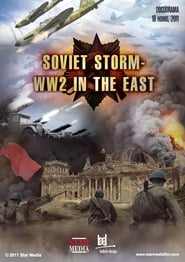
Soviet Storm: WW2 in the East (Великая война)
Download English Subtitle
Release info
Tags
Download English Subtitle Files for Mobile (9)
English subtitle preview
The first 200 lines.
Spring 1941. Nazi Germany dominates Europe. Poland and France have been occupied.
Only the British Commonwealth fights on.
Hitler now turns east to the Soviet Union,
where Nazi dreams of a new land empire are to be fulfilled.
Episode 1 - Barbarossa
April 1941. In a field in western Ukraine, a satisfied Soviet pilot
counted bullet holes in the aircraft he d just shot down.
The twin-engined German aircraft had civilian markings.
But the military bearing of the pilots was obvious.
The smell of burning plastic was further cause for suspicion.
It came from a smouldering pile of photographic film,
which the Germans had hurriedly tried to destroy.
In the spring of 1941 Nazi Germany and the Soviet Union were allies.
But everyone knew it could not last.
German reconnaissance aircraft, flying 33,000 feet above the Soviet Union,
usually passed unnoticed. But on 15th April 1941,
engine trouble forced one Junkers 86 to lose altitude.
It was quickly intercepted and shot down.
Under interrogation, the Junkers pilots said they d lost their way
flying to Krakow in German-occupied Poland. It wasn t very convincing.
They d been shot down near Rovno, more than 200 miles from Krakow
deep inside the Soviet Union.
The pilots were from the elite Rowel high-altitude reconnaissance squadron.
They had been secretly photographing Soviet territory for months,
in preparation for the German invasion of the Soviet Union.
Ten days later, a top-secret report arrived in Moscow from Major General Tupikov,
the Soviet military attaché in Berlin.
His report made two conclusions. Number One
The Germans are planning war with the Soviet Union. Number Two
They plan to attack soon definitely before the end of the year.
In the spring of 1941, neither Tupikov nor other Soviet agents
could say exactly when the German invasion would come.
Stalin s best spy, Richard Sorge,
had claimed that the invasion would begin around March,
after the harvest was sown. Then, he said the end of May.
When that passed, he said the second half of June.
The reports from Soviet agents were confused and contradictory.
In short, no one in Moscow was certain if or when the Germans would invade.
In later years it was rumoured that the German invasion plans were on Stalin s desk
almost as soon as they were signed. But in reality, no such plans were stolen.
Masses of information was received from the Soviet intelligence network.
But only a few reports received proper analysis.
Many valuable ones got lost in the Soviet bureaucracy.
5 months earlier, in December 1940, Hitler had issued Fuehrer Directive 21.
It ordered German forces to prepare for the invasion of the Soviet Union
codename: Operation Barbarossa.
Now, German troops were streaming eastwards,
taking up position along the Soviet frontier.
Hitler would later claim that the Red Army had been massed along the border,
poised to invade Germany. Thus he claimed Operation Barbarossa
was a pre-emptive strike a legitimate act of self-defence.
But this was classic Nazi propaganda. Hitler wanted others,
particularly in the neutral countries, to believe his invasion was justified.
But few were fooled.
In private, Hitler was more candid about his reasons for invading the USSR.
It is only the possibility of Russia entering the war , he said,
that now gives the English hope. If that hope is ruined,
the English would have to make peace.
Operation Barbarossa was an ambitious invasion plan,
relying on the blitzkrieg tactics that had proved so effective against the French
and British the previous year.
The attack was to be spearheaded by 4 Panzer Groups.
Their tank and motorised infantry divisions would seek to make rapid advances deep
into enemy territory, leading to the encirclement
and destruction of enemy armies on the frontier.
The four panzer groups were commanded by generals von Kleist
Hoepner Guderian and Hoth.
The ultimate goal was the capture of Moscow, and the whole of European Russia.
German strategists believed that their military superiority
would lead to victory in 3 to 4 months.
For the invasion, German forces were divided into three formations.
Army Group North was to advance towards Leningrad
Army Group Centre towards Moscow
and Army Group South towards Kiev and the Donets Basin.
Army Groups North and South each had one panzer group.
Army Group Centre had two, including Third Panzer Group commanded by Hoth.
Colonel-General Herman Hoth had distinguished himself
in the campaigns against Poland and France.
He was 56 years old, and referred to affectionately
by his soldiers as Papa Hoth.
Unlike Russia, where many senior officers had been killed in political purges,
Germany could call on a wealth of experienced commanders.
Most Soviet generals were in their 40s. In contrast, Guderian was 53...
Hoepner 55... and von Kleist 60.
Panzer Group command staffs arrived at the Soviet frontier during the winter of 1940.
At first only staff officers and signals troops were sent.
The tanks were not to arrive until the very eve of the attack.
By keeping his tanks in the west,
Hitler wanted it to look like he still planned to invade Britain,
and prepared only defensive operations in the east.
And so an invasion army quietly assembled on Russia s doorstep.
In 1941, the Wehrmacht was at the height of its power.
Its divisions had been brought to full strength.
Morale was high after victory in the west.
The last few months had been spent in intensive training
for blitzkrieg operations.
In contrast, the Red Army was dispersed across the Soviet Union,
with many of its units still at peacetime strength.
The forces at the border spent much of their time listening to political lectures.
It would take two or three weeks of redeployment to properly reinforce them.
And there was little preparation for defence after all,
the Red Army always expected to attack.
Furthermore, Stalin was in no rush to fight a war against Nazi Germany.
He knew the Soviet Union was not ready.
In 1939 Nazi Germany and the Soviet Union had signed an alliance.
But Stalin harboured no illusions.
Intensive military construction was under way in the USSR.
The Red Army had grown from strength of one and a half million troops,
to five million. In the summer of 1941,
Soviet armed forces were still in the midst of reorganisation and expansion.
Fortifications were still being built, airfields overhauled, and new units formed.
Until these preparations were complete,
Stalin was desperate to stave off any conflict with Hitler s Germany.
But the reports from Soviet intelligence were becoming more ominous.
In early June 1941, the Germans started moving armoured
and motorized divisions towards the frontier.
This no longer looked like preparations for a defensive operation.
8 days before the invasion, the Soviet state news agency, TASS,
printed a report in one of its newspapers.
It read, In the British and foreign press in general,
there are rumours circulating about an imminent war
between the Soviet Union and Germany.
Soviet official circles believe that these rumours are absolutely groundless.
It was an invitation from Stalin to Hitler
to settle their differences through negotiation.
But in reply, there came only deathly silence.
Stalin finally ordered reinforcements sent to the frontier.
Even now, three days after the TASS message,
Soviet spy Richard Sorge reported:
The invasion has been delayed until the end of June.
Stalin hoped once more that war could be put off.
But it was too late: the invasion was now less than one week away.
On 22nd June the Red Army was formed in three echelons,
stretching from Poland to the Dnieper River.
Most Soviet troops were only just beginning to move west to face the Nazi threat.
In contrast German forces were massed on the frontier, ready to strike.
At the start of the invasion,
in the Baltic republics 21 Soviet divisions would face 34 German divisions.
In Byelorussia, 26 Red Army divisions faced 36 German divisions.
In Ukraine 45 Soviet divisions would meet 57 Wehrmacht divisions.
The Red Army was outnumbered, and although it had more tanks and aircraft,
they would prove to be of little value.
On 21st June, German high command transmitted the signal Dortmund .
It confirmed Operation Barbarossa for the next morning.
Tanks, armoured vehicles and trucks moved to jumping-off positions.
That evening, German officers summoned their men,
to read them a proclamation from Adolf Hitler to his troops.
It declared, The fate of the German Reich is now in your hands.
In the days to come, German soldiers were to be guided by directives such
as those from General Hoepner:
Your struggle must pursue the objective of turning today s Russia into ruins,
and must be carried out with extreme severity.
But not all soldiers wanted to be part of this so-called crusade for civilization .
Sapper Alfred Liskow, a secret communist, made for the border.
He crossed the Bug River, and surrendered to Soviet border guards.
Stammering with excitement, he told them that at dawn the next day,
the Nazis would attack.
Before the sapper was dry his words were on their way to Stalin.
Similar information came from a Soviet agent in the German Embassy, Gerhard Kegel.
On the morning of 21st June he reported that the war would begin within 48 hours.
In the Kremlin, General Zhukov, Marshal Timoshenko and General Vatutin
managed to persuade Stalin that action was needed.
A directive placed all troops in a state of readiness,
but with a warning that the Germans may be trying to provoke them.
The orders reached front line units just after one o clock in the morning.
In Minsk, General Pavlov, Commander of the Byelorussian Military District,
arrived at his headquarters in the middle of the night.
Waiting for him was a report from the town of Grodno near the frontier. It read,
Ammunition has been distributed. We re taking up defensive positions.
Commander of the 3rd Army, Vasiliy Kuznetsov.
Vasiliy Ivanovich Kuznetsov had been conscripted to fight in the First World War.
He later rose to command a rifle regiment in the Russian Civil War.
When the Second World War began, he was 47 years old,
and would endure its hardships from the first day, to the very last.
The warnings about an invasion didn t surprise Kuznetsov.
His troops had been listening to the roar of engines
from across the border for many hours. It could mean only one thing.
The first Germans to cross the border were from the Brandenburg Regiment,
an elite German special forces unit.
With a mixture of trickery, stealth and surprise,
the German commandos secured key bridges across the Bug River.
The Luftwaffe was already airborne.
They were heading for major Soviet cities in the west,
and airfields identified by German air reconnaissance.
The Soviet Air Force, its aircraft parked in neat rows,
had no idea of what was about to hit it. As German pilots made their final approach,
they were the first to see the sun rise on that fateful day.
At 4am their bomb doors opened and destruction rained from the sky.
Russia's Great Patriotic War had begun.
Dawn on the 22nd June 1941. Soviet airfields were under attack.
One squadron commander, Captain Berkal, was quick to act,
ringing the alarm and getting his men into the air as fast as possible.
Where Soviet fighters did manage to get airborne,
they found the unmanoeuvrable German dive bombers were easy prey.
Mlynuv airfield in Ukraine became a graveyard for German bombers.
Here the German Edelweiss squadron lost 7 aircraft.
But these were token victories in a disastrous day for the Red Army Air Force.
Some airfields survived the first German strikes.
But then the Luftwaffe hit them again, and again.
In the course of five or six German air raids,
More English subtitles for Soviet Storm: WW2 in the East
- Soviet Storm Wwii In The East Series 1 720p x265 [HashMiner] · 24 downloads · 2022-02-01
Comments
No comments yet. Be the first to leave one.