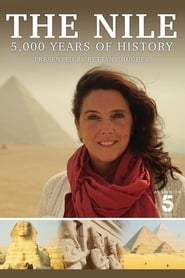
The Nile: Egypt's Great River with Bettany Hughes
Download English Subtitle
Download English Subtitle Files for Mobile (4)
English subtitle preview
The first 200 lines.
For 5,000 years this land, Egypt, and the epic civilisation it gave
birth to has been shaped by one thing more than any other,
this awesome river.
The River Nile.
The Nile helped temples to rise...
Pharaohs to rule and pyramids to be built.
Without the Nile there'd have been no Ancient Egypt.
So, I'm setting off on the historicaljourney of a lifetime,
a 900 mile adventure, along the Nile, across the whole of Egypt.
I'll explore Egypt's greatest achievements...
It is truly wonderful, isn't it?
And find treasures hidden for thousands of years.
Oh, my God. That's a sheer drop down.
This is my chance to travel this fabulous land.
And experience it as the ancient Egyptians did, from the River Nile.
From pharaohs to slaves, from facts to fantasies,
I want to explore, first hand, and understand how this river
shaped one of the world's first, and greatest, civilisations.
Join me as I uncover 5,000 years of history along the River Nile.
For thousands of years this river has been the lifeblood of Egypt.
My first taste of the mighty Nile is its mouth.
I've hitched a lift on this fishing boat to check out
where the river meets the sea.
These boats are coming in from the Mediterranean.
I'm right at the very mouth of the Nile delta.
Since ancient times this has been Egypt's gateway to the world,
and it was along these waters the world connected
to a civilisation that's had enormous influence on all our lives.
For thousands of years the Nile has nourished culture,
and civilisation, and technology. But it's also been people's home.
So over the next few weeks I'm going to be leaving the land,
and living on the water.
I hope to be meeting old friends and perhaps making new ones
so I can try to understand the power, and the secrets,
and the stories of this historical dynamo.
My journey proper begins on the other side of the Nile Delta
at Cairo, where the mass of streams and canals at the Nile's end come
together to form one glorious river.
From there, I'm sailing upstream using the river like a historical
treasure map to investigate great sites and new discoveries
from ancient Egypt.
It's an adventure along Egypt's river artery,
all the way to its border with Sudan.
But to do any of this, I'm going to need more than
just a fishing boat.
Because I'm making a historical journey,
my home for the next couple of weeks is going to be a traditional boat
that for centuries has sailed up and down the river Nile.
It's this beautiful thing, a Dahabiya.
Part barge part sailboat, Dahabiyas are unique to the shallow waters
of the Nile.
My goodness, this is absolutely huge.
I wasn't expecting it to be so big.
Hello. Hi. Are you Osama? Please. Nice to meet you.
Thank you. Welcome. Thank you so much. Please. I will.
Gosh, this is so beautiful. What an amazing boat.
I've seen them in pictures, these, but I've never actually
had a chance to sail on one before.
Flat bottom boats like this have sailed up the Nile
for thousands of years.
In ancient Egypt the symbol for any kind of a journey
was a boat.
This is our captain.
Hi, nice to meet you.
Hi, I'm Bettany. Welcome. Thank you.
And this is this is your cruise. Yeah. Hi, Gentlemen.
Hi, I'm Bettany.
The ancient Egyptians were a bit wary of ocean travel,
but when it came to the Nile they were in their element.
Let me show you cabin.
Cruises on Dahabiyas like this became popular 200 years ago,
as modern day travellers fell under Egypt's spell.
Pitch-black in here, everybody.
I'll open the curtains.
Oh, my goodness.
Hello, Nile.
This is ridiculous.
What am I going to tell my husband and my kids when I get home?
They think I'm working very hard.
This is your private terrace. I've got my own little deck.
Oh, that's not bad, Osama. I do really love this river.
The river Nile is actually the father of all other rivers,
all over the world.
Yes. This is what I think about the River Nile.
Yes. Yeah, well, it just created a whole world, didn't it, the Nile?
There's no doubt. No. Amazing.
I'm not going to explore its secrets.
One thing you learned quickly in Egypt is that it's smart to avoid
the midday heat.
So, as dawn arrives the crew get ready to depart.
And as the sun appears we're on our way.
The Nile united ancient Egyptians from north to south, bank to bank.
I want to try to understand these people,
and the role this river played in all their lives.
And I'll be exploring the land that first got me hooked on history.
Whenever I go travelling I always take one of these,
so I write notes on the places I've visited.
I bring quotes from ancient authors and sometimes photos.
But for this trip I've been asked to include some photos of myself
and there's a reason for this.
I was five years old when I first saw the British Museum,
and it's amazing Tutankhamun exhibition.
That experience inspired me to write my first book.
This is My Busy Book, by Bettany.
This is my theory on why, and how, Tutankhamun died.
"Tutankhamun was a long time ago.
He must have lots of men because he was rich,
and he was very, very nice.
But one day some, spelt 'sum', mosquitoes, that were very germy,
bit him, and he died. Somebody buried the jewellery,
and made doors for the jewellery, but after some men dug it up."
Obviously, archaeologists.
And lots and lots, and lots, and lots of people went to the museum,
and on the television you can see it.
The story of Tutankhamun has captivated millions.
He's one of the reasons I became a historian.
I've been tipped off that this afternoon something rather
extraordinary is happening.
I've got an appointment
with one of the world's leading Egyptologists
at the Egyptian Museum.
I can't tell you how much this is my happy place,
because this museum is 5,000 square meters.
It's absolutely jam packed with artefacts,
and treasures and objects.
They even say there's not enough room for them all.
So they have to be stored out here in the courtyard.
This magnificent museum holds 120,000 Egyptian antiquities.
Amongst them is the world's greatest collection of royal coffins.
And this afternoon one of them is going to be opened
for a very rare glimpse of the mummy inside.
I think it's somewhere around here. I think.
Hi, Salima.
Professor Salima lkram and I share a passion for the story of Egypt.
I'm so pleased that you could come.
Salima is a world expert in mummification.
And today I'm joining her team.
Their subject is 3,400 years old.
She's called Thuya.
And she's no less than the great grandmother of Tutankhamun.
I've never actually seen her face.
No, no, because this has not been opened for ages.
Salima needs to check on Thuya's body, so her glass cabinet
is being opened.
Her coffin lid will be removed.
And for the first time in years, we'll be able to see her mummified.
In the centre of modern Cairo just yards from the River Nile
I've come to the Egyptian Museum for a rather special rendezvous.
This afternoon I'm coming face-to-face with the great grandmother
of Tutankhamun.
Oh, my goodness. My heart is actually beating faster.
Why she's special, is it's maybe one of the best preserved mummies.
Absolutely. She is one of the best preserved mummies that we have.
This is Thuya.
She was discovered two decades before her great grandson.
When we look at her face, do you think that could give us
any genetic clues as to what Tutankhamun looked like?
I think that would be quite possible especially because they've got
the same set of teeth sticking out a bit.
What's really extraordinary is that she's not born royal.
There's a lot of social mobility.
I mean, she starts off quite common. just has a priestess,
and then she's in this splendid tomb with all of this gold,
and stuff. Amazing.
Can you smell that?
It smells like resins and incense. It does.
So, look down here.
That's actually the resins that are part of the mummification
and burial ritual, and they were poured over,
and some of them are still...
you can see it must have been in a funny position
because of the way it's dribbled. Wow.
Can I just have a moment to get this millennia old smell?
That is amazing.
This is closer than anyone normally gets to Thuya.
Yeah, I think all of our conservators are ready.
It's time to see how the lady herself is faring.
OK.
Oh, my God! Look at her!
She's magnificent.
She's so tiny, and so perfect.
Look at her hair, she's got this beautiful, thick head of curly,
kind of, strawberry blonde... is that the original colour?
Well, we did... We're not 100% sure,
but when you're using natron which we use for mummification,
it's a bleach.
So it's like putting salt on your hair, when you go to the beach.
And look at her. She's got double pierced earrings.
She has.
She does have that Tutankhamun overbite.
She's even more beautiful than in her pictures.
By Thuya's time mummification had been practised
for at least 1,200 years.
That sophisticated process of preparing and preserving the body
would have taken over two months to complete.
She's a really fine example of mummification
but how can you tell that? What here tells you this is a really, really,
really good job. Well, I mean, it's a totally, beautifully
well-preserved, recognisable face.
Completely. You can see her eyebrows and cheekbones.
The Nile: Egypt's Great River with Bettany Hughes subtitles in other languages
Comments
No comments yet. Be the first to leave one.