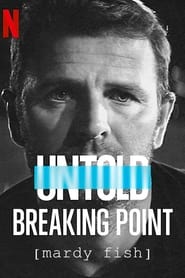
Untold: Breaking Point
Download English Subtitle
Release info
Tags
English subtitle preview
The first 200 lines.
This tape is about mental toughness.
Achieving mental toughness is no easy task,
but if you follow the steps outlined on this tape,
you'll get real results.
Number one, 100% fighting effort.
That means no whining, no complaining, no escape routes.
I'm a couple hours away from the biggest match of my career.
The biggest match of my life.
I was just curled up in a ball,
trying desperately to figure out a way to just stop having these thoughts.
One hundred percent fighting effort
And I'm about to play the greatest player of all time...
to get into the quarterfinals of the US Open.
That means no whining, no complaining, no escape routes.
This match, I had physically and mentally and emotionally trained
for my entire life.
And now, in the car ride to Arthur Ashe Stadium,
my mind is a million places.
All of a sudden, just... boom!
The thoughts just came flooding in,
more and more and more.
Just nonstop thoughts.
And my heart is just racing.
Big, deep breaths.
No complaining. No escape routes.
I'm Googling "what is anxiety disorder,"
"panic disorder," "mental health."
I'm listening to talks on YouTube of how to deal with it, how to beat it,
thinking, "How am I gonna get through this?"
I mean, just basically, I'm... I'm desperate.
I didn't know what to do.
Tennis in this country seems to be on the decline.
Now some people are trying to do something about that.
The United States Tennis Association
is setting up a nationwide program
to develop and support talented players through regional tennis centers.
We're developing a national training center
where we would take our top young players,
give them a scholarship,
and we will have some more champions.
This is our map, which shows all of the area training centers
that we have around the United States.
We're gonna take the best thousand kids, and the other 500 of you, you are out.
Now we are gonna leave 200. The rest of you are out.
Now we have ten, and out of these ten, we must develop a champion.
Everything about American sports is the best
and about immediate gratification, and, you know, tennis was no different.
At that point, American tennis was sort of on the back nine.
Tennis officials say America's best are getting older.
And many around men's tennis are worried about its future.
So, enter the USTA, who really felt the pressure
and invested tremendous resources building the next top American.
There are endless demands from corporate sponsors,
the media, and fans for the new hope of US tennis.
So, even at the academy level, having an American player
who potentially could play at the next level was a commodity.
But let's just be frank.
When I first watched Mardy,
there was nothing that you would say,
"This guy's a prodigy. This guy's gonna be world class."
There was the part that was flat-footed.
There was the part that you'd go, "That forehand's pretty terrible."
But man, his mind intrigued me.
Mardy would pull you wide. The short ball would come.
He'd snap this cross-court angle, and you'd be like, "Wow, shit. That's...
That's a big shot."
So I went to the USTA and said, "I want Mardy at Saddlebrook."
Saddlebrook was a big turning point.
A lot of tears.
I went to orientation there and cried all the way home,
uh, when we left him.
We enjoyed having him around the house. All of a sudden, you know, he's gone.
And I never imagined him leaving at 15.
I lived in a small town. Vero Beach, Florida.
So I remember the first time that I moved in
was a real eye-opening experience.
Real pros were there.
Jim Courier trained there.
Pete Sampras trained there at the time.
And I got to watch them train and really feel like a tennis player.
Here at Saddlebrook,
we're experts at developing some of the best players in the world.
Pete Sampras, Martina Hingis,
Andy Roddick, Jennifer Capriati.
The US tennis elite.
We really believe mental toughness is one of the biggest defining things
about them as... as competitors.
Within the player development program,
we'll really work on developing their physical skills,
their emotional skills, their mental skills,
so that they can become a successful professional
and do well in Grand Slams and Davis Cup.
So we had to instill that mental discipline early on.
It was something that was never gonna be instinctual with a child.
You'd get up in the morning.
There are times when you'd hit even before school.
I don't know how hard the school was, but we played a lot of tennis.
We really believe in practice makes permanent,
and you have to practice perfectly.
And then we'd work out in the gym.
Go to school for a few hours.
You're back on the tennis courts by one o'clock.
Boom. Groundhog Day the next day.
And then twice a week, we'd go into a conference room,
and we'd watch a mental toughness video of Jim Courier and Pete Sampras.
Achieving mental toughness is no easy task.
But if you follow the steps outlined on this tape,
you'll get real results.
I learned at that age the philosophy of, "Put your head down."
"You go about your business and not show them any weakness at all."
That means no whining, no complaining,
no escape routes.
Can you create a champion?
Mold them into the next Tiger Woods or Michael Jordan?
At the Saddlebrook Resort in Florida,
a group of promising kids live and train away from home.
But only a handful will make it as professionals.
It is simply and brutally the survival of the physically strongest
and the mentally toughest.
It was pretty jaw-dropping to see how tough a lot of these players were.
But Andy Roddick...
This kid was different.
His competitiveness was different than any of the kids that you played.
Andy had this fire to him.
Very intense, ruthless on the court,
to the point where I would give in a little bit.
He wanted to win almost too bad.
A win, I've got a prediction.
What is it?
I'll win today.
That is one of, if not the main reasons why he had his hall of fame career.
Andy, what would you like to achieve in tennis?
Just to be the best player I can work to be.
Who'd you like to be like? Andre Agassi? Pete Sampras?
Probably Pete Sampras and Andre Agassi.
When Andy ended up at the academy,
there was a buzz about this kid.
He was really something extraordinarily different.
People would go by on the tennis court,
and everybody would stop and watch Andy serve.
I was practicing with Mardy one day, and I was pissed off in practice.
I walked up, did a little half-motion off of two feet.
I just hit it as hard as I could,
um, and it went in,
and then I just did that for the next 15 years.
When Andy and Mardy left the academy,
Andy was on a track to be a world-class player.
So Mardy was really meant to serve Andy's needs.
The Roddicks knew that Andy needed peers to practice with.
They also knew that it was important for Andy
to have friends and to enjoy it,
and Mardy fit that bill.
He was the guy that could keep up with him, could have fun with him,
but, um, ultimately, you know, was that kid to practice with.
When I left, I was 16 years old,
and the Roddicks were nice enough to say, "You can live with us."
Didn't know them personally at the time,
but I moved in, and I had a bedroom across the hall.
I think he was a bit more of a laid-back beach kid,
and then he comes into our house, and he's going, "What is going on?"
But my dad said, "Hey, listen. You can stay here. It's a choice."
"But if you are here, then I think we operate a certain way."
My dad was a tough man, and I say that in a great way.
You know, army guy. There was no BS.
His father would wake me up at, like, five o'clock in the morning
and go, "Mardy, it's time to stretch."
And I'm like, "It's five o'clock, Mr. Roddick."
"I can't do it. I'm too tired."
"Get up. It's time to stretch."
It was such an intense level of training and competitiveness.
Now my competition was across the hallway.
If he was playing better, it was in my face at dinner.
We competed at everything,
whether it was a video game,
basketball,
girls.
We weren't best friends. We were brothers.
So we could yell at each other, almost come to fistfights,
and the next day, it would be super fun good times.
It was great for me to have talent like Mardy close.
I think ultimately it was good for the both of us.
The Roddicks took me from a top player in the country
to a top player in the world.
Second in the nation is not too shabby.
Mardy Fish.
When Andy and Mardy turned pro,
the expectation for an American to be good early was...
it was important.
The US tennis fan was so spoiled for so many years.
Sampras, Agassi, Courier, Connors, McEnroe.
I mean, you went through decades of American dominance in tennis.
Growing up, I caught the tail-end of the Connors and McEnroe generation.
I was at the '91 US Open.
I remember sneaking into the stadium.
The atmosphere was insane to me.
Connors was going nuts and just being a rock star.
That night had such a huge impact on me.
It changed my life and my aspirations.
Wow!
The American tennis that came before Roddick and I
Untold: Breaking Point subtitles in other languages
More English subtitles for Untold: Breaking Point
- Untold Breaking Point 2021 720p WEBRip x264 AAC-[YTS MX] · 14 downloads · 2021-09-09
- Synapse 2021 1080p WEBRip x264 AAC5 1-[YTS MX] · 17 downloads · 2021-09-09
- Untold Breaking Point 2021 WEBRip x264-ION10 · 12 downloads · 2021-09-07
Comments
No comments yet. Be the first to leave one.