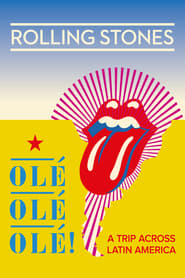
The Rolling Stones: Olé Olé Olé! – A Trip Across Latin America
Download English Subtitle
Release info
Tags
English subtitle preview
The first 200 lines.
Something good.
This is the last day of our rehearsal.
We've been rehearsing for two weeks.
Working what numbers we're gonna do...
There's always a bit of rust to rub off.
Rehearsal's a big word for bonding.
When you sit and play the first song
it's the same feeling as it was when I first joined.
We haven't seen each other for a while and it's fresh
like reuniting and lots of it comes magically flooding back.
Kind of feeling when you rehearse the last couple of days
all it really needs is an audience.
Yeah.
So this tour we're gonna visit nine Latin American cities
and hopefully the tenth that we haven't yet visited
is gonna be Havana, Cuba.
To try and put on a big show, that is really hard
but we're gonna try our best to do it.
To see the world from a Rolling Stones point of view,
nobody else sees the world the way we do.
It's the explorer in us, I think.
The Christopher Columbus in all of us
that wants to see what's round the corner
and is it round or is it flat?
Stand by. Stand by, everybody.
At the start of the tour it's like being
on a tightrope that, once you've set foot on it, that rope widens
and becomes a bridge you can run across.
House lights go, please. House lights go.
Ladies and gentlemen, The Rolling Stones!
Present arms!
A lot of the Latin American countries
in the '60s and '70s were under military dictatorships.
They had censorship of songs
and basically styles of music they didn't like.
The Rolling Stones, being part of
this '60s kind of rebellious movement,
this idea of freedom of expression and sexuality
was an anathema to a lot of these regimes.
In several countries, rock 'n' roll was banned.
The minute you ban something,
you're gonna create a movement around it.
Anything that smacks of rebellion,
they sort of take to heart.
Thank you!
When Obama started to free up relations,
it seemed an obvious thing on a tour of Latin America to do Cuba
so we started to investigate it.
But the idea of doing it and the actual organising it
is somewhat two different things.
Cuba. Cuba, Cuba, Cuba.
Every single day. It's all about Cuba.
I wake up in the middle of the night and go,
"Oh. I fucking forgot. Oh, shit!"
People have done theatres, people have done small things.
But to put The Rolling Stones there and do a free show,
nothing has happened like this in Cuba before. Ever.
Ever.
Let me just... This is Adam. He's gonna lead this project.
He has considerable experience
in dealing with communist governments.
He opened China for us and now he's gonna open Cuba for us.
This is a place where
they don't function and operate the way we do
so e-mail and phone calls and that kind of stuff.
It's just not the same.
This has gone up to the very top of the food chain. Raúl Castro.
They look at this as almost a piece of government policy.
That this event will be something that can symbolise,
in a very positive way, that the country is opening up.
Adam, I know they're saying the right things
and they want it to happen. But in a way that's irrelevant.
We know. We want it to happen too.
We are going to have to, within a very short space of time,
take a view as to whether the show is feasible.
In terms of next steps, we're on a very tight timeline.
That's probably our biggest constraint which we're aware of.
So decisions are gonna have to be made imminently.
We can't talk about this, even to our own staff yet.
When it's time to announce it to everybody else we'll do that.
Otherwise the rumors and everything will crush us.
Every day that we lose on this, makes it harder.
Argentina is the first South American country
the Stones played and this is where
we really got in contact with this continent.
During the military dictatorship
and then the Falklands War, we couldn't play there.
In our absence, a kind of cult, a kind of fashion emerged,
called the 'Rolingas', dedicated to The Stones.
The Stones are a religion here.
They're so much more than just a band.
It's like an urban tribe.
Rolinga culture is uniquely Argentinian.
I can't really explain it, it flows, runs through your veins.
This is our way of life, it won't go out of fashion.
His name is Jagger.
He is called Jagger after his majesty.
The person who taught us how to be.
When I was 11, I used to look at the tongue logos on walls.
I used to ask, 'What is this? What is this?'
And when they showed what it was,
that was the best thing that ever happened to me.
I feel proud of what I am
and the fact that people look at me and say,
'Oh look, there goes the Rolinga'
I love it, I love it!
- I love it! - I love it!
The first time we came, it was unbelievable.
It was like a large version of the '60s. It was mad.
And it's been like that ever since.
We are at the Four Seasons Hotel.
We are going to see the best band in the world,
The Rolling Stones.
We're here because everyone says they always stay here.
Let's hope they come out, that's why we're all here.
I've been here almost three days.
Incredible. I slept here yesterday.
Charlie Watts is in the last window, in that balcony.
And we've been told that Keith Richards is in this one,
this window.
Gentlemen, come on in.
I was hoping it was room service.
Our humble abode.
To me, if I'm in Argentina, this is home.
The temporary home, which is not too shabby, really.
Come on.
Ah, had a restless night.
I think these are the windows to see.
Let's see what we can do.
Richards!
The wake-up call is, "Richards, Richards, Olé Olé Olé."
And you, "Oh, well. Time to get up, I guess."
For some reason, they've always been great supporters of ours.
We are at the '40 x 5 Tributo' bar.
We are with friends on this very special day.
We're going to what could be the last Rolling Stones concert
in our country.
That's why we invited our friends to share
this 'Beggars Banquet' for all of us.
Argentinians don't like being told how to behave.
I think The Rolling Stones music
is something we captured and made our own.
It's a beautiful relationship we have with them.
It is like a circus.
It's a circus we've made, by the way.
We built the ring and the tent and without it,
we'd have eight people sitting there.
After 50 years, they've kind of got used to
some mad crowds and mad fans.
But you'd expect after the fourth or fifth visit
for things to die down.
He just saw Mick in the car and it's amazing.
He can't believe it.
It's very emotional.
Come on!
Come on!
One more time!
Do it one more time.
We're very lucky because when I first joined The Stones
you had like 20 people in the club.
Here we are, whatever age we are,
and there's all these people cheering.
You can't help but get drawn into the crowd.
It is so enthralling and sometimes,
they're louder than the band and if they jump up and down,
I've found myself just jumping up and down.
I use muscles that I don't even know I had.
They bring out another part of you.
Ten years is far too long.
Finally, we meet again.
Argentinians, I don't know, somehow they've woven us
into their incredible warp and weft.
And we're part of it.
And it makes me quite humble, actually.
We are Blues Motel.
We are a band connected with the Rolinga or Stones rock scene.
Unfortunately, during the dictatorship here in Argentina,
radio wasn't allowed to broadcast English music.
When democracy returned,
it allowed the broadcasting of foreign music.
And that made it easier for us to listen to those sounds.
In 1995, for the first time.
The Rolling Stones arrived in Argentina.
That moment was crucial
because it was the first contact Rolingas had
with The Rolling Stones.
After the arrival of The Rolling Stones,
more bands started coming out.
Many bands took the baton of Stones rock
and started spreading it.
We are proud to represent that style of music.
Stones music.
Come in.
- Hi, guys. - Hi.
- How you doing? - Hey, Mick.
- How are you? Hola. - How are you?
Very well, thank you.
- You came to the show in 1995. - Yeah.
Yes. And it was a great show.
- In the River Plate. - In River Plate Stadium.
The Rolling Stones: Olé Olé Olé! – A Trip Across Latin America subtitles in other languages
More English subtitles for The Rolling Stones: Olé Olé Olé! – A Trip Across Latin America
- The Rolling Stones - Olé Olé Olé! – A Trip Across Latin America (2016) NF WEB-DL · 35 downloads · 2020-12-13
Comments
No comments yet. Be the first to leave one.