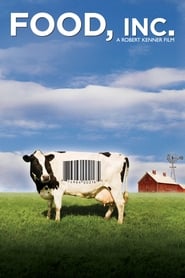
Food, Inc.
Download English Subtitle
Release info
Tags
English subtitle preview
The first 200 lines.
The way we eat has changed more in the last 50 years
than in the previous 10,000.
But the image that's used to sell the food,
it is still the imagery of agrarian America.
You go into the supermarket and you see pictures of farmers,
the picket fence, the silo,
the '30s farmhouse and the green grass.
It's the spinning of this pastoral fantasy.
The modern American supermarket
has on average 47,000 products.
There are no seasons in the American supermarket.
Now there are tomatoes all year round,
grown halfway around the world, picked when it was green,
and ripened with ethylene gas.
Although it looks like a tomato,
it's kind of a notional tomato.
I mean, it's the idea of a tomato.
In the meat aisle, there are no bones anymore.
There is this deliberate veil,
this curtain, that's dropped between us
and where our food is coming from.
The industry doesn't want you to know the truth
about what you're eating,
because if you knew, you might not want to eat it.
If you follow the food chain back
from those shrink-wrapped packages of meat,
you find a very different reality.
The reality is a factory.
It's not a farm. It's a factory.
That meat is being processed
by huge multinational corporations
that have very little to do with ranches and farmers.
Now our food is coming from enormous assembly lines
where the animals and the workers are being abused.
And the food has become much more dangerous
in ways that are being deliberately hidden from us.
You've got a small group of multinational corporations
who control the entire food system.
From seed to the supermarket,
they're gaining control of food.
This isn't just about what we're eating.
This is about what we're allowed to say,
what we're allowed to know.
It's not just our health that's at risk.
The companies don't want farmers talking.
They don't want this story told.
How about a nice chicken club sandwich made with fresh cooked chicken?
You know, that's a nice idea,
but I think what I'd really like
- is a burger. - All right.
My favorite meal to this day
remains a hamburger and french fries.
I had no idea that a handful of companies
had changed what we eat and how we make our food.
I've been eating this food all my life
without having any idea where it comes from,
any idea how powerful this industry is.
And it was the idea
of this world deliberately hidden from us.
I think that's one of the reasons why
I became an investigative reporter,
was to take the veil-- lift the veil away
from important subjects that are being hidden.
The whole industrial food system
really began with fast food.
In the 1930s,
a new form of restaurant arose
and it was called the drive-in.
The McDonald brothers had a very successful drive-in,
but they decided to cut costs and simplify.
So they fired all their carhops,
they got rid of most of the things on the menu
and they created a revolutionary idea
to how to run a restaurant.
They basically brought the factory system
to the back of the restaurant kitchen.
They trained each worker to just do one thing
again and again and again.
By having workers who only had to do one thing,
they could pay them a low wage
and it was very easy to find someone to replace them.
It was inexpensive food, it tasted good
and this McDonald's fast food restaurant
was a huge huge success.
That mentality of uniformity,
conformity and cheapness
applied widely and on a large scale
has all kinds of unintended consequences.
When McDonald's is the largest purchaser
of ground beef in the United States
and they want their hamburgers
to taste, everywhere, exactly the same,
they change how ground beef is produced.
The McDonald's corporation
is the largest purchaser of potatoes
and one of the largest purchasers of pork,
chicken, tomatoes, lettuce, even apples.
These big big fast food chains
want big suppliers.
And now there are essentially a handful of companies
controlling our food system.
In the 1970s, the top five beef-packers
controlled only about 25% of the market.
Today, the top four
control more than 80% of the market.
You see the same thing happening now in pork.
Even if you don't eat at a fast food restaurant,
you're now eating meat that's being produced
by this system.
You look at the labels
and you see Farmer this, Farmer that--
it's really just three or four companies
that are controlling the meat.
We've never had food companies this big
and this powerful in our history.
Tyson, for example,
is the biggest meat-packing company in the history of the world.
The industry changed the entire way that chicken are raised.
Birds are now raised and slaughtered
in half the time they were 50 years ago,
but now they're twice as big.
People like to eat white meat,
so they redesigned the chicken
to have large breasts.
They not only changed the chicken,
they changed the farmer.
Today, chicken farmers no longer control their birds.
A company like Tyson
owns the birds from the day they're dropped off
until the day that they're slaughtered.
Let me go to the top.
- This is the Chicken-- - National Chicken Council.
The chicken industry has really set a model
for the integration of production, processing
and marketing of the products
that other industries are now following
because they see that we have achieved tremendous economies.
In a way, we're not producing chickens;
we're producing food.
It's all highly mechanized.
So all the birds coming off those farms
have to be almost exactly the same size.
What the system of intensive production accomplishes
is to produce a lot of food
on a small amount of land
at a very affordable price.
Now somebody explain to me what's wrong with that.
Smells like money to me.
16 chicken houses sit here.
And Chuck's son has four over the top of this hill.
The chicken industry came in here
and it's helped this whole community out.
Here's my chicken houses here.
I have about 300,000 chickens.
What do you want?
We have a contract with Tyson.
They've been growing chickens for many many years.
It's all a science. They got it figured out.
If you can grow a chicken in 49 days,
why would you want one you gotta grow in three months?
More money in your pocket.
These chickens never see sunlight.
They're pretty much in the dark all the time.
So you think they just want to keep us out?
I don't know.
If I knew, I'd tell you.
It would be nice if y'all could see what we really do,
but as far as y'all going in,
we can't let you do that.
I understand why farmers don't want to talk--
because the company can do what it wants to do
as far as pay goes since they control everything.
But it's just gotten to the point
that it's not right what's going on
and I've just made up my mind.
I'm gonna say what I have to say.
I understand why others don't want to do it.
And I'm just to a point
that it doesn't matter anymore.
Something has to be said.
It is nasty in here.
There's dust flying everywhere.
There's feces everywhere.
This isn't farming.
This is just mass production,
like an assembly line in a factory.
When they grow from a chick
and in seven weeks you've got a five-and-a-half- pound chicken,
their bones and their internal organs
can't keep up with the rapid growth.
A lot of these chickens here, they can take a few steps
and then they plop down. It's because they can't
keep up all the weight that they're carrying.
That's normal.
There's antibiotics that's put into the feed
and of course that passes through the chicken.
The bacteria builds up a resistance,
so antibiotics aren't working anymore.
I have become allergic to all antibiotics
and can't take 'em.
Food, Inc. subtitles in other languages
More English subtitles for Food, Inc.
- Food, Inc 2008 Bluray-1080p-iVy en hi · 41 downloads · 2025-10-29
- Food Inc 2008 1080p BluRay x265 RARBG en · 54 downloads · 2025-08-15
- Food Inc 2008 720p BrRip x264 YIFY · 66 downloads · 2021-12-11
- Food Inc 2008 720p BrRip x264 YIFY · 67 downloads · 2014-06-04
- Food Inc 2008 720p BluRay x264-CiNEFiLE · 39 downloads · 2014-01-19
- Food Inc 2008 720p BluRay x264-CiNEFiLE · 47 downloads · 2014-01-19
- Food Inc 2008 720p BluRay x264-CiNEFiLE · 68 downloads · 2014-01-19
- foodInc-faye-xvid · 47 downloads · 2009-11-19
Comments
No comments yet. Be the first to leave one.