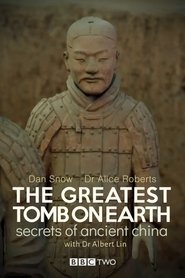
The Greatest Tomb on Earth: Secrets of Ancient China
Download English Subtitle
Release info
Tags
English subtitle preview
The first 200 lines.
I'm Dan Snow and I've come to China to investigate
the single largest burial site on Earth.
Starting with its greatest treasure - the Terracotta Army.
That is one of the most wonderful views in the world.
Over 1,000 warriors guarding their ruler for eternity.
With the possible exception of the Great Wall,
there's nothing more Chinese than these warriors.
And yet, a new theory suggests that this great icon of China
may be guarding an explosive secret.
New evidence suggests that the inspiration for all this
could have come from the West.
There's a possibility they really have some other culture stimulation.
That is such an important idea.
The person who made that had an understanding of anatomy
that is extremely surprising.
It's often thought China grew up isolated from the West
until Italian explorer Marco Polo came here in the 13th century.
But if we could prove that wrong by 1,000 years,
it would rewrite the history books.
To help in my search I'm joined by two expert investigators -
Alice Roberts and Albert Lin.
As our medical scientist,
Alice will be examining any human remains buried here.
This doesn't look like a typically East Asian skull.
Albert will use the latest imaging technology to try and find
the first roads joining East and West.
If I'm right then what I'm standing on right here could be one of
the roads built by the First Emperor.
And I'll be interrogating the secrets of the Emperor's mausoleum
looking for the traces of Western technology.
Look at that! That's fantastic.
Together we'll be exploring an extraordinary possibility
that East and West were connected
far earlier than anyone thought possible
and that connection changed the face of China.
This is the starting point for our investigation,
one of the most hallowed sites in all of China.
The burial grounds of the First Emperor.
Oh, yeah. That, according to legend,
is the First Emperor's tomb.
Albert is setting out to survey the entire burial site
by climbing the tomb.
In over 2,000 years, no-one has been inside this sacred earth pyramid.
It's pretty incredible.
The Emperor's tomb is right beneath my feet.
He was buried at 50 metres below the surface of this mound.
And the Chinese government has decided to protect it further
by denying access to the public.
It's like being on top of Tutankhamun's tomb,
but not being able to get inside,
maybe for good reason,
nobody really knows what's in there.
Even from the top of the overgrown tomb
there's only one way to see the surrounding site...
OK.
Wow! Look at that.
Nobody's ever been allowed to fly here.
This is unprecedented access.
The nearby hills are studded with top secret military instillations
and it's taken us months of negotiating with the Chinese Army
to get permission to do this.
But, once in the air, it's clear it was worth the effort.
Look at that. It just keeps on going. It just expands.
The exterior walls of the mound are over there.
At 100 square kilometres, this is the biggest burial site on Earth.
200 times bigger than Egypt's Valley of the Kings.
Can you imagine building this for yourself for your afterlife?
And that's just what's visible on the surface.
Beneath these fields, archaeologists have uncovered a vast buried world
of more than 600 pits and structures,
each one a gold mine of archaeological riches.
Almost every day there are new discoveries,
and we have unprecedented access to them.
Anyone could potentially link China to the outside world in
the 3rd century BC.
This was the era of classical Ancient Greece,
a time it was always assumed when China existed in total isolation.
That assumption started to crumble because of
the first discovery they made here -
the Terracotta Army.
It's not these buildings over here.
It's the building...
It's that one, it's the one beyond.
The Terracotta Army lies 1.5km away to the east.
Today it's one of the biggest tourist attractions on Earth,
but few people realise this extraordinary collection of figures
contains one of the greatest
unsolved mysteries in China's history.
No-one has ever been able to explain their origins.
The mystery began when all this was farmers' fields.
And one of those fields yielded a life-sized terracotta head.
It was 1974.
Look at that.
So what's happening here?
This is right at the beginning of the excavation, I presume.
So that's you?
Yeah. Fantastic.
42-year-old Yuan Zhongyi
was the first archaeologist sent here from Beijing.
What was the thing which most surprised you?
Yuan's first week here turned into decades.
And today I'm coming to meet the person
who's continuing his pioneering work,
his former assistant Janice Xiuzhen Li.
Hi, Janice. Hi. How are you?
I'm fine. How are you? Very good.
They believe the Emperor's Terracotta Army
is an exact copy of the real thing.
So these were going to be his army in the afterlife?
Yeah, to protect him.
What I really notice looking around is I think they all look different.
I can't see any two that are the same.
Some of them have got a bit of a belly on them,
some of them are very, very tall.
Were they all individually crafted?
They're really quite individual.
You see the moustache is different and also the eye shape.
This stunning realism amplifies
the great mystery surrounding these figures.
Where do they come from?
Because they're nothing like any figure made in China before them.
Let me show you the figures made in China before the warriors.
OK. So the figurines is really small. OK.
It's about ten inches.
Oh, so tiny. Tiny. Suddenly they start producing this.
Yeah, and this about two metres. So something has changed. Yes.
These warriors are far more sophisticated,
much bigger and much more realistic.
Yeah, much more detailed.
But were they all made in China?
Yeah. Let me show you the stamps here.
This is the name of the artisan.
So this Terracotta Warrior is produced locally.
The big question is -
how did Chinese craftsmen achieve such an incredible transformation?
Like going from a stickman to a Leonardo in a single step.
Something remarkable happened here 2,200 years ago.
To understand quite how remarkable,
I need to put it in a global context.
The world at the time of the First Emperor, around 220 BC.
Over here, right on the eastern edge of the Eurasian landmass
you've got the Chinese world,
a competing cluster of mini states over there.
Over on the west of Eurasia you've got Roman Empire
starting to expand over here and you've got Greece over there.
Now what's going on artistically in East and West is very different in
the 3rd century.
This is classic Greek art,
absolute high watermark of artistic expression. Beautiful.
Metre and a half tall, intricately painted, human in its look.
But over here in the Chinese world, as Janice has showed me,
you've got that.
Just ten centimetres tall, far more basic.
Then something changes.
In fact, everything changes, there's a revolution.
Suddenly in 220 BC, just after that, you get the Terracotta Warriors.
Light years ahead of what's gone before.
It starts to look far less like it's predecessor
and far more like what's going on in the Western world.
Both life-size, both lifelike, attempts at realism,
using paint and the sculpture to reflect the realities of
the human body, the human form.
And this couldn't be more important because it's always been assumed
that China developed in isolation.
But if that's not the case,
if the First Emperor of China imported Western ideas
and techniques to create his extraordinary necropolis...
Well, that forces us to completely rewrite the history books.
If you're going to rewrite the history books, you need evidence.
You need a lot of evidence.
And I think there is enough evidence just with the Terracotta Warriors.
This is a theory that turns on its head centuries of thinking about
the relationship between China and the West.
It can't just be based on one statue.
It just seems that there are so many
mysteries associated with this place. It's phenomenal.
It just feels as though there's an awful lot more to be discovered.
There is a history, Chinese history, so maybe there's a lot to
the stories that were written in this historical text.
It's amazing to have those texts as well. I mean, how fantastic.
OK. This is it. It's called the Shiji.
We've got 20 pages of a text that was written over 100 years later
by the first Chinese historian called Sima Qian.
He talks about the First Emperor's tomb, but he doesn't even mention
the Terracotta Warriors, they don't even get a mention.
What is now one of the most important sites on Earth
doesn't even get a mention in this.
And, unfortunately, he doesn't mention foreigners
or people beyond Central Asia. Wow. So there are gaps in the history.
There's big gaps in the history.
So we're relying on you guys.
Well, you know, the extent of this place is huge.
So what we're looking at here is the main burial mound.
And the Terracotta Warriors are pretty far off to the east side of
the entire burial complex.
And, you know, what I think is the interesting question is -
is there a road network that extends from this?
Do you think you could ever find
connections with points further west?
It's hard to say because it's going to go, obviously,
The Greatest Tomb on Earth: Secrets of Ancient China subtitles in other languages
Comments
No comments yet. Be the first to leave one.