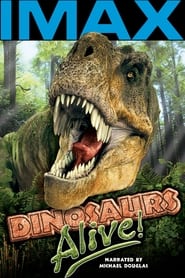
Dinosaurs Alive
Download English Subtitle
Release info
Tags
English subtitle preview
The first 200 lines.
80 millions years ago, two dinosaurs,
a crested Protoceratops and sharp-clawed Velociraptor,
fought to the death.
Somehow, as they died in the sands of the Gobi desert,
their battle was frozen in time.
The Velociraptor flat on its back,
its clawed arm caught in the jaws of the Protoceratops.
An extraordinary fossil.
A mysterious glimpse of life and death in the age of dinosaurs.
For more than 150 million years,
dinosaurs roamed every corner of the planet.
Only a very few left evidence of their existence,
their fossilized bones.
And those bones never sees to fascinate us.
Dinosaurs came in amazing shapes and sizes.
Some were the largest animals ever to walk the Earth.
Paleontologists, the scientists, who study prehistoric life,
are discovering more dinosaurs now, than ever before.
And this fossil evidence is allowing them to reconstruct
not only their strange skeletons,
but also their lives.
An example is this gigantic long-necked plant-eater,
known as Seismosaurus.
Found in New Mexico,
it lived during the Jurassic Period,
150 millions years ago,
when many dinosaurs grew to unprecedented size.
Seismosaurus means "earth-shaking lizard",
and there's no doubt,
that their footsteps echoed across the Jurassic landscape.
Measuring 110 feet from nose to tail,
it is one of the longest dinosaurs ever discovered.
Strangely, when it was excavated,
some 240 smooth, round stones were found
in and around its huge stomach cavity.
Some scientists believe,
Seismosaurus swallowed stones to help its digestion.
Others say, that finding the stones
was a coincidence, that they were part of the riverbed,
where Seismosaurus was found.
Seismosaurus weighed over 30 tons,
as much as 8 elephants.
It must have consumed hundreds of pounds
of vegetation every day.
Sometimes scientists can even learn, what dinosaurs ate.
From clues they left behind in their fossilized dung.
Dinosaurs were first discovered in Europe and America.
But in the 20th century, scientific explorers struck out
for the most remote corners of the Earth.
And a full extend in the dinosaur kingdom began to be revealed.
The Gobi desert spans
a half-million square miles of Mongolia and China.
The ancient land of Genghis Khan.
Beneath sands, that camel caravans traversed for centuries,
lay a vast treasure trove of fossils.
Undisturbed for more than 70 million years,
that would forever change our view of dinosaur life.
In 1920s, a team of scientists
from the American Museum of Natural History
set out to explore the little-known Gobi.
Their leader was Roy Chapman Andrews.
Andrews and his team traveled in a fleet of automobiles.
It was one of the first major expeditions
used motorized transport in Central Asia.
To keep his expeditions supplied,
when the nearest gas station was 1000 miles away,
he came up with a novel plan.
Sending out camel caravans in advance,
loaded with food and fuel.
And the camels provided an unexpected service to the expedition.
Hair, plucked from their shedding winter coats
was ideal for packing fragile fossils.
Mongolia was a dangerous place,
full of roving bandits.
But Andrews thought to be the inspiration for Indiana Jones,
reveled in the adventure of it all.
Never again will i have such a feeling as Mongolia gave me.
All this thrilled me to the core.
Somewhere in the depths of that vast silent desert
lay those records of the past, that i had come to seek.
Andrews fended off the bandits,
but he and his team could not avoid the violent sandstorms,
that often sweep across the Gobi.
To their amazement,
they found that each new storm uncovered a wealth of bones.
Dinosaurs bones never before seen,
and perfectly preserved in the desert sands.
Mark Norell and Mike Novacek
of the American Museum of Natural History,
following in Andrews' footsteps,
have been leading expeditions to the Gobi
every year since 1990.
Fascinated by dinosaurs in their youth,
Mike and Mark have become renowned paleontologists.
They have dug dinosaurs all over the world,
but they have made their most spectacular finds here,
in the Gobi Desert.
Dr. Julia Clark has arrived in Mongolia's capital Ulaanbaatar,
with graduate students Alan Turner and Amy Balanoff
to prepare to this year's expedition.
They are part of a team,
that will join Mike and Mark in the desert.
This will be my sixth summer in the Gobi.
Mongolia has proven so rich in fossils,
i know, that each year,
there will be great new finds to be made.
There are few paved roads outside Ulaanbaatar.
The team's destination in the western Gobi
is a minimum of three days' driving.
A "Mad Max" journey over hot, dusty plains
and through mountain passes.
In 1921, after months of overland travel,
Roy Chapman Andrews' motor-caravan came across
a strange and beautiful place
of eroded canyons and sandstone towers.
The late-afternoon sun seemed to set the rocks on fire.
Andrews named it the Flaming Cliffs.
Here they would come upon one of the greatest repositories
of dinosaur remains ever found.
More than 80 years later,
the Flaming Cliffs are still a fabled and productive destination
for dinosaur hunters.
To find dinosaurs,
paleontologists must first look in the right places.
They know, that fossils are preserved in certain rock deposits.
The only tool, they need at first, is keen eyesight.
Tiny white bone fragments on the surface hint,
at what can be an entire dinosaur buried below.
There's alot of bones in here.
Always a good place.
Hey, come check this out. -Oh, what? - An egg.
With decades of experience,
Mike and Mark readily spot fossils and identify them.
For grad students Alan and Amy,
time in the field is the best way,
to develop their own skills.
This is my first time going to the Gobi with Mark and everyone.
I'm really excited and happy to be a part of a tradition,
that goes back to Roy Chapman Andrews.
The Gobi expeditions are a collaboration
with the Mongolian Acadamy of Sciences.
This year, Mongolian grad student Boldra Mingin joins the team.
My father is a paleontologist.
And when he first showed me a giant skeleton found in Mongolia,
i couldn't believe, such animals really lived.
I have loved finding fossils ever since.
Today, after only a few hours of searching,
the team uncovers a fossilized skull.
Julia is quick to recognize it as that of a large, armored dinosaur.
It's called the Pinacosaurus,
it was sort of a heavy tank of its day.
With experience, we can visualize,
what fossils like this, would have looked like in live.
Pinacosaurus and its relatives, like this Tarchia,
were built for defence.
Their backs bristled with rows of hard, bony plates and spikes.
Even their eyelids were armored.
And their tails ended in a massive bony club.
One of Tarchia's few enemies was the ferocious Tarbosaurus,
whose bones have also been found in the Gobi.
Tarbosaurus was a close relative of Tyrannosaurus Rex,
and it was a top predator.
It was 30 feet long and weighet five tons.
It had a super-sized bite
with razor-sharp teeth nearly six inches long.
Scientists have debated for many years,
how fast or slow these big predators were.
This scale model of a T-Rex skeleton reveals,
how a massive two-legged,
or bipedal dinosaur might have moved.
As they walked, they shifted their entire weight from leg to leg,
as humans do.
Their large tales helped to balance them.
Their legs were directly beneath their hips,
allowing them to carry more weight and move faster.
Dinosaurs like T-Rex could have reached speeds up to 25 mph.
Faster than an average human could run.
Tarbosaurus was at the top of the food chain in the area of Asia,
that is now the Gobi Desert.
But Tarchia was no wimp,
and could use its tale club to cripple or kill an attacker.
In the 1920s, the Andrews' expeditions
found a number of new dinosaurs.
Their most important discovery wasn't a ferocious predator.
It was something rather small.
But one of the great dinosaur finds of all time.
They find the first dinosaur eggs.
Lying in large round nests in the ground.
This amazing find confirmed, that dinosaurs actually laid eggs.
Andrews and his team believed,
the eggs belonged to Protoceratops,
because they found so many of these dinosaurs in the Gobi.
About the size of sheep,
Protoceratops had a distinctive head shield and a hook-like beak.
On top of one nest, they made a puzzling discovery.
The skeleton of a bird-like meat-eating dinosaur,
definitely not a Protoceratops.
They concluded, that it was a predator,
that had been raiding the nest.
It was named Oviraptor,
Dinosaurs Alive subtitles in other languages
Comments
No comments yet. Be the first to leave one.