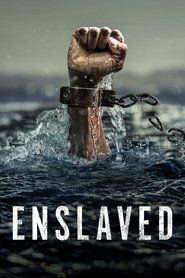
Enslaved
Download English Subtitle
Release info
Tags
English subtitle preview
The first 200 lines.
The Atlantic Ocean floor
is one giant graveyard and a crime scene.
Remains of over 2,000,000 of our ancestors
once covered these dark recesses of the world.
For centuries, the transatlantic slave trade seemed unstoppable,
but it was brought to an end.
What got this many people so fired up that they spoke out?
There's a greater than 99% probability
that all living African Americans
have at least one relative
who landed here, really the epicenter of slavery.
The world of print would bring slavery right up close.
It's something that you can't avoid thinking about anymore.
These Africans had actually
fought and won their freedom.
They ended up dying in chains in freezing cold water.
This was equal in value to a human being.
So, researching the details and the horror
of the transatlantic slave trade radicalized him.
Is it fair to say Lincoln freed the slaves?
Not quite.
The captain said, "I come from hell
and I'm going to damnation."
I think I know exactly what he was afraid of.
London was at the very center
of the transatlantic slave trade.
England's enormous wealth was in part created
by the trafficking of enslaved humans.
But it was also the place where the first political steps
were taken to bring the awful chapter
in human history to an end.
- Hey. - Hi, Sam.
- Hello. - Good to see you guys.
- You, too. - How are you?
Wow.
- Wow, look at this. - It's kind of awesome, right?
The Abolition of the Slave Trade Act of 1807,
as the King wishes.
So it had royal assent.
Yes.
This is a "wow."
"The same should be forthwith abolished
and prohibited and declared to be unlawful."
But this doesn't abolish slavery.
It abolished the purchase and transfer of slaves
from African countries. It's all about the trade itself.
Britain was the biggest trafficker in Africans,
and then it was the first European country
to abolish it.
It was a really momentous time in British history
because after decades of campaigning, petitions,
Parliament finally decided to stop British ships
and British merchants kidnapping
and trafficking Africans.
But they left the institution of slavery in the Caribbean,
on which the economy was still very dependent,
that remained intact.
- Exactly. - If you were a slave,
you wouldn't have felt any different.
It would take almost another 30 years
to abolish slavery altogether.
Okay, so suddenly in 1807, this is possible.
Why wasn't it possible in 1806?
There's another document that I want to show you.
Right, this is the Manchester petition
against the slave trade.
It's got many thousands of signatures on it,
as you can see.
These just would have been ordinary people
trying to influence Parliament.
There were hundreds of petitions like this that were presented
to Parliament, especially in the 1790s
and in the years right up to the Act of Abolition.
And this is just Manchester?
This is just Manchester.
It's really strange, what your eye is drawn to
when you look at this.
You know, I've found like four Samuels already.
I'm used to seeing "Samuel", so I was like,
"Oh, wow, there's a "Sam." There's a "Samuel."
Think there's an "Afua" on there?
That I doubt.
Never say "never."
All these ordinary people.
That made a difference.
Regular old jobs that are trying to make a difference,
just like now.
Another thing here is you can see women signed it.
I mean, this was an era before women had the vote.
What I want to know is what happened
that suddenly got this many people so fired up
that the attitude changed and they spoke out?
What turned this country into the first European country
to abolish slavery?
Exactly.
In this small town, on the Western coast of England,
just at the moment,
when the tide was finally beginning to turn
against the slave trade,
a slave ship called "The London" was wrecked in a storm.
It was carrying over 60 enslaved Africans.
Almost all of them died as the ship smashed
on the cliffs of the Bristol Channel.
Yet the tragedy was practically forgotten
until recently when Professor Mark Horton
and his colleagues began the process
of reviving the story.
The story starts in 1796.
A convoy of ships was coming in from the West Indies,
carrying loot, but also Africans
from the former French Colonies,
who'd been fighting for independence in St. Lucia.
They'd be captured and re-enslaved.
And one of the ships, "The London," got separated out.
A great storm erupted, and as you can see,
it's a very dangerous coastline.
And in a trice, the ship was dashed onto the rocks just here.
All of the people on the deck survived, but of course,
the people below decks...
shackled in their positions,
down there as cargo,
would have drowned as the ship stoved in.
The water would have rushed in.
It was a dark night in October, nobody would have bothered
to come and rescue them.
So, these people died in shallow water
and no one bothered to unshackle them
or even give them a fighting chance.
Yes, everyone was looking after their own skin.
Are any of those remains, any of that,
is that still down there today?
Well, surprisingly, nobody has ever looked.
We will be the first try and explain this tragedy
from the very last days of the slave trade.
The slave trade took place at a time
when it was not easy to spread new ideas like abolition,
but one man found a way to do it.
Who was Thomas Clarkson?
Thomas Clarkson was a native of Wisbech.
He was born in 1760.
And he was set an essay, and the subject
was is it lawful to make others slaves against their will?
Thomas didn't know too much about the subject
but immersed himself in it.
It completely changed his life.
He realized then that something had to be done
to abolish this dreadful slave trade.
And Thomas just became completely overtaken
by this desire to see the end of the slave trade.
So, researching the details and the horror
of the transatlantic slave trade radicalized him.
Yeah, very much so.
He spent the rest of his life dedicated to that cause,
traveled thousands of miles all around the country
on horseback.
He would be this figure turning up in the towns,
talking to groups of people,
getting them to set up societies to abolish
firstly the slave trade and then slavery.
Basically, anything and everything that could be done
to support the cause of abolition,
Thomas Clarkson was there doing it.
So he tried to make people understand that Africans
were not chattel, but human beings
with knowledge and culture.
Yes, he did.
Is this what he referred to as his African chest?
His African box, yes.
The first division, as he called it,
was the manufactory items, items from nature
that could be used in this country for medicines.
He would also have the fabrics
to show the craftsmanship of the people in Africa,
basically to argue that we've got these amazing things,
why are we selling Africans when we could be
trading with them for this wonderful objects?
So, these were items to make a positive case
as to what the potential for trading Africa was.
Looks like there were some things that also made
the more negative case about what was wrong,
how African slaves were treated.
Yeah, he had some items in the bottom of the chest.
Division four contained the instruments of torture.
This is a sinister- looking object.
What was this?
The neck collar.
This would have been torture.
This would be put around the neck.
You've got these spikes sticking out,
which meant that the person who had to wear it
wouldn't be able to escape into the bush
because they'd get caught on the growth.
You also couldn't lay down.
You couldn't sit comfortably.
They wouldn't be able to get close to people.
Must have been absolutely horrific,
not to mention the weight of the object itself.
And then we have a long chain
to put around the ankles to fix people,
a row of them.
Enslaved subtitles in other languages
More English subtitles for Enslaved
- Enslaved S01E05 Resistance 1080p AMZN WEB-DL DDP5 1 H 264-TEPES · 4 downloads · 2020-10-13
- Enslaved S01E05 Resistance 1080p AMZN WEB-DL DDP5 1 H 264-TEPES · 5 downloads · 2020-10-13
- Enslaved S01E04 New World Cultures 1080p AMZN WEB-DL DDP5 1 H 264-TEPES · 7 downloads · 2020-10-06
- Enslaved S01E04 New World Cultures 1080p AMZN WEB-DL DDP5 1 H 264-TEPES · 6 downloads · 2020-10-06
- Enslaved S01E03 Follow the Money 1080p AMZN WEB-DL DDP5 1 H 264-TEPES · 8 downloads · 2020-10-01
- Enslaved S01E03 Follow the Money 1080p AMZN WEB-DL DDP5 1 H 264-TEPES · 5 downloads · 2020-10-01
- Enslaved S01E02 Rationalization 1080p AMZN WEB-DL DDP5 1 H 264-TEPES · 4 downloads · 2020-09-26
- Enslaved S01E02 Rationalization 1080p AMZN WEB-DL DDP5 1 H 264-TEPES · 6 downloads · 2020-09-26
Comments
No comments yet. Be the first to leave one.