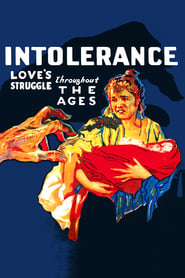
Intolerance: Love's Struggle Throughout the Ages
Download English Subtitle
English subtitle preview
The first 200 lines.
INTOLERANCE Love's Struggle Throughout the Ages
Our play is made up of four separate storyes,
laid in different periods of history, each with its own set of characters.
Each story shows how hatred and intolerance,
through all the ages, have battled against love and charity.
Therefore, you will find our play turning from one of the four stories
to another, as the common theme unfolds in each.
"Out of the cradle wndlessly rocking."
Today as yesterday, endlessly rocking, ever bringing the same human passions,
the same joys and sorrows.
INTOLERANCE
Our first story - out of the cradle of the present
In a western city we find certain ambitious ladies banded together
for the "uplift" of humanity.
Even reform movements must be financed.
"If we can only interest Miss Jenkis - with her money-"
A little affair is being given by Mary T. Jenkins,
umarried sister of the autocratic industrial overlord-
Seeing youth drawn to youth, Miss Jenkis realizes the bitter fact
that she is no longer a part of the younger world.
The girl of our story keeps house for her father who works
in a Jenkins mill. With a wage of $2.75 a day, a little garden,
four hens, ditto geese, and a fair measure
of happiness and contentment.
The little Dear One.
The Boy, unacquainted with the little Dear One,
is employed with his father in the same mill.
Age intolerant of youth and laughter.
"The vestal virgins of Uplift" succeed reaching Miss Jenkins
in their search for funds.
-Comes now from out the cradle of yesterday, the story of an ancient people,
whose lives, though far away from uors, run parallel
in their hopes and perplexities.
Ancient Jerusalem, the golden city
whose people have given us many of our highest ideals,
and from the carpenter shop of Bethlehem,
sent us the Man of Man, the greatest enemy of intolerance.
Near the Jafa gate.
The house in Cana of Galolee
Certain hypocrites among the Pharisees
Pharisees - A learnd Jewish party, the name possibly brought into
disrepute later by hypocrites among them.
When these Pharisees pray they vemand that all action cease.
"Oh Lord, I thank thee that I am better then other men"
"Amen."
Another period of the past.
A.D. 1572 - Paris, a hotbed of intolerance, in the time of
Catherine de Medici, and her son Charles IX, King of France.
The heir to the throne, the effeminate Monsieur La France.
Pets and toys his pastimes.
Catherine de Medici, queen-mother who covers her political intolerance
of the Hunguenots beneath the cloak of the great Catholic Religion.
party of this period.
The great Protestant leader,
the Admiral Coligny, head of the Huguenot party.
What a wonderful man, the Admiral Coligny, if he only thought as we do.
What a wonderful king, if he only thought as we do.
The King's favor to Coligny increases the haterd of the opposite party.
Celebrating the betrothal of Marguerite of Valois,
sister of King, to Henry of Navarre, royal Huguenot,
to insure peace in the place of intolerance.
Marguerite of Valois.
Henry of Navarre.
Brown Eyes, her family of the Huguenot party,
and her sweetheart, Prosper Latour.
Brown Eyes attracts the attention of a mercenary soldier.
Returning to our story of today we find the embittered
Miss Jenkins aligning herself with the modern
Pharisees and agreeing to help the Uplifters.
A diversion of the mill workers.
"To every thing there is a sesion.... a time to mourn and a time to dance...
He hath made everything beautiful in his time." Ecclesiastes III
The little Dear One having the time of her life.
"Want my straw?"
Miss Jenkins receives a check from her brother
for the purposed uplift of humanity.
Jenkons studies his employes' habits.
"Ten o'clock! They should be in bed so they can work tomorrow."
And now our fourth story of love's struggle against Intolerance,
in that distant time when all nations
of the earth sat at the feet of Babylon.
Outside of Imgur Bel, the great gate of Babylon,
in the time of Belshazzar, 539 B.C. Merchants, farmers, East Indians,
with trains of elephants, Egyptians, Numidians,
and ambitious Persians spying upon the city.
The Mountain Girl down from the mountains of Suisana.
The Rhapsode, a Warrior singer-poet agent of the High Priest of Bel.
The priest of Bel-Marduk, supreme God of Babylon,
jealously watches the image of the rival goddess,
Ishtar, enter the city, borne in a sacred ark.
"Dearest one - in the ash heaps of my backyard there will be small flowers;
seven lilies - if thou wilt love me - but a little."
"Ishtar, goddess of love, seven times seven I bow to thee.
Let her enjoy this kiss."
On the great wall. The Prince, Belshazzar,
son of Nobonidus, apostle of tolerance and religious freedom.
walls, 300 feet in height,
and broad enough for the passing of chariots.
The two-sword man, Belshazzar's faithful guard,
a mighty man of valor.
The intolerant High Priest of Bel sees in the enthronement
of rival gods, the loss of his own great powers in Babylon.
The gate of Imgur Bel which no enemy has been able to force.
Hand maidens from Ishtar's Temple of Love and Laughter.
The Princess Beloved, favorite of Belshazzar,
in a room of scented cedar, plated with pure gold,
in the hareem of My Lord the Prince.
A love blossom from Belshazzar.
Stricken by her pale beauty, as though by white lighting.
The brother of the Mountain Girl, having some slight trouble
with his high-spirited sister, takes the matter to the court.
The first know court of justice in the world.
Nore: Babylonian justice according to the code of Hammurabi,
protecting the week from the strong.
The Mountain Girl's brother tells the Judge that she is incorrigible.
The judgment is that she be sent to the marriage
market to get a good husband.
Endlessly rocks the cradle uniter of here and hereafter.
Chanter of sorrows and joys.
Resuming our story of today. Dividends of the Jenkins mills
failing to meet the increasing demands of Miss Jenkins' charities
she complains to her brother, which helps decide him to action.
"Order a ten percent cut in all wages."
A great strike follows.
"They swueeze the money out of us and use it to
advertise themselves by reforming us."
Hungry ones that wait to take their places.
The militia having used blank cartridges, the workmen
now fear only the company's guards.
Clear the property.
The Loom of Fate weaves death for Boy's father.
The exodus after a time of waiting. Forced to seek emploment elsewhere,
many victims of the Jenkins' aspirations go to the great city
nearby - the Boy among them.
A friendless one - alone - as the result of the strike.
So too, the Dear One- and her father.
Fate leads them all to the same district.
The Boy unable to find work - at last -
And again in Babylon.
The marriage market. Money paid for beautiful women given to
homely ones, as dowers, so that all may have husbands and be happy.
Lips brilliant with juice of henna; eyes lined with kohl.
women corresponding to our
street outcasts, for life the wards of Church and State.
The auctioneer.
"Tish tish! 'tis no place to eat onions."
The girl's turn - perhaps not so different from the modern way.
In distant Nineveh - One who would give his life
if he were able to buy the merchandise
held so lightly upon Love's market.
"And man will be happy with
this sweet wild rose - this gentle dove."
"But touch my skirt and I'll scratch your eyes out!"
The temper and rough language of the "wild rose"
prove her to be not without thorns.
"With her goes a third of a mine of silver."
"You lice! You rats! You refuse me?
"There is no gentler dove in all Babylon than I. "
Belshazzar now ruling for his father.
"Oh, lord of lords! Oh, king of kings!
Oh, masu! Oh, scorching sun of the mid-day,
these bugs will not buy me for wife!
"I dwell in sorrow."
"This seal gives you freedom to marry or not to many - to be
consecrated to the goddess of love or not as thou choosest."
The Rhapsode, working in the tenements,
to convert backsliders
to the true work ship of Bel.
"Put away thy perfumes, thy garments of Assinnu,
the female man. I shall love none but a slodier."
The love - smitten Mountain Girl vows eternal allegiance to Belshazzar.
In the Love Temple. Virgins of the sacred fires of Life.
He promises to build her a city, beautiful as
the memory of her own in a foreign land.
"The fragrant mystery of your body is greater
than the mystery of life."
Belshazzar the king, The very young king, of Babylon -
And his Princess Beloved. Clearest and rarest of all his pearls.
he very dearest one of his dancing girls.
Belshazzar, sharherd of the mighty nation, purified by the sacred baths
and a Sabbath of rest, visits the temple of the moon god.
My masu, my hero love.
- UnAnother agent of the High Priest of Bel,
agitating against Belshazzar.
"Lies! Lies! Lies!"
For the affront to the Priesthood the High Priest orders that she be
beaten to death with a rod of iron.
"I swear, oh Sar, this priest spoke evil og thee."
"Since when has the High Priest of Bel
the power of death over my subjects?"
Belshazzar again gives the girl her freedom.
The Dear One in her new environment forced
upon her by the Jenkins strike. The same old love and dreams.
The hopeful geranium.
"I'll walk like her and maybe everybody will like me too."
In the same neighborhood, the friendless one again.
Across the hall. The Musketeer of the Slums.
The Boy, now a barbarian of the streets, a member
of The Musketeer's band.
Imitating the walk of the girl of the street.
Intolerance: Love's Struggle Throughout the Ages subtitles in other languages
More English subtitles for Intolerance: Love's Struggle Throughout the Ages
- Intolerance (1916) HDTV 720p · 105 downloads · 2013-11-15
- Intolerance 1916 DVDRip x264 AC3 Eng Extras · 122 downloads · 2012-01-02
Comments
No comments yet. Be the first to leave one.