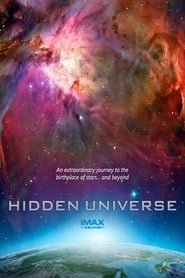
Hidden Universe
Download English Subtitle
Release info
Tags
English subtitle preview
The first 178 lines.
This is home.
Our very own corner of the universe.
But stand here on the surface of Earth and look up.
Hidden out here, in the limitless reaches of space,
is the story of our past, present, and future.
For centuries, astronomers from every corner of the world
have striven to unlock secrets of the universe.
This is Dr. Jonathan Whitmore,
and I suppose you could say
that he's always had stars in his eyes.
I have two great loves in life.
Music and astronomy.
As a kid I dreamt of playing piano at Carnegie Hall one day,
then flying to some distant mountaintop to stargaze the next.
But Carnegie Hall will have to wait,
because I got hooked on astronomy in a big way.
My very first glimpse through a telescope
showed that even our closest neighbors are stunning.
When I saw the moon,
I felt that I could almost reach out and touch it.
Saturn has her amazing rings that circle the planet.
The rings alone are 20 times wider than the Earth,
but in some places, are only 10 meters thick.
And there's Jupiter.
The stormy gas giant.
We have one moon.
At last count, she had more than 67.
But for me, the most beautiful object in the sky
is the thing we're all bound to.
The thing that gives us warmth and life itself.
The sun.
Our sun is a star,
just like all the other stars we see in the night sky.
When I found that out, my mind was made up.
Jonathan's decision to become an astronomer
led him halfway around the world,
to one of the highest and driest places on the planet.
Chile's Atacama Desert is his launch pad
for a trip to the edge of the universe.
When people find out that I'm an astronomer,
they always ask me to point out what I observe in the night sky.
And the truth is, I can't,
because the things I study are so far away,
you can't see them with human eyes.
That's what I love about science.
It challenges our boundaries and constantly pushes us forward.
Take Mars, for example.
Not long ago, we thought of it as just a pale, red dot in the night sky.
Now we can see it in extraordinary detail.
Starting in 1997,
the Mars Global Surveyor mapped
the entire surface of Mars so precisely,
that we could see detail down to a mile in size.
It revealed huge canyons,
10 times longer than the Grand Canyon,
and volcanoes three times taller than Mount Everest.
More recently, NASA sent the Mars rover, Curiosity.
It's a mobile lab that is scouring the landscape
for water and interesting samples.
And from orbit, we are mapping Mars with incredible precision.
We can now see rocks on the Martian surface that are barely a foot wide.
These images of the surface of Mars
aren't some special effect
created for the next Hollywood sci-fi epic.
This is the real thing.
These images were taken using HiRISE,
the largest telescope ever carried on a deep-space mission,
aboard the Mars Reconnaissance Orbiter.
If you've ever dreamt of living on Mars,
just come to the Atacama Desert,
and you'll be amazed by how similar it is to the Martian landscape.
In the middle of one of the world's most arid deserts,
the team at ESO have constructed a place that's full of life.
This is where we live.
In fact, if we ever colonize another planet,
this might be the kind of biosphere that we build there.
Sheltered from the extreme conditions outside,
you'll find an oasis, with all the comforts of home.
A swimming pool, a library, a restaurant,
and even a music room where I can practice piano.
Astronomers from all over the world are drawn to this place
by their passion for the stars.
And up the mountain is the telescope we have all come to use.
It's called the ”VLT."
The Very Large Telescope.
So we're not exactly that great at coming up with names,
but that's exactly what it is.
A very large telescope.
Make that four very large telescopes.
VLT operator and mountaineer, Lisa Tura,
is here to prepare the telescope.
On her days off,
you'll find Lisa scaling the highest peaks of the Andes.
So she is unfazed by the task of calibrating these gigantic,
and sometimes temperamental, machines.
When you operate the VLT,
you have to treat it with the utmost care.
One miscalculation can throw out
an entire night's observations.
Its instruments are so sensitive
that even your body's temperature can affect the readings.
So we need to be extremely thorough
every time we start it up.
The VLT is one of the biggest optical telescopes in the world.
It has a 27-foot mirror that acts like a giant light bucket,
capturing as much light as possible.
This main mirror
reflects and focuses the light up to a second mirror,
then down to a third mirror in the middle of a telescope.
And finally,
into instruments on the side of the VLT.
Once Lisa has finished her calibrations,
the VLT can see objects four billion times fainter
than those detectable by the human eye.
For me, music will always play a big part in my life.
But when I'm about to look up
and see distant objects that no one else has ever seen,
I know I've made the right choice.
Before the night's viewing begins,
everyone must leave the building.
The VLT demands total darkness.
As I said, temperamental.
Every speck of man-made light has to be shut out.
Even the tiniest bit could ruin the observation for that night.
As the Earth spins,
the Milky Way appears to pass over us,
while the telescopes twist and turn,
tracking distant objects in the sky.
Nowhere else in the world can you see the stars shine as brightly.
On the clearest of nights,
you can see your own shadow,
cast from the light of millions of distant stars.
And as we explore the heavens,
we have found the birthplace of stars.
This monstrous cloud of gas and dust is the Carina Nebula.
It's a star factory,
churning out thousands of stars,
some of which are the brightest in our Milky Way.
You could call it a stellar nursery.
Because in a nebula like this one,
stars are being formed.
And even though these stars are relatively young,
they're not exactly small.
And there are a huge range of star types.
In fact, our own sun would have been formed in a cloud of gas and dust just like this.
Sometimes, these nebula are named by the shapes that they seem to make.
Here's one with a great nickname.
The Snow Angel Nebula.
The blue wings of the snow angel are actually hot gas,
being illuminated by a huge star forming in the middle of this hourglass.
The astronomers who named the War and Peace Nebula
could see a dove dancing in the gas.
I don't see it myself,
and I'm more interested in the gigantic stars here.
They're shining hundreds of thousands of times
brighter than our sun.
But not every nebula is a stellar nursery.
A thousand years ago,
Arabian, Japanese and Chinese astronomers
all recorded a strange, lingering light in the sky,
as bright as the full moon.
They were witnesses to the death of a star.
A supernova explosion that scattered gas and dust particles
60 billion miles into the cosmos,
forming this.
The Crab Nebula.
Sometimes, astronomers look deep into the sky
and see the cosmos looking right back at them.
This magnificent eye in the sky
is just the remnants of a burned-out star
that has shed its outer layers back into the universe.
By studying formations like this,
we now know that stars come and go from the universe.
Just like life begins and ends here on Earth.
Beyond our Milky Way,
you'll find stars, gas and dust
clumped together in huge structures called galaxies.
Galaxies come in all shapes and sizes,
Hidden Universe subtitles in other languages
More English subtitles for Hidden Universe
- IMAX Hidden Universe 2013 1080p BluRay x264-DON · 136 downloads · 2018-01-28
Comments
No comments yet. Be the first to leave one.