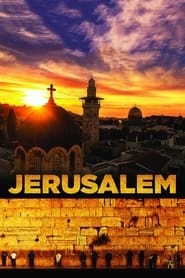
Jerusalem
Download English Subtitle
Release info
Tags
English subtitle preview
The first 144 lines.
Beyond the barren shores of the Dead Sea
lived an ancient people called the Jebusites.
Thousands of years ago, on a large outcrop of bedrock,
it is said they worshipped Shalem,
the god of the setting sun.
The city alone was known as the place of Shalem.
Yerushalem.
Over time, this city became the gateway to God for three major religions.
And the most fought over piece of land in history.
Many believed it was the center of the world.
Today, the walled old city at the heart of Jerusalem
is a mosaic of cultures and beliefs.
Where Jews, Christians and Muslims live side by side,
yet in separate quarters.
Each in their own Jerusalem.
Everyone in Jerusalem has a favorite gate.
Mine is Damascus Gate.
When you enter Damascus Gate
you are in the Muslim quarter, my quarter.
This is my Jerusalem.
In Arabic, we call Jerusalem, al-Quds, which means the holy city.
But it is also a place where people go to work, where we buy our groceries,
and kids play and go to school.
Jerusalem to me is more than just a city.
It's beauty, it's spirit and it's also my religion.
But most importantly, it's my family.
Most people don't think I'm Muslim.
It's only when I go to the mosque and I put a head-scarf on, that surprises them.
But Jerusalem is full of surprises.
Twice a week, in the Jewish quarter, there is a big celebration.
For boys, it's called the bar mitzvah.
For girls, it's called a bat mitzvah.
It's the moment when you become an adult.
Jews in Jerusalem have come from over a hundred different countries.
Take for example, my family. My mother is from Paris.
Her parents are from Tunisia. My father's family is from Poland.
No matter where we come from, we all trace our roots back here.
Sometimes I feel like I'm walking on the same stones as my ancestors.
Since Biblical times, we have a special word when Jews return to the promised land.
We say we're making aliyah, which means going up to a higher place.
And for us, the Jews, there is no higher place than Jerusalem.
For me, the best time to come to Jerusalem is Easter.
Every Easter starts with the Palm Sunday procession.
It's where we walk down the Mount of Olives
celebrating the day where Jesus entered the city.
Every year, me and my brother George join in this Palm Sunday procession
and we end up meeting people from all over the world.
Easter, for most people, is about the eggs, the bunnies and decorations.
But here, we still have the same Easter like 2,000 years ago,
we still re-live what happened with Jesus
the passion of Christ, the same step-by-step every Easter.
In the Christian quarter, we have the Ethiopians, the Greek Orthodox,
the Catholics, the Coptics, the Syrians and each community,
celebrates Easter in their own way.
Next to the Christian quarter, we have the Armenian quarter
and they celebrate Easter in their own church.
The old city is very small and the four quarters do not communicate a lot.
Although we live in the same area, we don't know a lot about each other.
Smaller than a square mile,
Jerusalem's old city contains some of the holiest sites in the world
for Jews, Christians and Muslims.
So, how did half the people on Earth come to cherish the same tiny space?
Jerusalem lies at the crossroads of Africa, Asia and Europe.
A region known as the cradle of civilization.
The first empires began here 5,000 years ago.
As other great powers emerged, the land surrounding Jerusalem
became a constant battleground.
Each civilization left its mark here.
The Romans built vast port cities on the Mediterranean Sea.
On the tombs of Biblical prophets, Muslims built shrines.
On a high plateau, above the Dead Sea,
King Herod the Great built Masada,
a mountain fortress where Jewish rebels
made their last stand against the Roman army.
In the Judean Desert, early Christians built remote monasteries.
Some still inhabit it to this day.
Conquered over 40 times,
Jerusalem is many cities.
Each one built on the ruins of another.
And most can still be found beneath our feet.
Imagine you are a detective
and you try to solve a mystery based on pieces of evidence that you put together.
That's exactly what archeologists do except that we do it for the past.
One of the things that makes Jerusalem such an exciting place to work
is the continuous occupation layers, one on top of the other.
Going all the way back, 5,000 years ago to the first inhabitants,
the Biblical Jebusites, and then through the Israelites
and the Roman period, and the Crusaders and all the way up until today.
Understanding ancient Jerusalem is like trying to put together a giant puzzle
where we are missing most of the pieces
and we don't know what the original picture looked like.
Everything that we dig up out of the ground is a new piece of that puzzle.
Jerusalem lies in the heart of a region
that has yielded some of archeology's most incredible finds.
One of the most spectacular finds is the Dead Sea Scrolls,
which were written over 2,000 years ago
and are by far the oldest copies we have of the Hebrew Bible.
The deepest levels under the ground, we find the earliest remains
of the people who lived in this land.
What is it that drew people to Jerusalem in the first place?
It's an isolated, poor, rocky mountain town.
The answer is simple. Water.
In the heart of the ancient city of Jerusalem
is a spring which has fresh water in it all year round.
So, the inhabitants cut a tunnel through solid bedrock to get to that water.
Along with water, there is another reason Jerusalem became important.
And that was at the top of the hill that overlooked the city.
The large outcrop of bedrock where it is believed the Jebusites
worshipped the god of the setting sun.
In Jewish tradition, this is the foundation stone where the world was created,
and some of the most important stories in the Bible took place.
Abraham prepared to sacrifice his son, in a test of faith.
King David brought the Ark of the Covenant.
And King Solomon built the first temple, the house of God.
After the temple was destroyed by the Babylonians,
the belief survived, passed down through the Bible
that Jerusalem was the closest place on Earth to God.
My grandfather came to Jerusalem when he was 12 years old, in 1936
because his father felt that something bad is going to happen in Europe.
But all the rest of his family stayed in Poland,
and they all perished during the Holocaust.
He made research about every place in the old city,
and he even wrote seven books about Jerusalem.
And now in his 90s, he is still learning every day
something new about Jerusalem.
It's his biggest love, I think.
After his wife, but...
I think, I'm sure that part of his love
to Jerusalem has passed to his family, to me.
There's a tomb on the Mount of Olives, named after the prophet Zechariah.
That's where my family's name comes from.
Zechariah saw the destruction of Jerusalem over 2,000 years ago,
but he prophesized that one day the Jewish people would return to their homeland.
At the end of our holiest days, like Yom Kippur and Passover,
we sing, "Next year in Jerusalem."
For hundreds of years, this was the Jewish dream,
to be back in Jerusalem,
and I have the chance to live that dream.
I can really feel the power of this place.
How much energy is in this place.
I have this tradition, to go every birthday
and to put a prayer note in the wall.
We believe all prayers pass through the wall on their way to God.
The site of Jewish longing for generations, the Western Wall is one of four walls
Jerusalem subtitles in other languages
More English subtitles for Jerusalem
- Jerusalem (2013) 1080p H 264 ENG-SPA (moviesbyrizzo) · 17 downloads · 2018-11-29
Comments
No comments yet. Be the first to leave one.