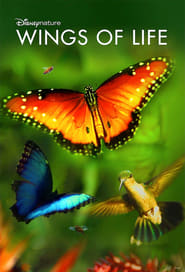
Wings of Life
Download English Subtitle
Release info
Tags
English subtitle preview
The first 198 lines.
In the countless landscapes of life on Earth,
things are not always what they seem.
What appears fragile may be fierce.
What appears innocent may be calculating.
Clever illusion is more than a means of survival.
It's also a story of love.
And of the mysterious force
relentlessly driving all living things to reproduce themselves.
By any means necessary.
Including deception.
I live in forests like this.
But then, I live almost everywhere.
This tropical forest appears still, but everywhere living things
are following the mute commands of their genes to find mates
and to ensure that their species lives on.
One might imagine that the most important life forms are large,
Or flashy,
or smart.
But it is love among the little things
that actually runs the vast machinery of life.
Some of the most important events on Earth occur quietly
in small and hidden worlds.
And some species critical to the grand scheme of life
are not what you expect.
This is a story about one of the most vital
and ingenious of all living things.
It's my story.
I'm a flower.
I'm going to tell you, on behalf of all flowers,
about life from our point of view.
You think we're just fragile wisps of beauty,
unaware that beauty is our strategy.
We're more important than you know.
We've helped life prosper across the ages.
Without us, humans might not survive.
Beauty is not always what it seems.
Beauty can be a tool of survival and seduction.
Every beat of every wing in every forest
is somehow keeping the great enterprise of life streaming forward.
The constant motion of life makes love connections possible.
Animals with wings and legs can search for mates.
But we plants are forever rooted in one place.
So we entice animals to us by offering rewards.
When they come, we use them
to make the love connections we can't make ourselves.
In this forest in Panama, a tropical orchid bee
has picked up an alluring scent and he's searching for the source.
It's me, an orchid.
And I'm one of the most cunning of all flowers.
My perfume is a trick.
The orchid bee depends on me for help with his central mission in life.
To mate with a female.
For weeks, he collects scent oils from orchids.
Eventually, he uses his mix of fragrances
as a kind of orchid "cologne" to attract a female.
The scents come from me, a bucket orchid.
The bucket is part of my trick.
The bee has to climb a waxy slope
to reach the scent oils cleverly hidden beneath a hood.
I've filled my bucket with a sticky fluid that makes the bee sink.
I provide only one escape route,
which leads him just where I want him.
After the bee climbs out, I grip him tightly.
I glue two pollen sacs to his back,
each filled with tens of thousands of pollen grains.
These are the only pollen sacs I will ever produce,
so I won't let him go until the glue is dry.
I may wait an hour or more before loosening my grip.
This one bee now carries my legacy.
When he comes upon the scent of another orchid that same day,
he heads right for it.
If he slips into the bucket of this second orchid,
the pollen sacs on his back will come unglued.
Pollination can occur.
A new orchid generation can begin.
How nature has created such intricate strategies
is a mystery of life.
Yet we can unravel some of the puzzle if we go back in time.
Back nearly 200 million years.
During the Age of Reptiles,
there were no mammals larger than a mouse.
For a very long time, there were no flowers, either.
Without flowers, Earth was a drab place.
But about 135 million years ago, life began to change dramatically
because of an invention.
When dinosaurs roamed forests like this,
most plants spread their pollen on the wind.
If they were lucky, a few pollen grains would reach another tree,
creating seeds that would become the next generation.
It still works today for pines, grasses and many other plants.
But it's not very efficient.
Most of the pollen goes to waste.
Some unknown plant in the deep past, perhaps a magnolia ancestor,
produced a device that would ensure delivery of pollen directly to a mate.
It would prove to be one of the most important events
in the history of life.
The device was me. A flower.
Our blossoms act like advertising billboards.
Our perfumes and tasty rewards lure passing creatures to us.
And we load them up with pollen
they will unknowingly carry to other flowers.
Beetles were among Our first "love messengers".
Our fruit, seeds, nectar and pollen
became crucial foods for millions of species.
We flourished and became a keystone life form.
Today, our pollination schemes knit together the fabric of life
across the planet.
Overtime, our pollination tactics evolved.
Pollinators adapted in turn.
And life everywhere became infinitely more diverse.
There's an example in this rain forest.
Some of us began hiding our nectar in tubes.
It encouraged some pollinators to specialize,
developing mutually beneficial relationships.
One of these pollinators evolved a longer beak for nectar tubes.
And wings that can beat up to 200 times a second.
With these unique aerobatic skills,
hummingbirds can hover to feed
and maneuver like airborne dancers.
Now, after millions of years,
pollination partnerships occur almost everywhere.
In luxurious habitats like the rain forest,
but also in some of the harshest places on Earth.
The Sonoran Desert of northern Mexico
is a world of blistering heat.
I live here, too.
We cacti are flowering plants central to life in this arid world.
Living as long as 150 years,
we help feed generation after generation of desert creatures.
We are living water tanks.
That's how we survive.
But to reproduce, we form alliances with unusual partners.
In this harsh realm, our strategy is not to deceive,
but to nurture.
When pollinated, we cactus flowers turn into fruit
with seeds to start a new generation.
So, on summer nights, to attract pollinators,
we open a few nectar-filled flowers.
And we wait.
Elsewhere in the night, our pollinators wait, too.
When the time is right,
they will leave their home on an island in the Sea of Cortez
to search for the white flowers beckoning from the desert.
These nectar-feeding bats are all female.
They live apart from males while pregnant.
Most are due to give birth soon.
Some are already nursing.
They desperately need nourishment.
Pollen sticking to their faces rubs off
and pollinates the flower of the next cactus.
A new mother gulps nectar
so she can nurse a baby born only moments ago.
Each flower opens on only one night,
its sole opportunity to spread its pollen across the desert on wings.
In billions of these brief intersections of the animal and plant worlds,
life regenerates itself over and over again.
If the flowers were pollinated and fertilized,
they will become nourishing fruit.
A wait begins among hungry creatures for the next gifts of the cacti.
A waiting game has also begun
among very different flowers in a very different world.
The farm fields of the American Midwest.
I live here, too.
I'm a kind of wildflower growing near the crops.
Each spring, I wait for a pollinator to sweep in from far away.
I thrive across North America, but I'm considered a weed.
"Milkweed" people call me, because of my special sap.
I make a milky poison
that can sicken many animals that might feed on me.
But I also produce sweet nectar
that draws a kind of beautiful pollinator
from a hidden retreat more than 1,000 miles away.
In a forest on a mountain in central Mexico,
monarch butterflies are amassed by the tens of millions,
waiting for the rising sun to energize their bodies.
In clusters so dense they can bend the trees,
they rest and prepare themselves
for the long journey northward to reach the milkweed.
Every autumn, to avoid freezing in the north,
they fly here from as far away as Canada
and perch in fir trees at an elevation of more than 1 1,000 feet.
It's the perfect climate to help them conserve energy through the winter.
As the morning sun warms their wings, they begin to cascade downward.
To stay alive, they must rely on stored fat
they accumulated last fall.
But to turn fat into energy,
they need water.
Their mission each day is to search for a drink of water.
They must maintain their strength
for the exhausting flight from here to the southern U.S.
From there, the children and grandchildren of these monarchs
Will journey on northward through the summer to Canada.
Their thirst quenched,
the monarchs return to the trees by late afternoon.
By next autumn,
their great-great grandchildren will return to these same forests.
Soon they will set out on the longest migration
of any butterfly on Earth
Wings of Life subtitles in other languages
More English subtitles for Wings of Life
- Disneynature Wings of Life 2011 WEB-DL DSNP · 40 downloads · 2021-04-21
- Wings of Life 720p HDRip x264 AAC MVGroup org · 60 downloads · 2015-10-29
- DisneyNature Wings of Life 2011 720p BluRay AC3-Eng-ITG · 72 downloads · 2014-11-03
- Pollen 2011 FRENCH 720p BluRay x264-ATeR · 65 downloads · 2014-11-01
- Pollen 2011 FRENCH 720p BluRay x264-ATeR · 53 downloads · 2014-11-01
Comments
No comments yet. Be the first to leave one.