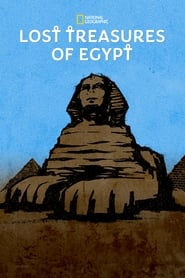
Lost Treasures of Egypt
Download English Subtitle
Release info
Tags
English subtitle preview
The first 200 lines.
Egypt, the richest source of archaeological treasures on the planet.
Oh, that's a fabulous one!
Beneath this desert landscape...
Lie the secrets of this ancient civilization.
Wow, you can see why the pharaohs chose this place.
Now, for a full season of excavations
our cameras have unprecedented access
to follow teams on the frontline of archaeology...
I'm driving so fast because I'm so excited!
It's an entrance, we can see an entrance.
Revealing buried secrets...
I have just been told that they have found something.
Oh my god.
And making discoveries that could rewrite ancient history.
This time, new secrets about one of Egypt's greatest rulers...
Hey-ah-ho!
The pharaoh queen, Hatsheput.
Doctor Szafranski discovers buried treasure at her magnificent temple...
The Darnells uncover how she formed a mysterious
double identity to seize power...
'For my beloved daughter', not son.
And John and Maria unearth a rare and intriguing statue.
Hold, hold, hold, hold, hold, hold, hold.
Do you realize what you've just pulled out of the sand?
Luxor, Egypt...
A landscape strewn with ancient ruins and magnificent temples
built for the great pharaohs of Egypt.
Cut into the surrounding mountains lies the finest temple of them all.
Its owner was a revolutionary,
a rare female pharaoh,
called Hatsheput.
Now archaeologists are searching for clues to reveal more about this
enigmatic pharaoh queen.
Leading the hunt is Polish archaeologist Dr. Zbigniew Szafranski.
The landscape is dominated by Hatsheput’s immense temple,
constructed to commemorate her reign as a pharaoh.
Ancient builders carved the site directly into the towering rocky cliffs.
They built it in three separate levels,
each one a terrace connected by ramps over 100 feet long.
At the top, 26 statues of the god of the underworld, Osiris, stand as guardians.
This masterpiece of ancient architecture is the key
to the secrets of the pharaoh queen Hatsheput.
It is an exceptional building.
The temple is unique in the history of Egyptian architecture and in the
history of the world architecture.
Dr. Szafranski and his team have been excavating and restoring
Hatsheput’s temple for the past 19 seasons.
Hi, hi, hi!
They are on a mission to piece back together the temple ruins.
120 years ago,
legendary British egyptologist Howard Carter
was part of the team that excavated this site.
Much of the temple was buried and badly damaged,
and little was known about its owner.
Today, Dr. Szafranski continues working to restore and rebuild the temple,
to reveal the secrets of the pharaoh queen Hatsheput.
Hatsheput was only the second woman to ever become a pharaoh,
and the first for nearly 300 years.
The fearless queen oversaw military campaigns to Egypt's Southern borders,
and claimed to have visited the battlefield herself.
She built a fleet of ships to sail the red sea
and re-established an international trade network,
bringing back exotic goods and riches.
Under Hatsheput, Egypt prospered and she built giant monuments
across the country to show that she was in control.
Hatsheput’s temple was just one of around ten megastructures she built
during her 22 year reign.
Across the Nile she erected vast swathes of a giant temple complex called Karnak,
and a 98 foot obelisk, the largest standing in Egypt today.
But the extraordinary life of this radical woman still poses many mysteries.
Now, archaeologists are on the hunt for new clues.
80 miles south of her temple in Gebel, El-Silsila, lies one of Hatsheput’s quarries.
Here, on the banks of the Nile...
What do you want, mate?
John ward and Maria Nilsson from Lund university
are getting ready to excavate at the quarry.
These lovely eggs.
Do you want some bread?
They want to investigate how Hatsheput used the
quarry during her reign.
In dig season, they live on this boat with their baby son Jonathan,
daughter Freya, and dog Carter.
What are you going to do today, Freya?
Yeah?
When you're a little bit older you can come over and help daddy, yeah?
Archaeology and Egypt itself has been with me since I was a kid.
I knew from the beginning.
That I'm here now is no surprise to family and friends back home.
The very day that I gave birth to Jonathan
we were going through what we actually needed on site.
We never stop, it never stops for us.
- No. - Even on Christmas day.
Guys, come on! We're ready?
John and Maria have spent the last ten seasons investigating this site,
used by Hatsheput.
Hatsheput was responsible for removing hundreds of thousands of
tons of sandstone from this quarry alone,
let alone the other quarries across the whole landscape.
With evidence of over 10,000 years of
human activity across 15 square miles,
it's one of the largest archaeological sites in Egypt.
Here, the couple is excavating an abandoned statue.
They want to know if it belonged to Hatsheput.
Good morning sphinx-y.
An unfinished, ram-headed sphinx.
It's a unique find.
It is.
The sphinx is a mythical beast modeled on a lion,
but with the head of a human.
Others were carved with the head of a ram, and are known as criosphinxes.
They act as guardians, protecting the entrances to
pyramids, temples, and sacred sites.
It's thought that Hatsheput started the greatest display
of sphinxes known to ancient Egypt,
an Avenue of sphinxes, enhanced over the centuries,
stretching nearly two miles
between the great temples of Luxor and Karnak.
It's absolutely amazing, it's one of those dreams to, to work with this
kind of monumental statue.
Let's go there.
John and Maria need to dig out the buried sphinx to confirm
where this statue was meant to go.
They set to work to see what lies beneath the sand.
Guys!
120 miles from Luxor, in Aswan, lies Qubbet El-Hawa.
This site is a densely occupied necropolis of around 100 ancient tombs.
Some have never been opened and hold secrets to how the necropolis
was being used during Hatsheput’s time.
It's amazing.
Archaeologist Martina Bardonová is part of a Spanish team preparing
to open up one of the unexplored tombs.
When I was about 15 I read about archaeology in Egypt,
then I completely fall in love.
Martina wants to excavate inside a new, unopened tomb, but before
she can get to it she needs to clear a pathway through the sand outside.
Everything is covered.
I'm thinking about which was to take off the sand.
The basic problem here.
Strong desert winds have blown sand in front of the tomb entrance.
But after just an hour clearing a path,
the team makes a discovery that could put a halt
to everything.
Aah!
A member of Martina’s team has found parts of a body hidden in the sand.
These human remains appear to be ancient.
It's, basically it's so fragile when, when you touch it or when you,
when even the sand around moves it's just falling apart.
We can put wet toilet paper because otherwise the bones crack.
Yeah.
Martina needs to find out why this body is outside the tomb,
and find any clues that will help her to put a date on the burial.
As she clears away the sand, the bones reveal something even more unusual.
It looks like a child, it might be a child.
In the quarry at Gebel El-Silsila,
John and Maria are excavating
what could be one of Hatsheput’s sphinxes.
Come and get your apples and pears now, come and get them!
This is my archaeological field box,
it's a little bit heavy, but this is the prototype.
A new version will come next season I hope, which will be lighter.
At the moment we've just got a nice stony layer on top which goes for the first two to
three centimeters, then beneath that if I stick my little magical tool inside
and then withdraw it, it's full of that,
which to the untrained eye is just black powder,
actually that's iron filings from the chisels of the quarrymen of these quarries.
The sand still today contains a memory of all that work
that took place here thousands of years ago.
The sand even holds clues about what the workers had for lunch.
Fish bones.
Someone could've had a nice meal down by the belly of the sphinx.
As work continues, the team unearths something
remarkable from under the sphinx.
Hold, hold, hold, hold, hold, hold, hold!
No, no, no, no, no!
Stand there, stand there.
Hahahahaha!
Do you realize what he's just pulled out?
A small sphinx!
Oh wow!
That is absolutely beautiful.
A small criosphinx.
There's the two haunches, there's the head, there's the head,
there's the body, here's the body.
What a discovery, I mean it's fantastic, it really is.
Wow.
Isn't she beautiful?
Large sphinx statues are seen throughout Egypt,
but a miniature on this scale is one of a kind...
Meet the child.
And must be recorded by the dig inspector, Khaled Shawky.
Khaled is supervising the dig to report any finds back to the Egyptian government.
This is amazing.
This is very wonderful.
Personally, I think it's a model.
Was it the son or the child, possibly, or the apprentice, copying the master,
the master's making the real thing.
This is a copy, yes, I think so.
And he's making a copy. You've got the horn here.
I see that, yes.
For that, but this side is broken off. Yeah.
Lost Treasures of Egypt subtitles in other languages
More English subtitles for Lost Treasures of Egypt
- Lost Treasures of Egypt S04E01-E08 NORDiC 1080p WEB-DL H 264 DDP5 1-CiNEMiX · 76 downloads · 2025-02-11
- Lost Treasures of Egypt S03 NORDiC 1080p WEB-DL H 264 DDP5 1-CiNEMiX · 55 downloads · 2025-02-11
- Lost Treasures of Egypt S02 NORDiC 1080p WEB-DL H 264 DDP5 1-CiNEMiX · 74 downloads · 2025-02-11
- lost treasures of egypt s01e06 curse of the afterlife internal 720p WEBRip x264-CAFFEiNE · 39 downloads · 2019-04-10
- lost treasures of egypt s01e04 tomb raiders internal 720p WEBRip x264-CAFFEiNE · 36 downloads · 2019-03-27
- lost treasures of egypt s01e03 cleopatras lost tomb 720p WEBRip x264-CAFFEiNE · 40 downloads · 2019-03-20
- lost treasures of egypt s01e02 hunt for the pyramid tomb 720p WEBRip x264-CAFFEiNE · 31 downloads · 2019-03-13
- lost treasures of egypt s01e01 tutankhamuns treasures 720p WEBRip x264-CAFFEiNE · 45 downloads · 2019-03-13
Comments
No comments yet. Be the first to leave one.