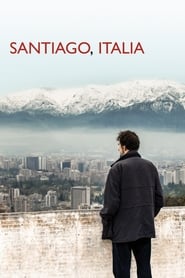
Santiago, Italia
Download English Subtitle
Release info
Tags
English subtitle preview
The first 200 lines.
The united Left
will never be defeated.
1970-1973 THE UNIDAD POPULAR YEARS
The candidate, Salvador Allende!
With the poet, Pablo Neruda!
Neruda, Neruda, the people salute you!
The Unidad Popular years
were like a waking dream.
A whole country, a whole society in a state of love.
There was an intensity to life...
that lives on now.
It's that eternal instant
of the moment when hope is not for tomorrow,
but for today, now.
It was a great moment for us,
the most important moment experienced by my generation
because we thought
we would make this country happier,
that illiteracy would be wiped out, that the land would go to the peasants,
that the workers would have a better life...
We did all we could to change the country
in what we saw as a highly positive way.
We worked with the peasants and students.
Those were unforgettable times for me.
I learnt everything I know during that time.
It was a wonderful experience.
The country was advancing and, of course, anyone aged 18, 19 or 20
advanced with it.
It was a country in love
with Allende and with what was happening.
Fantastic, fair, beautiful...
- And you? - I was there, among the people.
I recall I was shooting a film called The First Year
that related all the events, month by month, over a year,
Allende's first year.
It was amazing, one long celebration.
In the countryside, cities and homes,
there was a joy I had never seen in Chile.
It was Che Guevara's idea of a new man
with the possibility of emerging from underdevelopment,
of resolving the injustices here
that were simply terrifying.
Terrible infant mortality...
I worked at that time in schools,
initially in primary schools. I had just begun.
Some children were too ashamed to come as they had no shoes.
Things no one can really imagine these days.
The other aspiration
was to provide education for all children.
Education in Chile was free, unlike now.
It was free under Allende,
at universities,
middle schools, primary schools.
It was a race
to figure out what was happening, how, etc.
You wanted everything but you also began to realize
that, politically, things take time, right?
It led to a split.
There were two views.
One said we had to "avanzar sin transar",
strike while the iron was hot, while the others were saying
we had to go slowly so as not to alarm the bourgeoisie.
The bourgeoisie must be treated well.
That is a very old view, as old as the hills politically,
for one side of the Left.
We Socialists, the majority of the Socialist Party,
were for this policy of "avanzar sin transar",
without compromise.
You have already partly felled the tree.
Do you straighten it or chop it down?
We felt we had to chop it down.
Humanist, democratic Socialism
was Allende's goal.
It would distinguish the Unidad Popular government
from the other forms of Socialism at that time,
with their hierarchical regimes,
highly authoritarian and dictatorial.
For the first time ever,
a Socialist, with his Marxist ideology,
attained power through a democratic vote.
Before, it had been done by force.
It struck the world and terrified the Americans.
Declassified CIA archives,
the Church Report to the US Senate,
provide clear proof
of the US efforts
to prevent Salvador Allende's election
by financing
key newspapers like El Mercurio
and other elements of the Chilean Right
to prevent Salvador Allende from being elected.
Once he was elected,
the Americans' very own documents prove
that American funding was fundamental
in the ensuing conspiracy and sedition in Chile.
In the declassified documents,
Kissinger says,
"Chile is a small Latin American land,
even if it's a major copper producer,
but the main problem with Allende's experiment
is the fact that this experiment,
this example, can serve in France and Italy
where there are strong Communist parties
that could propose this political program
with left-wing sectors of the Christian Democrats
or other forces in France."
The conservatives
could not admit there was a Socialist
who immediately began by freezing prices
and gave half a liter of milk a day to every Chilean child.
All these social measures that no one had thought of before.
Nationalizing copper...
He nationalized it without compensating the Americans
because he said they earned so much from our copper
they deserved no compensation.
That, of course, outraged the Americans
and their government too.
And so all this created a situation of social conflict,
social, not political,
as the country found itself split in two.
There was no bread, sugar, oil, electricity, etc.
No gasoline.
The Right had begun to block everything.
As they owned the factories,
they did not distribute what the people needed.
The government imposed a freeze on food prices.
Meat could only cost so much,
bread and cigarettes too.
Basic items for the population.
With prices frozen, the sellers turned to the black market.
You couldn't find anything.
Consumer goods were out of reach to everyone...
SUGAR
...except on the black market for twenty times more.
They controlled every media and we had none.
The right-wing press launched an aggressive campaign
to give an image of misgovernment,
an image of the inability to govern,
a continual denigration displayed in all newspapers,
with huge headlines on every newsstand.
It was a message to the people continually repeating,
"This government isn't working and will bankrupt the country."
Those of us with the government had no way to retort.
We had no media on our side.
I tell you, comrades,
comrades of so many years,
I tell you with calm,
with absolute tranquility,
I am no apostle,
nor am I a messiah,
I have no vocation to be a martyr.
I am a social fighter
with a task to complete,
entrusted to me by the people.
But let it be understood
by those who would turn back History
and betray the will of Chile's majority:
even without the vocation of a martyr,
I will not take a step back.
Let them understand,
I will leave La Moneda
once I complete the mandate the people gave me!
I have no other alternative.
Only by riddling me with bullets
can they curb my determination
to implement the people's program!
Trying to change the country in those conditions,
with so many enemies,
the financial sector, the military,
the Americans,
television and everything,
was tough.
We knew that in the end
they would intervene by force.
I learned at that time that democracy is a good thing
as long as it serves the mighty.
I must say, even though I was very young,
I had a slight tendency
to minimize things.
Three times already in Italy,
I had been through coup alerts.
Once, in a Turin pastry shop, we ate no end of sweets
because this secret group
had convened in a pastry shop.
And so I tended to say, "Fine,
they say we have coups at home, but nothing happens."
Today, after so long, how do you view your years of activism?
What a question...
I've never asked myself that, and that's fine.
How do I view my years of activism?
Beautiful.
If there's something
good about this life, it's being able
not only to earn it decently, which is a lot, a huge thing,
but also to do it for so many others.
Mistakenly or not.
SEPTEMBER 11, 1973
I was at home that day with the Chilean family hosting me.
I got up early as usual to call my paper, Lotta Continua , in Rome,
taking into account the time difference.
Santiago, Italia subtitles in other languages
More English subtitles for Santiago, Italia
- Santiago,Italia20181080pBlu-rayRemuxAVCFLAC2 0-HRSR · 15 downloads · 2023-04-14
- Santiago Italia (2018) (Chile) 2CD 1080p H 264 (moviesbyrizzo upl) · 13 downloads · 2020-11-14
Comments
No comments yet. Be the first to leave one.