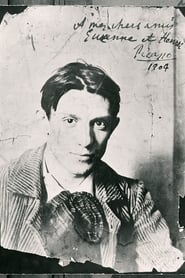
Young Picasso - Exhibition on Screen
Download English Subtitle
Release info
Tags
English subtitle preview
The first 200 lines.
In the autumn of 1907,
a young Spanish artist showed his Parisian friends a new painting.
So horrified were they that he rolled it up and hid it away for a decade.
Indeed, it wouldn't be properly shown until 1937.
And yet it's a painting that changed the course of art history.
The artist was Pablo Picasso.
Picasso was, like so many artists at the beginning of the century
an interesting mixture of many influences.
There was a Spanish poet, Antonio Machado, who said
that a man's homeland is his childhood.
Picasso's childhood is Málaga
and his core is Málaga.
This never left him.
He never forgot the light of the Mediterranean.
He remembered the bulls that he visited with his parents and his uncles
here in Málaga.
Flamenco was part of him.
Picasso is Málagueño but he is also from Barcelona,
from La Coruña,
and he is also, eventually,
an artist that is formed in Paris
but his homeland, his childhood, is Málaga.
The Málaga in which Picasso was born
was a Málaga of class struggle,
a Málaga divided between the upper bourgeoisie
and the working class.
It's a year in which Málaga's industry is still strong
but is falling behind
in comparison with other industrial areas.
Especially the north of Spain and Barcelona.
But Picasso's city was also the home
of the Golden Age of Málagueña painting.
In the city there are great painters
sculptors, engravers
but all local.
Picasso, from childhood, absorbed that environment.
One of the most important aspects of
Picasso's very nature
was the capacity he had for attention
fixation and, above all, retention.
Although Picasso studied in depth
the most important traditions of art
German, Italian, French
there was something in his work that takes us directly to the south
to this hybrid south, a south in which different cultures
have historically lived together.
The Jew, the Arab, the Christian.
I believe this is key to understanding the work of Picasso
because it has the elements
the forms, these cultural elements
that, distinct from their place of origin, comprised the south of Spain.
Here, in Málaga,
Picasso enjoyed bullfights
he admired doves and pigeons.
This brought him closer to Andalucía.
To his roots.
To his origins.
This is the house where Pablo Ruiz Picasso was born
on October 25th, 1881.
This house had been inhabited before the wedding of Picasso's father
by the father and his two sisters
but after the wedding of José Ruiz Blasco
with María Picasso López
the couple came to live here.
And this is where Picasso was born.
The family had a great influence on Picasso.
The character of Doña María
the profession of Don José
were key influences in his life and in his work.
Picasso grew up in a small bourgeois family in Málaga
where thanks to his father's profession and his father's friends
he came into direct contact with painting
with drawing, with colour.
Here he makes his first drawings, his first paintings.
The childhood of Pablo Picasso was an exciting one
because it was linked to art
since his father was an art teacher.
On the other hand his childhood was full of visual stimuli.
Málaga was a small city.
He lived where there was a lot of life on the streets
and that probably affected his way of understanding the world.
Málaga and the presence of his father
were the key points of his influences.
I would say that when his father was asking him to draw a pigeon
or to go to a corrida with him,
he was building his son with very strong Spanish roots.
We cannot neglect the fact
that Don José is very important for Pablo as an inspiration.
He realised that Pablo was more than talented
and that this needed to be supported.
In 1891, a few days before his tenth birthday,
Pablo arrived in a very different part of Spain,
La Coruña on the northern Atlantic coast.
Pablo's father, José, had secured a teaching role.
And it was here that he really taught his young son how to paint with oils.
"In La Coruña, my father did not go out
unless it was to go to the art school.
On his return, he painted.
But nothing more.
The rest of the time, he looked out the window at the falling rain
and then, in the end, he abandoned painting for good.
Instead he gave me his colours and his brushes
and he never painted again.
It frightened my parents that their child
dared exhibit his work.
Some friends chose a place,
an umbrella shop at Calle Real number 54,
more a junk shop selling everything from headscarves to suits.
In spite of my cheap prices the sales were poor.
I wouldn't have sold a thing
were it not for the generosity of my father's friends..."
Picasso arrived in La Coruña on October 14th, 1891 from Málaga.
He made the trip by boat with his whole family.
They would stay in La Coruña for three and a half years.
It was a very important period for the young Picasso
because it was where he started his academic training
and where he also began
to make his first pictures with a completely free spirit.
That first year Picasso was enrolled at secondary school
and the school of fine arts
which was in the same building as the secondary school.
Picasso had as his teacher his own father
José Ruiz Blasco, who had taken that position
and Picasso combined these studies between 1892 and 1894
but then in 1894 his father
decided that his son end his normal studies
to stop studying mathematics and grammar
and to devote himself solely to the study of art.
At the beginning of 1895
Pablo starts to study the natural figure
and it was Picasso's father who paid the models
to pose for Picasso and his classmates.
It was here that Picasso made considerable advances
because over two or three months he made many portraits.
These portraits were important not just from an artistic point of view
but from a psychological one
because Picasso exhibited these works
in the shop windows of the Calle Mayor
which was common for artists at that time.
Picasso received some very complimentary reviews.
Some even compared him to Giotto and Raphael.
These paintings, rather than being considered works of genius
should be seen as the works
of a 13-year-old boy already showing promise.
My grandfather realised that the artistic scene was in Barcelona.
Of course, he was very young: 13, 14 years old.
And there is a part of luck in his life
because when his father was appointed in La Coruña,
was offered to make a switch with someone in Barcelona,
it was just luck
because Pablo was going to be part of the artistic scene of Spain
and from Barcelona everything was possible.
When one looks at Picasso's work
one always sees the desire to rebel
of not wanting to do what others told him to do as an artist.
This is evident from the beginning
when, as a child he did things that adults usually do
and later, as an adult
he did things that children do.
We are talking about an artist
who can be described as a great rebel
against the artistic academy
against conventions
against stereotypes
against the authority of others.
Very shortly after arriving in Barcelona
Picasso was enrolled in the Llotja art school.
The training was very old-fashioned.
The young students did not like it
because the academy was basically repetition and copying.
Picasso was very reluctant
to follow this training.
But there is the great paradox
that the academic training that Picasso received
in La Coruña, in Barcelona and later in Madrid
was decisive for his training as an artist.
Picasso is an artist who throughout his life
will want to break the rules
and transgress from all the teaching
he had received in his training.
Despite this he is an artist who has
a very solid, very sound base.
A base that allowed him later to develop
in a more profound way as an artist.
The Picasso who arrived in Barcelona
at just 13 years of age
was no more than a student of fine arts.
He was not yet the genius he was to become.
Nor did he pass through Barcelona
as a great artist recognised by all the world.
The Picasso that was in Barcelona was an artist still evolving.
Very eclectic in the sense that he fed on
different influences that came from outside
but he had not yet defined his own style.
But in the meantime, he was being influenced
from all directions.
I think that the Barcelona period was important for two reasons.
The first, something more academic.
On the other side you have the people of Barcelona
and those exotic subjects like prostitutes or local people.
More English subtitles for Young Picasso - Exhibition on Screen
- Young Picasso 2019 1080p WEBRip x264-RARBG · 12 downloads · 2022-01-23
- Exhibition On Screen Young Picasso 2019 720p WEBRip x264 AAC-[YTS MX] · 7 downloads · 2022-01-23
- Exhibition On Screen Young Picasso 2019 1080p WEBRip x264 AAC-[YTS MX] · 12 downloads · 2022-01-23
- Young Picasso 2019 WEBRip x264-YTS MX-YIFY · 12 downloads · 2022-01-22
Comments
No comments yet. Be the first to leave one.