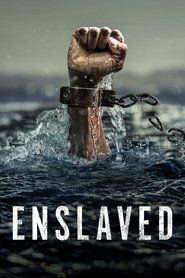
Enslaved
Download English Subtitle
Release info
Tags
English subtitle preview
The first 171 lines.
It wasn't just people who were brought from Africa
during the transatlantic slave trade,
it was knowledge.
Knowledge that helped give birth to the world we live in
without most of us knowing anything about it.
We brought our ways with us.
It's not in the history books.
We're going to find it in the bottom of the ocean.
They have an opportunity
to rediscover their ties to the past,
and their connection to the enslaved Africans
who were here.
Woo!
You look at this, and it's beautiful,
but it's also a mathematical.
Exactly.
There were 2,500 enslaved Africans
that ran away to join the pirates.
Here was a world where they had an equal vote
and an equal say alongside their white counterparts.
Your life depends on your skills,
your equipment and your attitude.
Why are you the first Black person I ever seen
play a banjo?
It was known by everybody
as a Black instrument.
All those things have been considered for so many years
to be slave food,
right now, everyone wants to celebrate it.
The memories and talents of the enslaved Africans
who arrived here
helped to create the culture of the new world
in a way we have only just begun to understand.
This community was started by the Africans
who were on the last illegal slave ship
to arrive in America, "The Clotilde."
Five years after they were brought here,
the end of the Civil War set them free
and they started the only African-run town in America.
Grammy award-winning musician, Rhiannon Giddens and I
are here with Joe'l Billingsley
who brought us here to see the monument
honoring her great-great- grandfather, Kazoola,
one of the founders of Africatown.
Kazoola happens to be the one we know the most about.
Right.
Because he lived longer and he shared his story
in a way that a lot of us are learning about it now.
Wow.
My grandmother was born in 18 something.
So her mother was a slave.
So she could talk to me about what that was.
That forms us in interesting kinds of ways.
I mean, people always talk about slavery
like it's ancient history.
- Yeah. - And it's not.
- Mm-mm - And lasted a long time.
That. Yeah.
In Africatown, they grew their own food.
They established their own community
based on what they did in their homeland,
based on their traditions.
And so as you sort of move through the decades,
you'll see that, that community at one time,
when it was thriving, had everything you needed.
Didn't have to go anywhere, to go to the grocery store,
see a doctor to be educated
or even have some entertainment.
Everything you needed to live
was right here in the community.
And so when you talk to people, they have so much pride
in what it used to be.
One time it was 12,000 people, now it's 2000.
Now we're trying to revive Africatown.
We have a place called Kazoola,
named after my great-great- great-grandfather.
So why are you the first Black
person I ever seen play a banjo?
- That's the question. - That is the question.
Because it was like, I grew up seeing white people
play the banjo and kind of going,
oh, that's cool, but it's not part of my culture.
And then I found there are some recordings
of the Black players of this music.
And then as I started to dig
and, like, this used to be a huge tradition.
It was an enormous tradition all across,
not just the south, but all across the country.
So I know the banjo as this, metal strings,
metallic instrument often played bluegrass style.
And then I learned that the banjo
was an African American instrument.
So it looked more like this.
It was known by everybody as a Black instrument.
The emblem of being Black was the banjo.
Then you have a change in the 1820s, and 30s,
and that's when white folk started going.
"That's really cool. I would like to play that."
So you have white entertainers picking up the banjo.
The reason why we don't talk about this shift
is because the white folks playing this banjo
would have been doing it in blackface.
This entire industry becomes the blackface minstrel show,
is the most popular form of entertainment
for, like, over 60 years.
Are you saying that what we know as bluegrass today
actually began with African Americans?
100% - Wow.
That's exactly what we're saying.
Wow.
So are you saying the original do-si-do
was an African American thing?
So, way back when you have nothing but dances
as entertainment, and you have plantations,
the musicians for these balls are African American.
Almost always.
And so they are forced to learn European dances,
European music,
and then they are themselves mixing it.
The thing that sets apart American square dancing,
and country dances from Europe is the calling.
You don't have callers.
And that's the thing that you think.
That stuff.
These are the innovations that make this music
uniquely American are African American.
Do it again now, come on!
Yeah!
We're here in Costa Rica,
because of a local group of young divers
believes that Africans contributed
to their history and culture.
This time we're not diving to investigate the deaths
of those that never made it.
This time, we're investigating one group
that may have survived.
Before we do any diving, Alannah, Kinga and I
are traveling through Southern Costa Rica
on our way to a remote village,
several hours from the ocean
into the rainforest of the Highlands.
We're meeting members of an indigenous group
called the Bribri.
They're considered to be descendants of the Mayans,
but there might be another side to that story.
Their folklore tells of slave ships
that were wrecked on the Costa Rican shoreline,
and of Africans who came ashore
to make a new life for themselves in the forests.
But their African ancestry
has always been considered to be a mere tribal legend.
Maria Suarez Toro has invited us here to a Bribri feast
to see if we can help this community
reclaim its lost history.
I would like to thank everyone for inviting us here
to hear your story.
On some level I'm jealous
because my question is always where do you come from?
And the answer to that for me is always,
I don't know.
I don't have a connection to my home or my people
so to be able to assist
in answering those questions
is a connection for me.
I want to hear the local story.
What do locals say about what happened
or those shipwrecks?
I can't really imagine.
You've just wrecked up in the middle of nowhere.
You have no idea where you are.
You look to your left, and it's just ocean.
Enslaved subtitles in other languages
More English subtitles for Enslaved
- Enslaved S01E06 Abolition 1080p AMZN WEB-DL DDP5 1 H 264-TEPES · 5 downloads · 2020-10-21
- Enslaved S01E05 Resistance 1080p AMZN WEB-DL DDP5 1 H 264-TEPES · 4 downloads · 2020-10-13
- Enslaved S01E05 Resistance 1080p AMZN WEB-DL DDP5 1 H 264-TEPES · 5 downloads · 2020-10-13
- Enslaved S01E04 New World Cultures 1080p AMZN WEB-DL DDP5 1 H 264-TEPES · 6 downloads · 2020-10-06
- Enslaved S01E03 Follow the Money 1080p AMZN WEB-DL DDP5 1 H 264-TEPES · 8 downloads · 2020-10-01
- Enslaved S01E03 Follow the Money 1080p AMZN WEB-DL DDP5 1 H 264-TEPES · 5 downloads · 2020-10-01
- Enslaved S01E02 Rationalization 1080p AMZN WEB-DL DDP5 1 H 264-TEPES · 4 downloads · 2020-09-26
- Enslaved S01E02 Rationalization 1080p AMZN WEB-DL DDP5 1 H 264-TEPES · 6 downloads · 2020-09-26
Comments
No comments yet. Be the first to leave one.