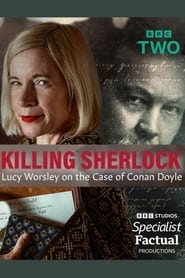
Killing Sherlock: Lucy Worsley on the Case of Conan Doyle
Download English Subtitle
Release info
Tags
Download English Subtitle Files for Mobile (3)
English subtitle preview
The first 200 lines.
It's 1893...
..and Arthur Conan Doyle, the author of Sherlock Holmes,
has a problem.
He's come to hate the fictional detective who's brought him
fame and fortune.
Arthur has the motive.
The means.
And the perfect location.
Sherlock must die.
Sherlock Holmes is the world's most famous detective.
Oh! And here's an address with a powerful spell to it.
Baker Street.
Admired for his intellect.
You had an almost infallible detective who offered certainty,
answers.
Adored for his skills of deduction.
It's a little bit of a precursor to what we call forensic science.
He originally appears in four novels and 56 stories.
And he pretty much always solves the mystery at the heart of each
one of them.
But there's one huge mystery that still remains.
Why didn't Sherlock Holmes' creator, Arthur Conan Doyle,
love him as much as the rest of us do?
You can see the dilemma that he's in, because he doesn't want
to be stereotyped only as the writer of Sherlock Holmes.
"I think of slaying Holmes.
"He takes my mind from better things."
In this series, I'm tracking down clues and evaluating the evidence.
Where is it? Where is it?
To discover where creator and creation diverged.
He escaped from Conan Doyle very early. Escaped.
It just sort of blew up with Houdini just eventually saying,
"I just think this guy is senile.
"He's sort of bamboozled easily."
I read my first Sherlock Holmes story when I was about nine,
and what I loved about him was his compelling weirdness
and the strange cases he took on.
But I've come to think that the most curious case of all of them
is this love-hate relationship that existed between the
great detective and the man who invented him.
In the world of Sherlock Holmes, nothing is as it seems.
And the case of his author, Arthur Conan Doyle, is no exception.
He didn't create his detective in the Victorian streets of London,
but instead in the coastal city of Portsmouth...
..where Arthur was to be found on the football pitch...
..playing under a false name.
Here's a match report in the Portsmouth Evening News
for March 1886.
In goal, we have AC Smith.
Now, that's actually AC Doyle.
He was 26 years old.
He was 6'1",
he weighed 15 stones - just the sort of man to stop a ball.
Arthur Conan Doyle was, in many ways,
a vision of middle-class propriety.
A young doctor, a keen member of the cricket and bowls clubs.
But Arthur the footballer is rather mysterious.
Why was it that when he played football, he disguised
his real name?
Now, football didn't have the same upmarket image as some
of Arthur's other hobbies.
Football was the sport of the working man, and maybe
he used his false name in order to preserve his reputation as a
newly established family doctor.
Now, I think that Arthur's life as a secret footballer might reveal
an awful lot about who he really was.
On the one hand, he had these crowd-pleasing instincts,
but at the same time, he had an enormous need to appear respectable.
I suspect that this dual identity may provide a clue to the curious
relationship between author and detective,
because just as his respectable life was taking shape
with a small medical practice and a suitable wife called Touie...
..Arthur was also working on a secret ambition.
He wanted to make a living as a famous writer.
And in March 1886, he put pen to paper.
Arthur was writing the first ever Sherlock Holmes story,
A Study In Scarlet, and he seems to have been seized
by a writing frenzy.
He finished the whole thing in just a month.
Yes, you did hear me right.
Arthur dreamt up the whole world of London's most famous detective
in just 30 days...
..from his desk in Portsmouth.
At the beginning of A Study In Scarlet,
Dr John Watson has just come to London and he needs to find
somewhere to live.
He's hanging out one day in the Criterion Restaurant
in Piccadilly when he hears tell of a possible flatmate who's based
at the St Bartholomew's Hospital in Smithfield.
Watson decides to cross town to go and interview this guy,
check him out. How does he get there?
He takes a cab.
Which means that right from the very beginning,
London, the streets of the city,
is like an extra character in the Sherlock Holmes stories.
You'd have thought that Arthur knew London like the back of his hand.
But again, there's some deception going on.
Arthur had grown up in Edinburgh.
He'd worked in several English cities.
He'd travelled abroad to the Arctic and to West Africa.
But he'd only ever spent a few weeks here.
So how did Arthur build up this really believable
picture of London?
We actually know the answer, because he wrote a letter
to his publisher in which he spilled the beans.
He explained that he'd used a Post Office map - like this rather
lovely one here.
You can see Piccadilly Circus, where Watson's journey begins.
And there's Smithfield.
That's where the hospital is.
Oh! And here's an address with a powerful spell to it.
Baker Street.
We all know who lives there.
I love the idea of Arthur, down in Portsmouth, looking
at his map, working it all out, conjuring up this whole city
from a piece of paper.
I think this shows Arthur's creativity and his ingenuity.
Characteristics he also gave to Sherlock Holmes.
We're first introduced to Sherlock here at St Bart's Hospital,
where he demonstrates his amazing powers of observation to Dr Watson.
"'How are you?'
"he said cordially, gripping my hand with a strength for which I should
"hardly have given him credit.
"'You have been in Afghanistan, I perceive.'
"'How on earth did you know that?'
"I asked in astonishment."
Arthur may have dashed off the book in a few weeks, but Sherlock leaps
from the page fully formed.
Wow.
I'd like to understand the process of creating such a striking
character, and I'm hoping crime writer Saima Mir can help me
to interpret a crucial piece of evidence.
So, then, I've got something here
that I think you're going to like, Saima.
Let me show you this.
This is a set of notes from when Arthur Conan Doyle
was first inventing the character of Sherlock Holmes. Wow!
There is A Study In Scarlet, the title of the first book,
and this is his handwriting.
We've got some ideas for the names of the characters.
"Sherrinford Holmes." Mmm.
That doesn't have the same ring to it, does it?
Sometimes when you write a character, the name
just doesn't stick and it doesn't work until you really get
to know them.
And I think the idea of Sherlock just sounds like such a hard, strong
name, doesn't it? Whereas Sherrinford - he doesn't sound like
a safe pair of hands to me.
I wouldn't ask him to investigate anything.
Do all authors do this sort of thing? Do you? We do.
So I definitely sit down and jot things out.
What I love about this is that we don't get to see
this from other writers.
I don't get to see what their ideas were and what they turned into.
I just get to see the finished product.
So I just absolutely love this. It's so fascinating.
And this character here, in this draft, is called Ormond Sacker,
from Afghanistan, which tells us that this was some sort
of a forerunner of Dr John Watson, who served in Afghanistan.
That's a name that's been on quite a long journey.
Dr Watson's sort of everyman, isn't he?
Everybody can relate to him. He's very solid.
You know what you're going to get with a Dr Watson.
Sherlock wouldn't work without Dr John Watson, would he?
No, he wouldn't work.
And I think you have to have sort of what's a straight man in the story,
to bounce ideas off against.
And if he's got this very nice man as his friend, he must have some
characteristics which make you warm to him.
Let's find a bit more about the set-up, then.
We've got, "Lived at 221B Upper Baker Street."
All the pieces are coming together here, right?
It's so interesting what's stayed and what left.
A "sleepy eyed young man"
isn't what we associate with Sherlock Holmes.
But the violin definitely is.
Yes. Somebody who stands for ages, has the discipline to practise.
So I imagine that's what's being conveyed there.
He's mentioned here some other famous fictional detectives
of the time. Lecoq, he says, "was a bungler.
"Dupin was better."
What's Arthur Conan Doyle doing here?
Well, this really shows the brilliance of Arthur Conan Doyle
and his ideas for his career.
This is his strategy.
He's clearly got a plan of what his story will be,
where it will be in the market.
He's saying, "This is the competition, and I write stories
"which are a little bit like that.
"But actually, Sherlock Holmes is going to be a cut
"above, and he's going to blow the competition out of the water."
Arthur Conan Doyle would go on to be so successful,
such an institution, that sometimes it's all too easy to forget
that he was a human being.
And what I like about this piece of paper is the way it gives
an insight into him...
..half-formed, not yet a success.
Taking risks.
It shows him...being vulnerable.
Arthur's first priority, though, was to earn money for his family...
Comments
No comments yet. Be the first to leave one.