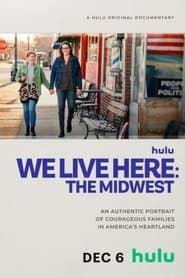
We Live Here: The Midwest
Download English Subtitle
Release info
Tags
English subtitle preview
The first 200 lines.
Here in Iowa, there is something called "Iowa nice."
It is really Iowa passive aggressiveness,
and it is--
no one is ever gonna say, "I don't support you" to your face.
They're going to be very kind to you,
and then they're gonna have a letter-writing campaign
to get you kicked off of whatever committee
or whatever thing behind your back.
We both grew up in Des Moines.
We've been here our whole lives. We've never left.
Yeah.
And then, we both had similar home lives
and church lives.
We met in second grade, and became really best friends in--
- Eighth grade. - Yeah.
You accepted me and I-- before I even could accept myself,
and I don't know that you even knew what it was,
but you saw the essence of me,
aside from gender.
In our small private school and in our churches,
when you dated, you were dating to marry someone.
So, when we started dating
at 17 and 16, respectively,
it was pretty much on the marriage track.
I did want a really big family.
That's just always been something for me, that family is.
And then, I loved the whole thing.
I loved being pregnant,
I loved giving birth.
It was so fantastic.
And then they just kept coming, and we were like,
"Okay, let 'em come."
And then we decided to adopt.
They are so loved and well-respected in our community.
You know, because our kids are in school,
they're seen more than we are,
and so they really do pave the way.
By the time that people get to us,
they already know our kids, and they're like,
"Oh, you must be great because your kids are fantastic."
I initially came out to myself,
and came out to Katie the same day
that I kind of came out to myself
'cause I thought that was only fair based on our relationship.
When we told the kids, she did a really good job
of drawing a picture for them.
I drew a picture for the kids that was,
"Here's our bodies,
"and some people have male bodies.
"And some people have female bodies.
"Here's our spirits.
"Some people have male spirits, very masculine spirits,
"and some people have very feminine spirits.
"And so sometimes, those things go together.
"Other times, they don't go together.
"So sometimes, our outsides match our insides,
"and sometimes they don't,
and that's called being transgender."
And they were like, "Okay, duh."
Like, they didn't have any reservations about it.
- You wanna crack the eggs? - Dads always crack the eggs!
It was a little weird,
but we all like kind of... - Adapted.
Adapted pretty quickly.
Well, we just added an O to Mom.
Are we making scrambled eggs?
- Yeah We still call both of them Mom,
but it doesn't get confusing.
It's just like we know who we're talking about.
- If I asked one of my moms to come downstairs to tuck me in,
the other one comes.
Mom, I'll take three!
- Three? - Three.
You know, whatever they needed to call me, they could call me.
And so, they called me Dad for a long time
after I had come out,
and even after I had started to transition
and had come out really publicly,
and we finally got to a point where we were
on a cross-country road trip down to Texas,
and we were in a Southern state in a gas station,
and I'm coming out of the women's restroom,
and they're yelling across the Conoco or whatever it was,
"Dad! Dad!" whatever.
And we got in the car, and I said, "Okay.
"We might need to rethink this because this,
this may end up not being safe for us."
Within the hour, they were like, "How about Momo?"
And I'm like, that's great, you know?
And they switched like on a dime, and have not looked back.
- It's on your French toast. - Yeah, but it's not on this one.
It's more unusual here in rural Iowa
to have two parents with the same gender.
So, it's coming out more, but they're pretty good,
and they know how to handle that kind of stuff.
My family was very surprised.
I think they thought
they had the all-American man
and father and son.
They came back immediately and said, "I love-- We love you." You know?
And that was kind of it. And I thought, oh, that's a good response.
And then, it kind of, from there, you know,
more discussion about religion and things like that,
which, um, kind of devolved over time,
and so, they, they were surprised,
and I think remain that way
to this day.
I do not have contact with my parents
or my sister.
I do have a brother that I speak to.
It took me by surprise for sure.
Nia and I's relationship has, um...
it was incredibly strong.
We were very close, our families were very close.
You know, over the years,
it's just evolved into something
that wasn't what it was before.
He kind of acted as the middle man between Nia
and the rest of the family.
And I think that that's a very difficult position for anyone.
So, I would hope that that can be...
mended to a place where we're close. We're all close again.
But I think too that there's so many boundaries
that have to be drawn in order for everyone
to stay safe and continue healing.
Katie was preaching at our church
and it was a non-denominational evangelical church.
I mean, the stance is that homosexuality is a sin.
- That's the byline, right? - Yeah, yeah.
- And I think that there is a push towards welcoming,
but not affirming.
I don't think the realization has been made
that that's more damaging than just saying, "No."
When I came out,
all of the energy got focused onto Katie and her preaching.
Nobody would outright say, you know,
something that was transphobic,
but it was, "Katie, your theology is bad."
I think the other layer to that, too, with being a woman
preaching in the evangelical context
was already like,
"We're allowing you to do this." Because we were
a more progressive evangelical...
non-denominational church.
We just pushed beyond what that tradition
was willing to hold.
I desperately miss the church.
Nobody really asks me this question, so sorry.
There's like a lot of emotion attached to it.
I gave a significant amount of my life to the church
because I love the people so much.
And I really love the ideas
that Jesus represents.
Of unconditional love,
of reaching out to those who are marginalized.
I mean, probably because I did have a queer identity.
I didn't know it my whole life.
That Jesus spoke those things to me,
that I was acceptable.
And it utterly breaks my heart
that my unconditional love for Nia
was the thing that had to break my relationship with the church.
Because, for me...
it is the church.
Like, for me, this is my religion.
This is my faith.
This kind of love.
Yeah, I tried out a couple different names
and had like some close friends use it with me
and my siblings. - Mm-hmm. Yeah.
How did that process feel?
I mean, it was odd.
- Yeah. - Because there was nothing
that felt right for a while. - Yeah.
I have found community in other places.
That is the thing that the church really gave me,
and the thing that I loved about church
was the relationship,
and I think God is relationship, and so, to me,
you know, finding that in other places is, is finding God elsewhere.
- Yeah, absolutely. Hi! - Good to see you. Hi.
One of the biggest struggles for me is finding belonging.
When Nia came out, finding my own label was really difficult.
I'd like to say that Nia gifted me my queerness.
She really gifted me that awareness that,
you know, you thought you were this one person,
but because you didn't have
the experiences that you needed, you didn't get to find out
that your whole person
is a lot richer and deeper than you thought.
- Let's talk about a dream summit because when was the last time we did that?
I say ambiguously queer because I don't know.
And I was just talking with another spouse
of another trans person the other day,
and they were saying the same thing.
"I don't really know where I fit.
I don't know what label you'd put on me."
So, I think we're like the labelless few
right now
of, you know, spouses of people who have transitioned.
We Live Here: The Midwest subtitles in other languages
More English subtitles for We Live Here: The Midwest
- We Live Here The Midwest 2023 WEB H264-RBB · 12 downloads · 2023-12-07
Comments
No comments yet. Be the first to leave one.