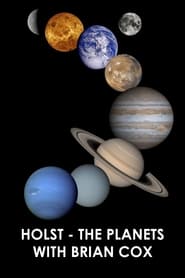
Holst The Planets with Professor Brian Cox
Download English Subtitle
Release info
Tags
English subtitle preview
The first 200 lines.
100 years ago,
Gustav Holst's masterpiece The Planets
premiered at The Queen's Hall in London.
It has since become a favourite on the concert platform.
Holst's inspiration was more astrological than astronomical.
When he composed the seven movement suites,
Holst knew little of the physical nature of the worlds he represented.
But thanks to a century of discovery,
using space probes and rovers,
these are now worlds we've photographed…
Worlds we've touched.
And, yet, Holst's music is just as powerful today,
reminding us of the fragility of humanity, adrift in the universe.
OK.
I've been working with the BBC Symphony Orchestra
and conductor Ben Gernon, exploring the latest science.
The images, I think, are very powerful.
I'll show you an image in a moment
which I think is probably my favourite image
in the history of space exploration.
We want to discover if this new knowledge
can deliver a fresh insight into the music.
Tonight, at a special event, at the Barbican,
all seven movements will be performed…
…this time, set to the backdrop of the latest imagery of the planets.
Holst's Planets were characterised by their astrological
and mythological characters.
So, Mars, The Bringer Of War. Venus, The Bringer Of Peace.
Neptune, The Mystic.
The aim of tonight's performance is to explore
how the music changes, if we listen today,
with the luxury of 100 years of scientific discovery
and, also, if we listen in today's social and political context.
You see, composers like Holst were involved in - and contributed to -
to the political and intellectual arguments of the day.
Holst was on the left of politics, and he was also a spiritual man.
He was interested in eastern philosophy,
he learned Sanskrit, and his music had a strong Indian influence.
While he was writing The Planets,
during the First World War and just before the First World War,
a time of great social, and economic, and geo-political instability,
his character, his interests,
and his political ideas are reflected in The Planets.
Precisely how, of course, is open to interpretation.
That is the point of great art.
But an interpretation I find interesting,
is that "The Planets" can be seen as an intellectual journey,
informed by Holst's socialism,
and his attraction to eastern mysticism.
In fact, the director Tony Palmer, in his film on Holst,
wrote that in this context, "The Planets" begins to make sense.
Not as an astrological chart, a la Mystic Meg,
but as a pilgrim's progress
from the ferocity of industrial capitalism, represented by Mars,
towards a karma of enlightenment, represented by Neptune.
Now, tonight I'm not interested in arguing for this,
or indeed, any other particular interpretation.
What I am interested in, is how the work might suggest new ideas
when set in a 21st century context,
alongside the images and the understanding of the solar system
to which we now have access.
This is a modern day spacecraft picture of Mars.
Everywhere we look, we see evidence of rivers.
So Mars, actually, was a world which could have supported life
about 3 billion years ago.
Now we know that there's water on Mars, there are minerals on Mars,
pretty much everything you need to support human life
in a civilisation.
And so Mars becomes not a bringer of war,
kind of a terrifying red object in the sky,
but a bringer of opportunity and hope.
I think it's really interesting. There's a moment…
Actually, in the orchestra, if we could just have a look, please.
And it's four bars before Figure 5.
And I'm wondering if we could just soften this,
to make this more hopeful?
This fanfare that we have in the brass, instead of it being
da-da-da-da-da-da-da-da-dee, da-da-dum,
could it be da-da-da-da-da-da-da-da-dee?
So it's ever so slightly softer and, maybe,
as you were saying, Brian -
offers a sort of place for hope.
Mars, as Holst would have known it,
was not a well-resolved planet, if you like.
The photograph behind me is a photograph taken
by telescope that was commissioned in 1917,
so, in fact, just after Holst had written the piece.
What you see is a fuzzy blob.
You can see dark markings on the surface.
And, at the time, even reputable astronomers mistook those markings
for, perhaps, signs of vegetation.
That image of Mars was dashed when we went there with spacecraft.
The first spacecraft to fly past was in 1965,
the Mariner 4 spacecraft.
And it sent back grainy images of the surface.
President Lyndon Johnson, president at the time, reflected…
…he said: It may be, it just may be, that life as we know it,
with its humanity, is more unique than we may have thought.
If we move forward to today, a fleet of spacecraft have visited.
The first thing we see is a world of geological giants,
you see a canyon spanning over half the face of the planet,
which is called the "Mariner Valley" after the Mariner spacecraft.
The Grand Canyon here on Earth would fit into one of its side channels.
It's also a planet of great volcanoes.
We have good evidence that there were lakes,
possibly even oceans on Mars.
We've landed on Mars.
As I speak, there's a robot called Curiosity,
which is exploring an old dry lake bed.
It's found the signatures of organic molecules,
it's found signatures of minerals
that only form in the presence of standing water.
So we've built a picture up of Mars
that tells us that it was Earth-like
perhaps, three billion - three and a half billion years ago,
with rivers and oceans and seas.
In a sense, it could have been a living world.
Whether life began there, we don't know.
But what's interesting is this changes our view of Mars again,
because a planet like Mars that had water,
and still has water, becomes a planet that has everything you need
to build a civilisation, to sustain life, to sustain human beings.
So, even if there weren't Martians three and a half billion years ago,
even if there aren't still Martian microbes today living sub-surface,
there will probably one day be Martians,
because the Martians will be us.
Can we listen to Holst's Mars
and forget the deeply ingrained 20th century symbolism
of mechanised warfare?
Can we instead view Mars with optimism?
Having survived the barbarism of the 20th century,
our technology and our rockets are now free
to deliver perspective on our cosmic isolation,
to provide a bridge to the future
where humanity is no longer confined to a single world.
Mars, The Bringer of War by Gustav Holst
I think the photographs of Holst speak to me about the time.
So he was late-thirties,
40, or so, when he wrote "The Planets". Mm-hmm.
But Holst didn't have so much success as a composer,
before he wrote this piece.
I often get the impression that he was searching for something deeper
and more meaningful than his current existence.
The First World War was on the horizon.
He wanted to sign up, he couldn't sign up, because he was ill.
He will have friends and colleagues go and fight on the Front,
potentially never come home.
The historical context
within which this piece was written, is frightening.
We didn't know there was an origin to the universe.
We didn't know how the sun shone,
so we didn't know about nuclear physics.
So all those things that we almost take for granted now…
…we'd not known. That's what's interesting.
This is music from a time when we had no idea
about our place in the wider universe.
And I'm intrigued to know,
so if Holst was standing in his back garden at night,
what could he see in the sky?
With the naked eye, he would've been able to see Venus, of course.
I mean, Venus is often, depending on where it is in its orbit,
but often the brightest thing in the sky,
either close to sunset or close to sunrise.
It's always close to the sun.
So he would have seen Venus very bright, Jupiter, Saturn,
Mars, again extremely bright.
But that's pretty much it. Mmm.
Venus, The Bringer Of Peace.
It's a planet that's very Earth-like in many ways.
It's not too much closer to the sun. It's about the same size as Earth.
And this really led astronomers in Holst's time
to consider it potentially Earth's twin.
Just like Mars, it was considered to be a world which may harbour life.
We can never see the ground from Earth, it's shrouded in clouds.
And that added, I think, to this idea
that Venus may be a tropical paradise.
But as with Mars, you know, we had a shock
when we first started to point,
initially, radio telescopes to Venus,
and then began to fly space probes past the planet.
We found that Venus is a scorched world.
This is a photograph from a Russian spacecraft called Venera 9,
which landed in 1975.
It found a world that it could barely survive.
It only lasted for around an hour.
It measured temperatures of 465°C on the surface.
The atmospheric pressure is 90 times the atmospheric pressure on Earth.
That means if you or I stood on Venus,
we would be toasted and then squashed.
And if that didn't do it for us, we would be dissolved,
because the clouds of Venus rain down sulphuric acid.
So, far from being an idyllic, beautiful bringer of peace,
the goddess of love,
Venus is the closest world to hell you could imagine.
Then we started peering through the clouds using radar,
and we see a surface that is covered in volcanoes,
far more volcanoes than any other planet in the solar system.
What's interesting, though, is that it seems that, again,
like Mars, Venus would have had water on the surface,
may have been a habitable world, may even have given rise to life,
More English subtitles for Holst The Planets with Professor Brian Cox
- BBC Holst The Planets with Brian Cox 720p HDTV x264 AAC MVGroup org · 27 downloads · 2020-11-05
Comments
No comments yet. Be the first to leave one.