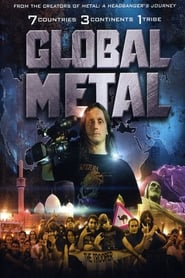
Global Metal
Download English Subtitle
Release info
Tags
English subtitle preview
The first 185 lines.
This is Wacken Open Air,
the biggest gathering of metal heads in the world.
Each year, over 60,000 devoted fans
come to camp out in the fields of northern Germany
to worship their favourite metal bands.
And whether you've come to see death metal,
power metal,
black metal,
goth metal,
or even viking metal,
if you're a diehard metal fan,
this is the place to be.
This is me.
My name is Sam Dunn
and, as you can see,
I'm one of the diehard metal fans.
Ever since I was 12-years-old,
I've been obsessed with all things metal.
And although my parents hoped it was a phase,
it wasn't.
I grew up,
got my graduate degree in anthropology,
and then decided to make a documentary
about heavy metal culture.
In the film, I traced the music back
to its working class roots
in the factory towns of England and America.
I then showed how early metal bands
like Black Sabbath, Deep Purple and Blue Cheer
laid the foundation for a crazy number of metal sub-genres.
Along the way,
I met some of my childhood heroes
and spoke to a ton of musicians
about the controversy surrounding this music.
Satan.
I also heard from hundreds of metal fans
about what this music means to them.
From the time I was 12-years-old,
metal was just a constant.
And what I discovered is this underground movement
is even bigger than I first thought.
And for metal heads,
it's about more than just music -
it's an identity.
After the film was released,
I got a flood of emails from metal fans
thanking me for giving this community
the respect it deserves.
But what surprised me was how many different countries
the emails came from.
Many were from places
I had no idea metal even existed.
I mean, I knew there was metal outside of Europe
and north America -
one of my favourite bands is Sepultura from Brazil
and I also have metal albums recorded live in Japan -
but the stories in these emails got me thinking.
For years anthropologists have studied the effects
of globalization,
but I've never considered heavy metal's role
in this process.
As metal has spread across the globe,
what new meanings is it taking on
for fans in countries
with such vastly different cultural,
political and religious backgrounds?
Clearly, there's a whole world of metal out there
I know nothing about.
But I'm not gonna find answers
in the fields of northern Germany.
So I'm taking my anthropology studies on the road
to understand how metal has gone global.
Yeah!
The first stop on my journey is Brazil,
the largest country in Latin America,
and a place most people associate with beaches,
soccer and samba,
but if you ask any metal fan,
they'll tell you that it's also known
for its massive metal scene.
So what happened to make metal so huge in this country?
The people in the '70s lived under a dictatorship in Brazil.
We had this dictatorship for almost 25 years.
During this dictatorship there was not a lot of freedom and it wasn't easy to access information.
And on that period when we were teenagers,
it was very hard to find good instruments.
The market was very closed
for everything that comes from abroad.
The Brazilian dictatorship ended in 1985.
At that moment the bands were starting to release their first albums of Brazilian heavy metal.
And what that means is that heavy metal came along with democracy.
I think the organizers of "Rock in Rio"
felt the momentum
and they organized this festival,
which was huge.
There were 1,380,000 people during 10 days,
and it was the first time, you know,
everyone knew what a metal head was
and that there were so many.
It may seem funny to you today, wanting to see Whitesnake.
It's a little ridiculous, but seeing Whitesnake, Ozzy Osbourne, Scorpions and Iron Maiden...
...was overwhelming for a Brazilian in 1985.
I wouldn't say that metal came to free us,
but I say that it was something that we were begging for.
We were begging to have
that atmosphere of freedom of speech,
freedom of communication.
Hey! Hey!
Two minutes to midnight!
Let me see your hands in the air!
Come on!
Hey!
We had to fly in by helicopter,
because to get there
all the roads were kind of blocked and stuff.
And so, as we got-
as you get in closer and closer,
you know, you could kind of see,
you know, you saw this kind of...
It looked like smoke coming up in the air,
you know, and what it was,
it was actually the steam rising off-
bodies.
The bodies, off the crowd.
They were all in sync, all having a great time.
You would see a multitude of people lose themselves.
It seemed like we were part of something bigger than us.
We felt like we were part of a big family...
...of a religion.
And people started to imagine that this could be the music,
...and the soundtrack of the moment that Brazil became a new and free country.
Everybody sing it! Go!
So here we are.
We're in Sao Paulo, in Brazil.
We're at the Grandes Gallerias,
otherwise known as the Galleria du Rock.
And uh...
I guess you know metal's huge in a country
when there's a whole mall devoted to it.
I first heard Sepultura
when I must have been around...
13 or 14-years-old.
It was hard to believe that there was metal
actually coming out of Brazil.
It seemed like it was coming from so far away,
from a place that was really so different.
Sepultura's founder, Max Cavalera,
is one of my all-time metal heroes,
and finally I get the chance to ask him
what it was like starting out
as an extreme metal band in Brazil.
Well, everything was a struggle actually.
From... From our own struggle -
we didn't know how to play,
but we wanted to have a band.
Then we didn't have money,
but we really wanted to be in a band.
The money was never a problem, you know.
You go around somehow.
You figure out.
Even how we looked we find ways.
When we saw the destruction album covers,
they had bullet belts.
So like we had to look like those guys, man.
You know, it was like,
"we look like shit. We look stupid.
We need bullet belts."
I think Igor came up with with the idea -
"well, let's get a bunch of double-a batteries,
glue them together, take the picture from far.
They will look like bullet belts."
And I was like, "you must be nuts.
It's not gonna work."
And like, "yeah, it'll work."
So he worked on those batteries for like a couple days.
And they looked perfect, they looked great.
And I was like, "man, cool.
Now we've got bullet belts.
You know, what's next?" You know?
Mass hypnosis!
It was crazy, man.
The Brazilian crowd just went nuts
from the first note...
You know, the entire stadium went crazy, mosh pit.
My head's going a thousand miles an hour.
Global Metal subtitles in other languages
More English subtitles for Global Metal
- GlobalMetal(2008) · 45 downloads · 2023-12-26
- GlobalMetal(2008) · 54 downloads · 2023-12-26
- GlobalMetal(2008) · 50 downloads · 2023-12-26
- Global Metal 2008 720p BluRay DD5 1 x264 FORCED · 39 downloads · 2016-11-09
- Global Metal · 42 downloads · 2012-03-27
Comments
No comments yet. Be the first to leave one.