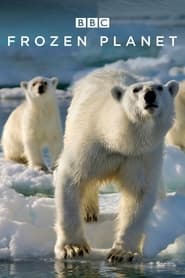
Frozen Planet
Download English Subtitle
Release info
Tags
English subtitle preview
The first 200 lines.
Summer in the polar regions, and the sun never sets.
Imagine a single day that lasts for months.
Some polar animals will face great challenges
as their ice world vanishes around them.
Others must use this special time wisely,
for summer's riches will not last.
The summer is just beginning
and the increasing power of the sun
is creating a spectacular new landscape.
This melting ice sheet in the Arctic is 150 miles long,
with 1,000 waterfalls.
Vast expanses of ice
that were once stone still, have come to life.
The polar bear's world is melting away
under the constant summer sun.
As the season advances, the frozen surface of the ocean disintegrates.
Soon, the ice here will have totally vanished.
The polar bear family have to adapt to their rapidly-changing home.
For the two cubs, this is a whole new watery world.
It's the first time they have seen the sea ice break up.
They're only six months old
and will be dependent on their mother for another two years.
They have much to learn.
Their first swimming lesson,
and they're not sure that they want it.
For their mother, swimming is second nature.
But the cubs still prefer to have ice beneath their feet
whenever they can.
Soon, it will be impossible to avoid the water.
This lone male has lived through a dozen summers
and is perfectly at home in the sea.
He can swim up to 50 miles a day.
He's hungry, and he's searching this ice maze for seals.
But travelling across this increasingly fragile ice scape
is hard work for an animal weighing over half a tonne.
It's also harder to hunt when you have to swim.
In open water, the odds are in the seals' favour.
Lean months lie ahead for the polar bears.
They will have to adopt new hunting strategies,
or risk starvation.
The northern part of the Earth is now tilting towards the sun,
and all around the Arctic, the sea ice continues its retreat.
The last remnants of the ice world
drift with the wind and the tides.
The sun's heat may be gentle at these latitudes,
but it is continuous for 24 hours a day,
and it carves the ice into magical shapes.
Those that need ice have to visit the glacier fronts to find it.
A comfortable bed is hard to come by.
A polar bear's fur is so dense
that water is easily shaken off.
And ice absorbs water like a towel.
That's better.
There's now little chance of catching seals,
and this bear may not eat again until the end of summer.
It's better to save energy and doze in the sun.
The warmth of the sun's rays
is now bringing the Arctic lands back to life.
FAINT BIRDSONG
TWITTERING
BIRDSONG
Red phalaropes.
They've flown all the way from the tropics
to feed in these rich Arctic waters.
They stir up the tiny creatures
that are now flourishing here with a special spinning dance.
All excellent fuel as they hurry to rear the next generation.
The Arctic terns have made an even longer journey to breed here.
They have flown 11,000 miles from the Antarctic.
Their newly-hatched chicks will need to grow fast
if they're to accompany their parents
when they return south in only six weeks' time.
An eider duck has chosen to nest in the centre of the tern colony.
Hardly a tranquil place to raise your young.
But the noisy neighbours have a feisty attitude to life,
and that can be very valuable.
SQUAWKING
A hungry bear looking for a meal
can destroy hundreds of nests
in a single raid.
Defensive squadrons of terns
take off immediately.
Sharp beaks stab down from above.
The bear has nothing in his armoury that can cope with this.
The terns have drawn blood from his muzzle.
He leaves in search
of an easier meal.
The eiders survive, thanks to their choice of neighbours.
And the ducklings begin their sprint to maturity.
Fishing continues around the clock
as the terns race to rear their young
before the return of the freeze.
So the rich waters of summer fuel the breeding of all these visitors
and enable them to build up the reserves they will need
for the long return journey south.
Inland, the winter snows have gone,
revealing a vast treeless wilderness.
The male snowy owl is finding plenty of lemmings
to bring to his mate.
But they're not just for her.
She is brooding their rather scruffy young.
She tears the meal into beak-sized chunks
that the owlets can swallow whole.
Each of them can eat two lemmings a day.
The male has no time to rest.
Over the course of the summer, he will have to provide his family
with over 1,000 lemmings.
The hungry owlets keep the adults working around the clock.
The Arctic summer may be short, but the days are long.
Everyone must take advantage of the 24-hour daylight.
None more so than the owls' tiny neighbours, the Lapland buntings.
SQUAWKING
Both parents feed their growing family continuously.
A mere ten days after hatching,
and they will all have left in record time.
The last needs a little encouragement.
The owlets have also left their nest
and turned into football-sized balls of fluff.
But they still depend on their parents for food and protection.
A skua.
Their mother's talons are her best weapons.
The owlets are dangerously exposed out on the tundra,
so they must hurry to change from balls of fluff
to fully-feathered adults.
And to do that, they need... more lemmings.
A lemming doesn't last long these days.
Times are harder for the wolves here in the high Arctic.
The cubs are now six weeks old and increasingly hungry.
The adults have to struggle to feed their growing family.
Somewhere on this vast expanse of tundra,
there must be larger prey.
Musk oxen are on the move.
They're heading into the valleys,
where the brief summer rains will produce fresh grazing.
This is an opportunity that must be seized,
even if it means travelling 80 miles in a day.
Their task is a formidable one.
Musk oxen are immensely powerful
and their sharp horns can kill.
A heavily-armoured bull would be an unwise choice.
Even two wolves would find it a struggle to bring it down.
A calf.
Much easier.
The two wolves work together
to split the herd and isolate their victim.
It seems that the wolf cubs will at last eat well.
But the herd regroups.
The cavalry ride to the rescue.
The whole herd encircles the calf with a protective wall of horns.
For the musk oxen, it's all for one and one for all.
For the wolves, another attack
would be not only futile, but dangerous.
They have spent a lot of energy
and have nothing whatever to show for it.
FORLORN HOWL
Their failure will be felt most keenly back at the den.
HOWLING
They have nothing to take back to the family.
HOWLING
The pack are forced to move on in search of better hunting.
They must find something soon
in this vast wilderness
to feed their growing family.
The brief Arctic summer is almost over.
FAINT SQUAWKING
At the southern end of the planet,
the long summer days transform life,
just as they do in the north, but the cast here is very different.
King penguins.
A parent, returning with food, must recognise its chick's call
amongst a chorus of 400,000 birds.
Huge colonies like this one
are found all along the north coast of South Georgia.
King penguins are active throughout the long summer days,
so they have to deal with an uncharacteristic polar problem.
By midday, the temperature can reach
a sizzling 17 degrees centigrade.
Any effort can lead to overheating.
It's best not to overexert oneself.
The heavily-insulated penguins stretch out
so their naked feet can cool in the breeze.
Their gigantic neighbours use a different approach.
Wet sand cools the backs of these elephant seals,
and also acts as a sunscreen.
The chicks, in their downy coats that have kept them warm all winter,
are in even greater danger of overheating.
It will be two months before they can swim properly,
but a dip in a shallow river brings a little relief.
There is, however, another way to cool the blood.
This murky pool has become a penguin spa.
It's a great way to cool the feet,
but there is no reason to stop there.
You can indulge yourself with the full treatment.
Mud, glorious mud!
For the fully-feathered adults,
there's a cleaner, more invigorating option.
The bracing waters of the Southern Ocean.
The 100-mile-long island of South Georgia
lies on the northern fringe of Antarctica.
Ice-free all year, its rich coastal waters
Frozen Planet subtitles in other languages
More English subtitles for Frozen Planet
- BBC: Frozen Planet - Complete Series (2011) · 136 downloads · 2018-07-16
- 07 On Thin Ice 720p HDTV MP4 · 83 downloads · 2014-03-17
- Frozen Planet -Complete Series-720p HDTV x264 YIFY-350mb-Eng · 133 downloads · 2013-07-23
- Frozen Planet 2011 720p BluRay x264-RO4EVA · 167 downloads · 2012-05-09
- BBCFrozen Planet EP01 To The Ends Of The Earth 2011 720p BluRay AC3 x264-HDxT En · 248 downloads · 2012-03-07
- BBC Frozen Planet 2011 1080p BluRay DTS x264 D-Z0N3 · 173 downloads · 2012-01-21
- BBC Frozen Planet E08 The Epic Journey · 81 downloads · 2011-12-30
- frozen planet ep7 Resync for vsenc release · 89 downloads · 2011-12-16
Comments
No comments yet. Be the first to leave one.