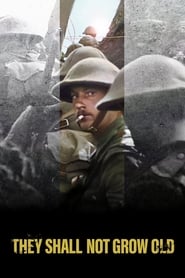
They Shall Not Grow Old
Download English Subtitle
Release info
Tags
English subtitle preview
The first 200 lines.
I gave every part of my youth to do a job
and to go through a savage war.
It was a different war from year to year
and one's reactions were completely different.
The intensity changed so much that anybody who'd been out in 1914
and went home, then came back in 1917, wouldn't recognise it as the same war.
I could only say one thing: I wouldn't have missed it.
It was terrible at times, but I wouldn't have missed it.
Oh, yes, if I could have my time again,
I'd go through it all over again because I enjoyed the service life.
I could only say that I have never been so excited in my life.
This was like a boy going to the play for the first time.
I never realised there was anything unusual about it.
There was a job to be done and you just got on and did it.
We were all instilled with that idea
that this was war and that we'd got to kill the Germans
and this was how we looked at the thing.
I don't regret having experienced it.
I wish I hadn't, but I don't regret it, because I'm safe.
There were good times and bad times in France,
but you took the rough with the smooth.
I was twice wounded and gassed, but it just didn't worry me.
I just made the best of it.
Just took it in its stride, like everybody else.
We were glad to be in it and we expected it to be rough,
and it was rough, but we didn't complain.
There was no real excitement about it.
You'd seen death so many times, you'd seen wounded so many times,
blood didn't excite you.
We were professionals and, to us, it was just a job of work.
It would be a fallacy to say that one enjoyed it,
but one got afterwards a nice, warm inner feeling
that one had been of some use.
It didn't affect me very much,
because I wasn't sufficiently up in the ways of the world.
I was only a kid, like other blokes there.
It was more like a great big game to be enjoyed,
apart from the actual shelling and all that sort of thing.
It made me a man, yes, it did.
I don't think I should have ever been the man I am
if it hadn't been for having to serve.
You'd learn to look after yourself
whereas, in your civilian life, your mother did all the chores.
You've got to learn how to cook for yourself, darn your own socks,
sew on your own buttons and all the things like that.
It was just a day's work.
I knew that I was not alone.
I knew that I wasn't fighting the war by myself
and that what happened to other people might happen to me.
I had no regrets at all but, you see, I had no wife, no girl, no nothing.
No regrets and no horrors...
because, if you survive that, you can survive anything.
We were aware there was sort of a nasty feeling between England and Germany,
as we knew of the Kaiser's ambition to expand his empire
and all that sort of thing.
During that summer,
there was a lot of talk about trouble going on in the Balkans,
but we were a long way from the Balkans and it didn't worry us at all.
It was that Serbia business, wasn't it? Serbia, when that chap was shot.
I was paying attention to politics
and I realised there was going to be trouble between England and Germany.
Well, it was a lovely August 4th morning.
We were all seated round the table
and we were starting the rugby football dinner with the German team.
There was a German here and next to him was an Englishman,
and next to him was a German, and so on and so on.
And a runner arrived into the middle of this dinner
with extraordinary news of outbreak of war.
There was a big placard: "War declared on Germany."
We didn't know what we ought to do,
whether we ought to seize a knife off the table
and plunge it into the German or what, but after a little bit of discussion
we decided that, as far as we were concerned,
the war was going to start tomorrow, and the party proceeded.
I'm proud of being a Britisher.
I mean, I think we're as good a country as any in the world
and you've got to be prepared to fight for that.
There's no doubt about it, in the First World War,
we prepared for war.
The Empire was strong. We weren't afraid of anyone.
Everybody bought little buttons and waved flags and sang songs.
There was no feeling of despair about it at all.
England couldn't possibly lose,
no matter how many Germans pushed how many Englishmen into the Channel,
they'd get no further.
We couldn't possible lose.
We were brought up to think that one Englishman's worth ten Germans.
I thought that any enemy of England
was an enemy of mine and I wanted to be in it.
Oh, six months or twelve months and it'd be all over and Bob's your uncle.
I went with a friend of mine into Shepherd's Bush Empire
to see the picture show there and they showed the fleet sailing the high seas
and played, "Britons never shall be slaves."
One feels that little shiver run up their back
and you know you've got to do something.
A friend of mine said to me, "We're going to join up."
It was from the patriotic point of view
and from the general excitement of the whole affair, I suppose.
I didn't believe in war to that extent,
but I was prepared to do my part.
You see, in those days, men weren't to think for themselves.
They just had to do what they were told and that's all there was to it.
Oh, my mother was very aggrieved about it
but, you know, a young man, you decide you're going to go.
At lunch time, I left the office, went along to Armoury House
and there was a queue of about a thousand people trying to enlist.
Everybody thought that it would be a civilised war
and wanted to be fit enough to go.
Two of us decided to join up together and when we told the boss
we were going to start training on Monday, he was very annoyed.
He didn't make any promise that our jobs would be there when we got back.
My mother, she said, "You wait until you're nineteen."
See, that was the age in those days, nineteen to thirty-five. Well, it was supposed to be.
We were all lads together, you know,
full of excitement and all this kind of thing.
I mean, I just wanted to have a go at Jerry.
I just thought that I'd like to go and fight for the country.
You were proud of your country and you'd do the best you could for it
and this was what most of the young people thought of doing in those days.
My mother, she said to me,
"Look, we could stop you doing this because of your age."
I said, "Yes, I know you could, Mother, but I'm sure you won't,"
which they never did.
I just felt that all the young fellas of that age were volunteering
and I thought it was my job to do the same.
I was desperately keen.
A whole heap of us went. I said, "Direct enlistment, please."
They were highly delighted and pushed me in as quick as lightning.
Lots of the lads were joining the local regiments,
like the Bucks and the Middlesex.
Lads that I knew and been to school with,
played football and cricket with, we joined up, hoping for the best.
We were good friends, comrades
and it was a relief from rather boring jobs at home, you see.
I was walking down the Camden town High Street
when two young ladies approached me.
"Why aren't you in the army?" I said, "I'm only seventeen."
"Oh, they all say that here."
And to my amazement, she put her hand in her bag
and I put my hand up to sort of safeguard myself
when this white feather finished up my nose.
As we marched to the station, some of the chaps had bowler hats,
some had straw hats, some had the regulation peaked army cap.
Some would have tunics, some would be dressed with their ordinary jackets
with a pair of army trousers.
Some had army boots, some didn't, and we really were a motley throng.
Some of them were obviously chaps who had hoped to live in some comfort
and brought suitcases with clothes with them which they never saw again.
We had to all get our hair cut. "How would you like it, sir?"
And you'd say, "Short back and sides,"
but the answer was straight over the top with horse clippers
and we looked more like convicts than soldiers.
As soon as war broke out, there was a call made for all ex-soldiers to rejoin
and they made em sergeants straightaway,
so you got a lot of instructors that way.
The people who really carried us through
was the old sweats who'd had previous war experience
and gave us a lot of wise advise as to what to look for and what to dodge.
We were ordered down onto the parade ground
and then we were allotted to different platoons.
When they came to us, they were weedy, sallow, skinny, frightened children.
The refuse of our industrial system
and they were in very poor condition and had to be made into soldiers.
Many of us had given our wrong ages to join the army.
The adjutant walked down the lines and gave an order,
"Every man under the age of nineteen to take two paces forward."
Nobody moved.
I was a lad of seventeen, and they'd probably see I wasn't nineteen,
which you had to be to join up,
but they says, "How long do you want to sign on for?"
Everybody else was joining up, so I went into the recruiting office.
He said to me, "How old are you?" I said, "Seventeen, sir."
"Well," he says, "Go outside and come back and say you're eighteen."
So, of course, I went outside and said I were eighteen.
Then straight o'er the sea for Flanders.
The sergeant said, "How old are you?" I said, "I'm eighteen and one month."
He said, "Do you mean nineteen and one month?" So I thought a moment.
I said, "Yes, sir." He said, "Right, sign here, please."
He asked me how old I was and I said I was sixteen in March.
"Oh." he said, "You're too young. You'd better go outside and have a birthday.“
I was sixteen years old in 1917, and I was six-foot-two tall
and my father allowed me to go.
So I entered my age as nineteen years old,
three years older than what I really was.
I was fifteen years, just two and a half years short of eighteen,
and I got before this medical officer who said, "All right, you pass."
I was just turned seventeen at the time
and I went up to Whitehall and enlisted in the 16th Lancers.
I was fifteen and I thought I'd have a better chance than when I were fourteen,
so I walked into the barracks and just said, "I'm eighteen," and that was it.
My parents wrote to the commanding officer
and asked for me, as I was underage, to be released.
He said, "Your parents want you back. Do you want to go?"
I said, "No."
The chaplain asked me my age and I said I was sixteen.
He said, "Much too young.
Would you like me to pray for you?"
The clothing came piecemeal into the quartermaster's stores.
One lad said, "These boots don't fit me."
The quartermaster said, "There isn't such a thing as boots that don't fit,
They Shall Not Grow Old subtitles in other languages
More English subtitles for They Shall Not Grow Old
- They Shall Not Grow Old 2018 720p BRRip x264 MkvCage · 180 downloads · 2020-10-04
- They Shall Not Grow Old (2018) [BluRay] [720p] [YTS AM] · 234 downloads · 2020-08-13
- They Shall Not Grow Old 2018 1080p BluRay x265-FGT · 217 downloads · 2020-08-10
- They Shall Not Grow Old [All blu-rays] · 188 downloads · 2019-05-31
- They Shall Not Grow Old [All blu-rays] · 164 downloads · 2019-05-31
- they shall not grow old 2018 limited 1080p bluray x264-cadaver-en · 263 downloads · 2018-12-21
- They Shall Not Grow Old 2018 LiMiTED 720p BluRay x264-CADAVER · 195 downloads · 2018-12-16
- they shall not grow old 2018 limited bdrip x264-cadaver · 166 downloads · 2018-12-16
Comments
No comments yet. Be the first to leave one.