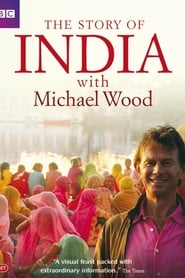
The Story of India
Download English Subtitle
Download English Subtitle Files for Mobile (6)
English subtitle preview
The first 200 lines.
Sixty years ago, India threw off the chains of the British Empire
and became a free nation.
And now, the world's largest democracy is rushing headlong into the future.
As the brief heyday of the West draws to a close,
one of the greatest players in history is rising again.
India has seen the ebb and flow of huge events
since the beginning of history.
Its tale is one of incredible drama and the biggest ideas.
It's a place whose children will grow up in a global superpower,
and yet still know what it means to belong to an ancient civilisation.
This is the story of a land where all human pasts are still alive,
a 10,000 year epic that continues today.
The story of India.
In the tale of life on Earth, the human story is brief.
A few hundred generations cover humanity's attempts to create order,
beauty and happiness on the face of the Earth.
The beginnings to most of us are lost in time, beyond memory.
Only India has preserved the unbroken thread of the human story
that binds us all.
According to the oldest Indian myths,
the first humans came from a golden egg laid by the king of the gods
in the churning of the cosmic ocean.
Modern science, of course, works in a less poetic vein,
but no less thrilling to the imagination.
For what science tells us is that our ancestors first walked out of Africa
only 70 or 80,000 years ago,
round the shores of the Arabian Sea and down into South India.
They were beachcombers, barefoot hunter-gatherers,
driven as human beings always have been
by chance and necessity, but also surely by curiosity,
that most human of qualities.
And when they came here to India,
they must have been overwhelmed by the fertility.
Here, down south, you throw a mango away and a tree will grow.
Life is superabundant.
So here, some of them stayed, and they were the first Indians.
And all non-Africans on the planet can trace their descent
from those early migrations into India.
The rest of world was populated from here.
Mother India indeed.
And amazingly for so long ago,
those first Indians have left their trail.
If you go inland from the beaches of Kerala
into the maze of backwaters, deep in the rainforests,
you'll still find their traces.
Clues to what lies beneath all the later layers of Indian history,
clues that, till recently, were completely unsuspected.
For here, you can even hear their voices,
sounds from the beginning of human time.
An ancient clan of Brahmins lives here, priests, ritual specialists.
They alone can perform the religious rituals.
They're preparing an ancient ceremony for the god of fire
that will take 12 days to perform.
For centuries, these incantations, or mantras, have been passed down
from father to son, only among Brahmins,
exact in every sound.
But some of the mantras are in no known language.
Only recently have outsiders been allowed to record them
and to try to make sense of the Brahmins' chants.
To their amazement,
they discovered whole tracts of the ritual were sounds
that followed rules and patterns but had no meaning.
There was no parallel for these patterns within any human activity,
not even music.
The nearest analogue came from the animal kingdom.
It was birdsong.
These sounds are perhaps tens of thousands of years old,
passed down from before human speech.
There are certain patterns of sounds preceding and succeeding texts.
That is what is called oral tradition.
You can't write those patterns in book. It's unprintable.
So only orally it can be transmitted through generations,
and this oral tradition is still alive in Kerala.
For 12 days, the priests and their wives
must stay inside the enclosure.
Then, when the ritual is over and the world purified,
the huts are burned down, all trace obliterated,
save in the memory of the Brahmin reciters.
So there's a crucial clue to the story of India,
how the experience of the ancestors is faithfully handed down
from generation to generation.
But it's not just sounds and rituals that have been passed on.
Over the hills in Tamil Nadu,
geneticists from the University of Madurai
have been testing the DNA of tribal villagers.
First we isolate the DNA from the solution,
and we look for specific markers in the solution,
ancient markers, which can give you the clue
about the migrational history of the people.
It's a direct evidence that we are out of Africa
and it's all a brotherly hood. We are all the same.
Here among the Kallar people,
Professor Ramasamy Pitchappan recently tested a man called Virumandi.
In his DNA was the marker of that first human migration.
Virumandi's wife.
Very nice to meet you.
Since the migration of the first man 70,000 years ago,
and which Virumandi, he probably carries that gene, M130, right?
Right, great.
So, Virumandi, how does it feel to be the first Indian?
Yeah, yeah.
I am very happy for this...
That you have this gene. - Gene, yes.
Wonderful.
Virumandi's tribe practise South India's and the world's oldest form of marriage,
with first cousins.
That way, they've handed down some of mankind's earliest genes.
Some 50 to 60,000 years ago,
this M130 gene pool came over here
and, luckily, somebody stayed in this village and expanded,
then we could identify.
You know, to our surprise, you know, that the whole village is of M130.
Everybody around us here?
Everybody around us here carries M130,
so you call it as a ponder fact, what will be that.
You've got the early migrations in at least two waves,
language is only developing later?
Yes, the scholars feel
that it is only just 10,000 years old, the spoken language.
Wow.
Maybe only 10 to 15,000 maximum.
Language is not the same as ethnicity. We need to make that clear, don't we?
Yes, it is absolutely essential. Yes, it is not.
The language can easily be adopted.
But the same is true with the religion, too.
- Ah. - It's a kind of belief system.
You believe in your system, in your education,
or in your capacity, or in your family, whatever way you feel like.
You have every liberty to feel proud of what you are.
This is because of this reason, I believe that India has become
such a cosmos of humanity with the diversity,
but still with a unity.
Is that what makes you an Indian, then?
Yeah, probably, yes. A human being all the more, I would say,
rather than Indian.
And despite all the later migrations and invasions,
India's gene pool has remained largely constant.
It's one of the unchanging roots of India.
Languages and religions came only later, and they are always subject to change.
But here in the south,
they've passed down humanity's oldest religion, too.
In the great temple of Madurai, they still worship the female principal,
the Mother Goddess,
as Indian people have done for tens of thousands of years.
And alongside her are countless other deities
that link humanity with the magical power of the natural world.
Over the ages, thousands of gods will emerge,
always adding to what had been before.
So the roots of Indian religion, too, will grow over a vast period of time
as India's expression of the multiplicity of the universe.
Why have only one god when you can have millions?
So, India's famous unity and diversity
goes back to customs and beliefs and habits that lie deep in prehistory,
like the worship of the goddess here in Madurai.
And when you look at all the tides of Indian history that follow,
you can see that identity is never static,
always in the making and never made.
Now we must rush over tens of thousands of years
in which humanity lived as hunter-gatherers.
And then in the Stone Age,
in a great arc from Mediterranean to India,
changes in technology led to the invention of agriculture.
And that would be the motor for the next turning point in the story of India,
the rise of cities.
In the year 2007,
for the first time in history, most of us will live in cities
rather than in the countryside.
Here in the Indian subcontinent,
that process of civilisation began in 7000 BC,
even earlier than Ancient Egypt,
with the growth of large villages in the Indus Valley.
So, despite the divisions made by modern borders,
nowhere else on Earth is there such continuity of settled life.
Hello.
Though, of course, when we talk about India in history,
we mean the whole of the subcontinent,
before modern politics divided up that deep continuum
and gave the people new identities and new allegiances.
So, Multan is your native place? Multan, your native place?
Ah, yes. - Ah, yes.
- Very nice. - What work you doing?
Making historical film for BBC London.
These days, "civilisation" is a very problematical word,
with many shades of meaning,
but to historians and archaeologists, it means living in cities,
large-scale, highly organised societies, monumental architecture,
law and writing.
And to find the origins of Indian civilisation,
we need to come first of all to Pakistan,
once part of India, but split to become a separate country in 1947.
Because it was here in the valley of the Indus River,
comparatively recently, in a series of amazing discoveries,
revealed a hitherto completely unknown ancient civilisation.
Those first discoveries took place in the 1920s
at a little halt on the railway line between Multan and Lahore,
Harappa.
At that time, the Indian subcontinent was under British rule.
And then, the idea that the people of what is now Pakistan and India
might be heirs to ancient civilisation far older than the Bible,
Greece and Rome, would have seemed incredible.
The Story of India subtitles in other languages
More English subtitles for The Story of India
- The Story of India S01 1080i Blu-ray Remux DTS-HD MA 5 1 AVC-TrollHD · 42 downloads · 2019-01-20
- BBC The Story of India - Extras · 33 downloads · 2017-05-24
- BBC The Story of India 6 of 6 - Freedom · 36 downloads · 2017-05-24
- BBC The Story of India 1 of 6 - Beginnings · 34 downloads · 2017-05-21
- BBC The Story of India 1of6 Beginnings · 44 downloads · 2017-04-07
- BBC The Story of India · 41 downloads · 2009-02-03
Comments
No comments yet. Be the first to leave one.