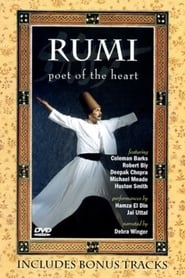
Rumi: Poet of the Heart
Download English Subtitle
English subtitle preview
The first 200 lines.
In the town of Konya, in central Turkey...
in the middle of the 13th century...
a prominent religious scholar named Jalal ad-Din Rumi...
was suddenly separated from his teacher and spiritual friend.
In his grief he took hold of a column and began turning.
Verses of poetry began pouring out of him.
Remarkable poetry.
His students wrote the words down.
700 years later, Rumi's poetry is being discovered in the west.
He is in fact the best selling poet in America.
RUMI, POET OF THE HEART
"Come to the orchard in Spring."
"There is light and wine, and sweethearts in the pomegranate flowers."
"If you do not come, these do not matter."
"If you do come, these do not matter."
RUMI
Rumi was born September 30th, 1207 near Balkh, Afghanistan...
which was then part of the Persian Empire.
When Rumi was still a child...
his family was forced to flee the oncoming armies of Genghis Khan.
After years of travel, they settled in Konya Turkey...
an important stop on the silk road and a meeting point of many cultures.
Islamic, Judeo/Christian, Hindu and Buddhist.
Rumi's father became the head of a Sufi learning community.
The Sufis are an ancient spiritual order.
And according to many Sufis...
the essential truths of Sufism exist in all religions.
The Sufis are a remarkable band...
in the history of religion.
They are the mystics of Islam.
And as the mystics of Islam, the Sufis...
we can connect with because, they're talking about these...
wonderful, sublime truths...
which have a way of piercing...
directly into the human heart, wherever it is.
The Sufi's used to walk, you know, down several roads...
visiting with the Christians, visiting with Islam...
visiting in all of the great religions, really.
I mean that's part of the nature of this kind of fluid imagination.
It crosses boundaries. It penetrates and it even slips by.
It works by way of humor, it works by way of stunning imagery.
It works in many different ways. As if to...
keep bringing people to some deep, human well.
Upon his father's death...
Rumi became the head of the learning community.
His life seems to have been a fairly normal one for a religious scholar...
Teaching, meditating, helping the poor.
Until the late fall of 1244 when he met the stranger.
A wandering dervish, Shams of Tabriz.
Rumi's genius was triggered...
by an actual human being.
An encounter with this mysterious figure, Shams of Tabriz.
He was an intense fierce mountain meditator.
Those kind of people. Like Thoreau magnified five times.
The connection between Shams and Rumi is...
one of the great stories of... learning.
And what we nowadays call mentoring.
But it's almost of an order beyond what people mean...
when they mean to learn from someone.
Because it means to almost, what seemed to happen was a sudden, knowing...
One can see here in Shams an older man...
who is outside the orthodox spiritual community.
Who comes in and helps a younger man who is...
deeply embedded in that orthodox spiritual community.
And then there's a kind of explosion.
What Rumi says, is that he was raw...
then he got cooked, and then he was burned.
And that means when his heart...
melted through his love for Shams, that...
his new experience enabled him...
to understand what he was talking about before.
And he took Rumi's book knowledge and says...
he said now you have to live what you've been reading about.
Pushed all his books into the fountain. That's one story of how they met.
And Rumi and he went off into this practice called conversation, "sobhet"
Which they disappeared evidently for weeks at a time.
In this conversation between the personal and the deep self.
This is the poem "I'm Not Saying This Right"
Which of course might mean that I might not say the poem right.
So, I'm not saying this right.
"You bind me, and I tear away in a rage..."
"to open out into air, a round brightness, a candle point..."
"all reason, all love."
"This confusing joy, is your doing, this hangover, your tender thorn."
"You turn to look, I turn. I'm not saying this right."
"I am a jailed crazy who ties up spirit-women. No, I'm Solomon."
"What goes come back. What goes comes back. Come back."
"We never left each other."
A disbeliever hides all disbelief, but I will say his secret now.
"More and more awake, getting up at night..."
"spinning and falling in love with Shams, falling with love for Shams."
"spinning and spinning, falling in love with Shams..."
"falling with love for Shams, falling, with love for shams."
And so Rumi became a poet then, became a real poet.
Became infused. The whole spirit came into him.
And um...
so it's one of the great love affairs, of the world.
The one between Shams and Rumi.
And they loved each other, not sexually but they loved each other in the heart.
Why does it impress people so much? Because it's a love...
that is beyond gender, beyond age, beyond sex, beyond species.
It is the essence of love.
The two oceans met each other.
And the force of love of god.
Because the earth has many oceans. All the time they meet, and...
once happened two will meet...
in the land of Konya, Turkey, 700 years ago.
"When you feel your lips becoming infinite and sweet..."
"like a moon in a sky..."
"when you feel that spaciousness inside..."
"Shams of Tabriz will be there too."
"Something opens our wings."
"Something makes boredom and hurt disappear."
"Someone fills the cup in front of us..."
"We taste only sacredness."
The relationship between Rumi and Shams...
is actually a reminder to us that all relationships...
have that potential and that when we fall in love...
then we actually are entering a spiritual domain of awareness.
Romantic lovers are confused. That's a very spiritual state to be confused.
Rumi says himself, he says...
"label me and define me"...
"and you starve yourself of yourself."
"Nail me down in a box with cold words"...
"and that box will be your coffin."
"Because I don't know who I am. I'm an astounding, lucid, confusion."
That's the state of love.
There was a lot of jealousy among Rumi's students, over this.
Jealousy is one of the main...
impulses in the human race, you know.
So no one knows exactly the truth, but...
some feel that what happens is that the students killed Shams and hid the body.
Rumi then went out in the backyard and there's a pole there.
And in his grief he kept going round and round and round the pole.
And this is the beginning of the Whirling Dervishes.
And it was done out of grief which is terrifically interesting.
That's how all that great poetry started was in grief.
The thing that we avoid the most.
And in that time he would begin to speak the lines, speak them out...
they'd all appear in rhyme and meter, perfectly done.
And then...
When he came out the students would say, oh my God, that's tremendous.
Write that down. No he said, let's keep dancing. Let's don't.
That's only words.
Rumi says everything is for the beloved.
Everything is for the friend.
And my understanding of that...
is that there is... a presence...
that we feel in the beauty that we see outside of us.
We feel it in a November sunset.
We feel it in a child sleeping, in a child dancing, playing soccer...
We feel it in a group of friends making supper on Sunday night.
He would say that feeling, is a presence.
That it's both outside of us, intending us, and inside us.
When we feel the jewel like quality of our own inner awareness.
That also is the friend. And this inner/outer presence...
is addressed directly in many of Rumi's poems.
When one says that wonderful pronoun "you" and you don't quite know who it is...
it's that presence.
"When it's cold and raining, he says, you are more beautiful."
"And the snow, brings me even closer to your lips."
"The inner secret, that which was never born..."
"you are that freshness, and I am with you now."
"I can't explain the goings or the comings..."
"you enter suddenly and I am nowhere again..."
"inside the majesty."
"I... you..."
"he... she..."
"we..."
"In the garden of mystical lovers..."
"these...
"are not true... distinctions."
"I... you..."
"he... she..."
"we"
I feel very grateful to Coleman Barks for having introduced me to a world...
that I knew existed, that I yearned for.
There was an agony of wishing in my heart.
but I didn't know how to find it.
I'd found it through other means, through other poets...
but never with the intensity and passion of Rumi. So...
I owe a great debt of gratitude to Coleman Barks.
for bringing me to that world.
We know Rumi through his poetry.
But in a sense that isn't his poetry...
because his poetry was in Persian, Farsi.
And we read him in English.
And the difficulties, the problems...
are also the mysterious connection that occurs...
but also a difference in translation is an abiding fester...
for all translators, but especially for poets.
First time I ever heard of Rumi was at one of Robert Bly's conferences in 1976.
When he handed me a book of scholarly translations...
by A.J Arberry and said these poems need to be released from their cages, you know.
And so I began rephrasing Arberry's English...
and in the course of that a sequence of coincidences happened...
and I met a Sufi teacher...
Abdullah Nujaladeen.
And he told me to do this work.
And if I had not sat in his presence for about 9 years on and off...
Comments
No comments yet. Be the first to leave one.