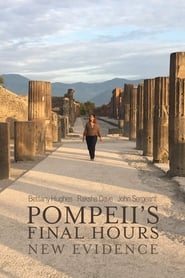
Pompeii's Final Hours: New Evidence
Download English Subtitle
Release info
Tags
English subtitle preview
The first 200 lines.
We're here in the great theatre of this remarkable ancient city
that was buried close on 2,000 years ago
by the cataclysmic eruption of Mount Vesuvius.
Now, we have extraordinary access right across the city
and we're going to be filming in places never seen before on TV.
What we'll be doing is taking you step-by-step
through what we think happened to bring life here to a dramatic end.
The destruction of Pompeii was far from instantaneous.
It played out over a horrific 24 hours.
That's the terrible irony of Pompeii -
how the city met its tragic end has preserved so much
for us to discover today.
We've seen how they went from their normal everyday life
through those first tremors
to the tell-tale signs of imminent disaster.
Tonight, we're taking you back to those terrible moments
that destroyed life here in Pompeii.
I'll be exploring Pompeii's secret corners,
uncovering clues to the population's final tragic moments.
We think that they were using those tools
to bash out this hole in the wall in a desperate attempt to escape.
I'll be discovering what natural horrors
the population faced in their final hours.
100,000 tonnes? Yes!
And I'll be following in the wake of a terrified eyewitness
to the disaster.
Pliny could see a giant plume of smoke
going right up into the sky raining down this debris
with thunderbolts flashing across the sky.
Join us as we count down on Pompeii's last 24 hours.
For two days, Vesuvius, a volcano that's lain dormant for 700 years,
has been reawakening.
Increasingly intense earth tremors
have been rocking the nearby town of Pompeii,
disrupting the water supply and prompting many to flee.
This is Mount Vesuvius.
But thousands remain
because people just don't realise
these are indications of an imminent eruption.
Do you think that they just carried on with their lives
thinking that it was just another earthquake?
Yes. Yes, of course.
But around 9am, that changes.
Pressure deep inside Vesuvius reaches critical levels.
A huge column of steam is ejected from the volcano.
The first eruption would have been frightening and confusing,
but it wasn't dangerous.
What's really interesting is
that the Roman writer Cassius Dio tells us that, at that time,
many of the people of Pompeii were sitting right here.
And you have to ask why?
I mean, it's pretty unlikely
that they'd come here to a theatrical performance.
Probably they were discussing what had been going on -
these worrying natural phenomena earlier in the day -
a kind of emergency town council meeting.
Until now, Pompeiians had no reason to fear Vesuvius.
They didn't realise the tree-covered mountain,
only five miles away,
was still an active volcano.
At the time, it would have looked more like this...
...standing 200 metres higher than it does today.
But around midday, the main eruption begins.
The mountain explodes
with far more energy than a nuclear bomb,
driving a vast column of volcanic debris far into the sky.
The shock wave blowing tiles, even some rooves off Pompeii's buildings.
We're told that people were here that morning.
It's the kind of obvious place to come to meet,
particularly if there's a trauma like that going on.
Oh, can you imagine when that thing blew,
there would have just been blind panic.
You just wanna get out.
It's so gha... I almost can't bear to think about it.
There'd have been a panic and a kind of crush,
as you say, as they tried to run out too.
Horrible, it's awful. It's just awful.
For the people of Pompeii,
this is the start of 18 terrible hours.
Raksha's headed up Vesuvius
to discover precisely what the volcano unleashed
on the unfortunate people of the town.
Hey, Giuseppe! Lovely to see you again.
I'm meeting up with volcanologist Giuseppe Mastrolorenzo.
33km?! Yes.
That's like 20 miles high. Yes.
100,000 tonnes of magma?! Yes.
The scale of the eruption is hard to take in.
Hundreds of thousands of tonnes of super-heated molten rock
was blasted miles into the stratosphere.
As it fell back to earth,
it cooled and solidified into ash and lumps of pumice stone.
So it's basically raining stones,
it's raining pumice on the people of Pompeii.
You can just imagine the terror and the horror.
Not only was magma being thrown up,
but it actually creates thunderstorms.
It would've been as though
the gods were having a great big battle in the sky.
It's quite sobering to think
that this volcano completely destroyed a town
10 kilometres away - Pompeii.
Coming up...
I discover how the volcano's first victims met their fate.
There was so much ash coming down on them
that they thought the ships would sink.
Lying in the corner of this room there were two skeletons.
They were close together on a little wooden bed
and they were clutching a casket that contained coins.
The people of Pompeii had been experiencing
strange natural phenomena for days,
but it seems the eruption of Vesuvius came as a complete surprise...
...because there's evidence right across the town
that some people at least were getting on with their normal lives
when disaster struck.
This is a typical Pompeiian insula.
Basically, it's an apartment block
with lots of houses of different size and status,
and over there you have a row of shops.
This is the grand mansion with it's impressive entranceway
and, in this case, this house takes up three quarters of the whole block.
It's one of the largest and most luxurious homes in Pompeii,
covering more than half an acre.
It's laid out in classic Roman style, around a central garden.
We think it belonged to Quintus Poppaeus,
a powerful politician
whose family seal was found in one of the rooms.
There's a possibility Quintus Poppaeus was related to the empress Poppaea,
the famously beautiful and ambitious second wife of the emperor Nero.
We know that Poppaea came from Pompeii,
so this could have been her family home.
Archaeologists discovered the house was undergoing major renovation,
so it's probable that Quintus and his family were away,
but the workers weren't so lucky.
On the morning of the eruption, this house was a hive of activity.
Building repairs were underway,
probably to deal with the earthquakes
that had been rocking the town in the weeks before.
Ten bodies were found in this corridor,
only they were actually 2.5 metres up on rubble,
suggesting that they'd been trapped in a room upstairs
and the floor had then collapsed.
Their bones are being stored in here.
And in this room, also trapped inside,
were a further three people -
a man, a woman and a child with a mattock and a pickaxe.
Now, we think that they were using those tools
to bash out this hole in the wall
in a desperate attempt to escape.
It's now 1pm.
Pumice stones and ash are accumulating like snow
in the streets and gardens of Pompeii.
Since the main eruption an hour earlier,
it's already six inches deep.
Now, we have precise timings for that eruption
thanks to one eyewitness
whose accounts of the terrible event has still survived.
He lived around 20 miles away from Pompeii,
right across the other side of the Bay of Naples,
so John Sergeant has headed there.
I've come to the port of Misenum,
which, 2,000 years ago, was a major Roman navy base.
It's on the opposite side of the Bay of Naples from Pompeii.
In the first century AD, Baiae was a hugely popular resort,
accompanied by plenty of big name endorsements -
Julius Caesar, Caligula, Nero, Augustus, they were all here.
At the time of the eruption,
the commander of the navy based here
was the famous Roman scholar and natural scientist,
Pliny the Elder.
And how do we know this?
Well, fortunately, Pliny the Elder's nephew,
called Pliny the Younger,
was staying with him at the time
and he wrote two letters to the historian, Tacitus,
explaining, in fantastic detail, the events of that day.
"At about one in the afternoon,"
"my mother desired my uncle to observe a cloud which appeared"
"of a very unusual size and shape."
Now this is interesting,
because Pliny the Younger describes the ash cloud
that comes out of Vesuvius at this point,
"like an umbrella pine,"
"for it rose to a great height, on a sort of trunk"
"and then split off into branches."
Umbrella pines still grow all around Pompeii
and we can see how accurate Pliny the Youngest's comparison was.
Seeing this awesome sight,
the scientist Pliny the Elder decided to sail across the bay to investigate.
When he set off from his villa,
he didn't realise that the ash cloud was caused by the erupting Vesuvius.
He set off in a spirit of inquiry.
His nephew wrote,
"This phenomenon seemed,"
"to a man of such learning and research as my uncle,"
"extraordinary and worth looking into."
But Pliny the Elder also realised that many people were in danger.
So he ordered his fleet of Roman Navy Galleys to join him.
I'm going to retrace their journey,
but I've opted for something a touch faster.
Pompeii's Final Hours: New Evidence subtitles in other languages
More English subtitles for Pompeii's Final Hours: New Evidence
- pompeiis final hours new evidence part 2 720p HDTV x264-CBFM · 16 downloads · 2019-02-10
- pompeiis final hours new evidence part 1 720p HDTV x264-CBFM · 12 downloads · 2019-02-10
Comments
No comments yet. Be the first to leave one.