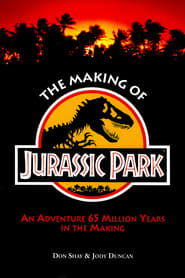
The Making of 'Jurassic Park'
Download English Subtitle
Release info
Tags
English subtitle preview
The first 198 lines.
Look out! Down!
How did you do this'?
I'll show you.
My interest is making a good movie
that honors the existence of dinosaurs,
even if juxtaposed with man today
which is a little out of kilter with actuality.
But if the movie is honorable and can get people to say,
"This is the first time I've really seen a dinosaur.
"This isn't Gorgo or Godzilla.
"This is really a movie that I think
"is really happening as I'm watching it."
Action!
With Jurassic Park, Steven Spielberg recalled from extinction
the greatest creatures our planet has known.
Reborn before our eyes were living, breathing dinosaurs.
Now we'll discover the secrets of their re-creation.
To resurrect these ancient and powerful creatures,
Director Spielberg and his team of special effects wizards
embarked on a three-year journey of discovery.
Creating new technologies, transforming old ones
and ushering filmmaking into the 21st century.
I'm James Earl Jones.
Join me as we make that same journey of discovery.
Share in the excitement of a motion picture
65 million years in the making.
From the earliest days of cinema,
movie dinosaurs have thrilled and terrified audiences
with their ferocity, if not always their believability.
But since The Lost World dazzled viewers in 1925,
moviegoers have become increasingly sophisticated,
expecting ever-greater levels of realism.
Expecting reality.
Jurassic Park set out to give us that reality.
To let us meet face to face the awesome creatures
whose legacy fills our grand halls of exhibition.
For 165 million years, dinosaurs ruled our world.
The most dominant species of all time.
Even their naked bones dwarf us.
Standing amongst them, our imagination is fired.
In awe, we wonder how they were as living creatures.
The sheer power of their limbs.
The rough texture of their skin.
The grace of their gait.
How they sounded, how they hunted.
Even how they ate.
This is the task that the makers
of Jurassic Park set themselves.
To bring these grand creatures
back to life with absolute credibility.
Steven Spielberg wished to show us not movie monsters,
but the animals themselves, as they might have been.
Immense and beautiful living beings
that were once lords of the earth.
Through an extraordinary combination of paleontology, artistry
and breakthrough technology, he did just that.
The story of Jurassic Park begins long ago,
when the prehistoric reign of the dinosaurs came to a mysterious end.
For 65 million years, their secrets lay buried in the earth.
Then, in the late-19th century,
man's discovery of ancient fossils suddenly unveiled
an undreamed of prehistoric past.
These towering skeletons captured the entire world's imagination.
We all longed to see dinosaurs live again.
My first toy from a museum that I ever got
was a little lead cast Triceratops.
I became fascinated as a kid, as all kids do,
because they're bigger than us.
And they were something that doesn't exist today.
I think because it doesn't exist today
and there's no immediate, direct access,
it becomes the thing that mythology is made of,
that makes mythology so fascinating.
Only it's real. It's not mythology.
And I think, even though it has
the pull and the seduction of mythology,
it also has its roots in reality.
That reality inspired Michael Crichton's
fact-based concept for Jurassic Park,
where genetic science allows our past to become our future.
The notion that extinct animals can be re-created genetically
has been discussed for at least 10 years in scientific literature.
When I started, I was talking to friends at MIT,
and saying, "I have this idea about,
"engineering dinosaurs."
I was saying it very tentatively and some of them said,
"It would probably work."
Which was kind of encouraging to me.
Michael Crichton and I were working
on another project together, a screenplay.
And I asked him,
"What are you doing in the world of books?"
He said, "I'm writing this thing about dinosaurs and DNA."
And my eyes got wide and suddenly I wanted to hear more.
I coaxed it out of him until he told me basically the whole story.
That's how the whole thing began.
Even before I had a screenplay, I began to storyboard the novel.
I'd never done that.
I broke the novel down into scenes that I thought I might want to
carry over into the motion picture version.
As Spielberg conceived his ambitious plans
for the movie and its dinosaurs,
it became clear that bringing his vision to life
would require an unparalleled level of special effects.
My one precedent for Jurassic Park was King Kong.
King Kong was the high-water mark of special effects
creating a world I never knew existed.
Especially the great fight between King Kong and the Tyrannosaurus Rex.
Almost like a sumo wrestling match.
That scene looks funny today,
because I see the professional wrestling parallels.
As a young person, that scene had no peer. That was my high-water mark
for imagining what it would be like to do a King Kong of today.
I don't consider Jurassic Park a classic, as King Kong is a classic.
But I was so inspired by King Kong,
that was one of the reasons I wanted to make Jurassic Park.
What have they got in there, King Kong?
Ironically, it was a modern-day Kong
that inspired Spielberg's initial plan for Jurassic's dinosaurs.
I was impressed with Bob Gehr
and his creation at Universal Studios with King Kong.
It's basically like a big inflatable balloon.
It moves with wonderful smoothness.
You can actually see muscle tone moving underneath the fur.
I was impressed with that,
so Bob Gehr and I had some initial conversations
about making some of the dinosaurs full-size.
Initially, I wanted to make all the dinosaurs full-size.
That, of course, was just my wishful thinking.
That didn't work out. We were going to break some new ground.
But it was going to be costly new ground.
The next idea I had was to go to the great physical effects maestros in town.
Spielberg assembled Hollywood's top special effects talent
for a unique collaboration.
Stan Winston.
Phil Tippett.
Dennis Muren,
and Michael Lantieri would compose Jurassic's design team.
I remember a conversation that was simply along the line of,
"Would we be interested?" And it was like... (PANTING)
Be interested? My goodness!
The initial approach for Jurassic's dinosaurs
relied on traditional technology,
combining moveable miniatures, created by Phil Tippett,
with a few full-size robotic creatures, designed by Stan Winston.
Michael Lantieri would supervise
the interaction of these elements
with the actors and the set.
And Dennis Muren would lead the team at industrial Light & Magic
in combining the elements on film in post-production.
By 1991, work was under way at Stan Winston's studio.
The first step was to determine the look of each character.
The artistry
of getting these dinosaurs to look real,
is absolutely the most important first step.
If they didn't look real,
if you didn't believe their skin, flesh, reality, details,
their eyes, teeth, mouth, everything about them,
no matter how good the performances were, they wouldn't be real.
You'd have something acting real but not looking real.
My kids'll love coming to the set till they see this.
Then they'll want to go home.
The reactions from Steven, Michael Crichton and anyone who'd walk in
and see the process, was always excitement.
You get jazzed. You get high.
You go, "Whoa! It's really coming alive."
As the sculpture is finished, the molds are taken from that.
From those molds the skins are made.
Those then go onto the robotics
and animatronics that have been built
in a parallel process.
So, you have the robotics which are your skeletal structure and muscles.
Then your skins, which are pulled from the molds
that go over those animatronic
and robotics of these dinosaurs.
That's why this is a perfect combination of art and technology.
It soon became important to decide how the dinosaurs
would be required to move on-screen.
Phil Tippett wanted to do storyboards three-dimensionally.
With little clay figures of dinosaurs and people.
They would completely imitate my storyboards
but flesh out my storyboards and give them dimension.
These temporary sequences were Known as "animatics. "
Storyboards don't show you any of the
temporal cadence, the sequence, the timing of it.
The animatics allowed us
to block out the entire sequence so that Steven, on the set
would have this template he could use to show the actors
that this is the way it's going to look.
Steven's direction from the very first day was that he knew
that things with big pointy teeth would be
chasing people and trying to eat them.
He had a monster movie on his hands.
That was a given.
But he didn't want to have these things portrayed as monsters.
He wanted to bring them back down to a naturalistic level.
He wanted them portrayed as animals.
So we spent a great deal of time working
Comments
No comments yet. Be the first to leave one.