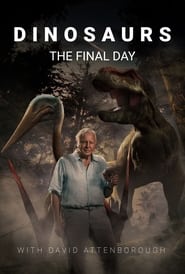
Dinosaurs - The Final Day with David Attenborough
Download English Subtitle
Release info
Tags
English subtitle preview
The first 200 lines.
66 million years ago,
Planet Earth was very different from today.
Back then, one of our closest ancestors might have looked
something like this little furry creature.
The rulers of the land were giant reptiles.
Dinosaurs.
That's one of the most infamous,
a carnivorous T-rex.
And just behind are the bison of their time,
a common plant-eater, Edmontosaurus.
But what happened to them all?
66 million years ago,
an asteroid hit the Earth,
and scientists think that it was this collision
that wiped out the dinosaurs.
But no-one has ever found direct evidence of that.
In fact, no-one has ever found the fossil of a dinosaur
that died within a thousand years of the impact.
However, a remarkable dig site promises to change that.
It's in the Hell Creek formation
in the American Midwest.
These badlands are rich in prehistoric remains…
…from triceratops…
…to pterosaurs.
And here, one patch of land
about the size of a football pitch
is yielding a collection of astonishing fossils.
The precise location is a closely guarded secret,
because this place may hold evidence…
…of one of the most dramatic events
in all the 4 ½ billion-year history of our planet.
Right, let me get down here between you.
For ten years, a palaeontologist and his team
have been trying to find out exactly what happened here.
You're at the edge of your seat every moment,
trying to dig this stuff up.
It's like trying to defuse a nuclear weapon
while you're in a rainstorm.
He's named the site Tanis,
and believes it could be a mass graveyard
of creatures that were killed
in the catastrophic asteroid strike.
A site that could reveal not only how the last dinosaurs lived,
but how they died.
If the dig team is right, Tanis could be a place
where the remains of a long-lost world
are frozen in time.
A place that gives us, for the first time,
an unprecedented window…
…into the lives of the very last dinosaurs…
…and a minute-by-minute picture of what happened
on the day the asteroid hit.
This landscape is full of fossils dating from the Late Cretaceous,
the period which began around 100 million years ago
and ended 66 million years ago,
when the dinosaurs vanished.
Palaeontologist Robert DePalma wants to find out more.
I think anybody who's ever liked dinosaurs in the past,
or still does, has thought at one point or another,
"Well, what happened to them?
"Why are they not here any more?"
So many different theories are out there,
and nobody has a tight answer to that question.
Judging from fossil evidence,
this is what Hell Creek looked like in the Late Cretaceous.
There were low-lying, marshy flood plains,
intercut by river channels and covered with horsetails,
ferns and trees.
Back then, it was warm and wet here all year round.
Tanis lies in the north-eastern corner
of the Hell Creek formation.
Instead of today's dusty prairies,
there were sandy river banks.
Instead of rocky cliffs, there were forests.
And instead of the life we know today…
…well, Robert is hoping to find out more
about what that was like.
A sandbank lying between a river and a forest
would one day become what Robert now calls Tanis.
He and his team have been digging here since 2012.
So somewhere from between there
and down here is where that came from.
It's come from up above. Hey, look at this.
What? Look.
Oh, yeah, yeah, yeah. OK.
And what they found is unexpected.
Here we've got this freshwater environment
of the Hell Creek formation,
and these shocking red, green colours
coming from the shells of ammonites, a marine organism,
kind of like a coiled snail in appearance.
So we've got this marine organism that's been thrown up
into this freshwater environment,
and they do not belong here.
How they got here is a mystery.
OK…
And there's more.
I'm just going to go ahead and plane down some of this rock.
Sitting just above the ammonites
is something that many dinosaur hunters
are desperate to find.
So this orange layer right here is composed 100%
of impact-related debris that is enriched in iridium.
Iridium is an element that's rare in the Earth's crust,
but it's common in asteroids.
The layer it's in is called the K-Pg boundary.
Dear Momma…
Oh, dear. Really? Yeah.
It's made up of dust and debris from a huge asteroid impact.
Look at that. That's amazing.
Yeah, yeah, yeah, yeah, yeah. That's what we want.
OK. So it's coming from this area here.
So somewhere within that region is where these pieces are coming from.
The boundary separates the age of the dinosaurs
from the age of mammals,
so the rocks here come from about the time
that the dinosaurs became extinct.
No rattlesnakes.
What makes the site even more exciting
is the rock layer right beneath the boundary
where Robert found the ammonites.
The rock here is really not quite rocky,
as you would expect dinosaur bones and things to be encased -
you expect really, really hard rocks and jackhammers
and things like this, but it's very, very crumbly
and it just falls apart in your hands.
As well as being crumbly throughout,
this layer of rock is also around a metre thick,
which, along with other unusual features, makes
Robert think that something very strange must have happened here.
Maybe a flood or a mud flow,
burying anything within it in an instant.
Oh, there's a beautiful… Look at that one - beautiful.
This could mean that anything he finds in this layer
would have been quickly entombed,
like the bodies in the volcanic ash of Pompeii.
Robert knows from the geology
that anything he finds at Tanis will be tantalisingly close
to the end of the age of the dinosaurs
and could be so well preserved
that it could reveal new evidence
that will bring this time period to life
in a way no-one has ever done before.
Robert digs at Tanis each summer,
the only time the weather allows him to do so.
Come on down, check out this lens over here.
In order to understand how the impact affected life on Earth,
you really need to get a very clear picture
of what the world was like right before.
That is a critical part of the story.
Palaeontologists Dr David Burnham
and Loren Gurche have been digging with Robert for years.
Oh, wow!
See… see the brown? Yep.
That might be a tubercle right there.
And it seems today is their lucky day.
Oh, my God! Look at that! Look at that.
Look, the scales are preserved!
Holy crap! Like doing a freaking dissection.
Oh, my God. Biology of Tanis.
Oh, the scale…
Look, look - the wrinkles continue down that way.
Mine's all nice and wet so far.
The scales are getting smaller in that direction.
How big are they there?
I got a… I got one with the projection over here.
What? Oh!
Yeah. Oh.
Yeah, there's the protuberance right there.
I've only seen that on one other specimen, in life. Yep.
This is the closest thing to getting to touch
a living, breathing dinosaur.
It is.
They found something extraordinary.
It is so exceedingly rare -
a piece of triceratops skin in the Hell Creek formation.
It may look like an impression in the rock,
but this is skin that has been fossilised
and, over millions of years, has turned to stone.
Triceratops bones are relatively common finds in Hell Creek,
but skin in such condition as this is very rare indeed.
The size and the patterning of the scales,
together with the age and location of the rocks
where it was found, strongly suggests
that this is from a triceratops.
The brown colour contains traces of organic material.
So it might even be possible from this
to work out which pigments were in it.
Finding and studying
such well-preserved fossils as this
helps palaeontologists build
a much more detailed picture of how these creatures lived.
Combining this information
with insights from scientists around the world
makes it possible to speculate
about what life in the Late Cretaceous
might have been like.
We know from bones
that adult triceratops could reach nine metres in length
and three metres in height.
Dinosaurs - The Final Day with David Attenborough subtitles in other languages
More English subtitles for Dinosaurs - The Final Day with David Attenborough
- Dinosaurs The Final Day with David Attenborough 2022 1080p WEBRip x265-RARBG · 228 downloads · 2022-04-29
- Dinosaurs- The Final Day with David Attenborough (2022) 720p webrip · 172 downloads · 2022-04-17
Comments
No comments yet. Be the first to leave one.