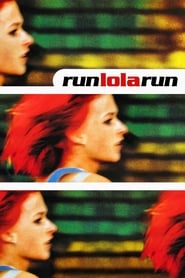
Run Lola Run (Lola Rennt) (Lola rennt)
Download English Subtitle
Release info
Tags
Download English Subtitle Files for Mobile (2)
English subtitle preview
The first 200 lines.
Hello. I'm Tom Tykwer. I'm the director of Run, Lola, Run, which you're about to see.
I'm Franka Potente. I'm the red-headed running person you'll see in this film.
So, what you see here is the logo of the production company from Germany.
It's called X Filme.
It's a company that was founded with three directors and one producer,
very much a directors-driven company.
These are quotes from one of my favourite poets
and one of Germany's most famous soccer coaches, Sepp Herberger.
He was the coach that led Germany to win the World Cup in 1954.
So when German people read the second quote, they normally laugh.
Yes.
We'll make Sepp Herberger somewhat known in America, do you realise that?
Okay. I wanted to make you known.
So, this is the opening of the film as I wanted it always to become,
that it looks in the first place as a horror movie,
because I still haven't made a horror film.
So, I always think I have some sequences in my film that remind me of that,
that I should come back to this.
It doesn't really turn out to become a horror movie in the end.
Actually, I always think the clock looks so much larger than it really is.
Well, the real one is kind of...
- It's kind of big. - What, three foot?
Well, no, two-and-a-half foot big.
It was made out of... Styropor?
Some foam kind of stuff, yeah.
So this is the opening sequence, which we shot on a big empty airport
which isn't in use any more.
In the script it was written like there's supposed to be like masses of people, like...
Of course, I was dreaming of millions of extras.
In fact, we couldn't afford this at all.
So, what it came down to was 300 that we could pay for.
So, with those 300, we tried to give you the suggestion of masses of people
and having characters that will later appear in the movie
stand out and look at us.
I was wondering, did you put team members in the crowd, too?
- No. - To make it...
No, no. They were all busy working.
The ball is round.
That's Armin Rohde. He's really famous in Germany.
He's the funny guy. He's real funny.
That's one of my favourite shots in the movie.
Well, to explain you how this worked, you know, we only had these 300 people,
and so we decided to let them do each letter singly.
So, the camera was 60 metres in the air
and looked down on, like, 300 people
creating an "L" and then "O" and then "L" and then "A" and all this.
And later we went onto the Domino compositor station and put it all together,
which took a lot of time.
So, this is the first time animation appears in this movie.
It was created
by a very, very talented animator from Germany.
In fact, he's Israeli-German.
His name is Gil Alkabetz. He's very, very talented.
And the whole crew of Studio Film Bilder from Stuttgart
created the whole animation sequence.
I love that. I always look forward to this title sequence.
Yeah. I still enjoy watching this.
This is something you do also on a digital Domino workstation
and you sit there and create all these elements.
It's kind of very, very long time that you sit down to put this together.
And in the end it still looked too clean to me, the whole image,
so we put this dirt film on top of it.
Do you see all these stripes there? It's very dirty. It was meant to be like that.
This was done from helicopter.
Of course, not all of it, as you can imagine, but most of it.
This took... Each of us took one day of shooting this scene.
Right. Well, it was one of the big acting events in this movie
because we have two characters being established in a very, very short time.
They don't have a lot of time
to really show details of their character.
But still, it was very important that you get close to them as soon as possible,
because I really wanted people
to care for Lola and Manni and for their fate immediately.
So, I was really happy to have two actors who are not too much suffering
from the fact they are only...
Like, Lola was only standing on the phone in this one room...
Actually, I was suffering.
Yes, I know. I mean, you were suffering where?
Well, because when you see Manni in the picture,
we shot a whole day of Manni, like, Moritz, in the phone booth.
Remember that you put me a whole day in this kind of sound tent.
So, I was all by myself,
staying on the phone with Moritz and with a walkie-talkie at my side...
Oh, yeah.
...getting all my instructions from you.
- I don't think... - It was quite boring.
I mean, I had my Diet Coke and I had my walkie-talkie
and little snacks around me.
But I think it was much more hard for Moritz, you know,
because he had to play, like, 14 hours one day, stay in this phone booth
and really create the whole desperate feeling of the movie.
Yeah, that's true.
And he did the same for me, too.
When I was shot, he would be so kind to sit in the sound tent for a whole day, too,
to play his part on the phone.
Right. So for the voices they had one day of shooting
without being ever filmed on that day.
You know how we actors, we hate it.
So, it's really hard to keep up with the pacing in this beginning
and tell everything that comes to my mind there.
The guy who appears there is Joachim Krél, also kind of a famous actor in Germany.
Nobody recognised him, though.
Nobody recognised him because he was playing the bum
and he was really, really looking very, very real, realistic, I think.
I always thought he looked like as if he smelt bad.
And he said... One day of shooting he told me that he really hates it
because once he was in his costume and his make-up,
they wouldn't take the beard off and anything.
All the people in the streets, people from the team,
they wouldn't really talk to him because he looked so awful.
That's what he felt like.
So, this is where it happens,
where the whole thing starts to be really a problem.
And this is where the film establishes the big conflict,
which is of course very small
because we always wanted it to be a very simple premise for the whole film
that leads to all these difficult and different variations.
I'm such a fucking amateur! A dumb-ass!
This could only happen to me! If you'd picked me up, it wouldn't have happened.
You see all the material that messes up,
that is mingled here, this is shot on video.
Then parts were shot on black and white. The whole thing is more or less a flashback.
These are real postcards that we took.
And here we are again in black and white.
So the idea was to have, you know,
for every level of the film to have a certain aesthetics.
That means, when we go into flashbacks, it was always meant to be black and white.
When we go into actions that are not in the presence of Manni and Lola,
so the whole world next to them, which they always were...
in a way changed, so that's why we felt it was kind of artificial,
was shot on video.
And this, of course, when they're present,
the whole world when they're present, was shot on 35mm.
Oh, shit!
See! I knew you wouldn't come up with any idea.
I always said someday you wouldn't know what to do.
Not when you die, sooner!
You said, "Love can do everything."
- So find 100,000 marks in 20 minutes. - 20 minutes?
In 20 minutes.
I remember how we rehearsed that.
It was good to rehearse that scene
'cause it really has to have some tempo and some rhythm.
I agree. That's really a lot of energy and information
in a very, very short time, given to us.
What for? You can't get me 100 grand either!
So, very soon,
Lola had to give him the first sign of her energy.
There you go.
Yeah. Actually, was that the first scream that I had in the movie
or did we shoot the other scream first?
No, I think that was the first one.
So, Franka, in the first place, I very much remember her saying to me,
"Well, how do you think the scream is supposed to be?"
And I thought, "Well, like, scream. Scream like it."
And we did some rehearsals, and...
I just remember you realising you haven't screamed like that,
really, I mean, like that strong...
For 24 years of my life. No. I mean, have you?
I really realise...
I mean, you remember how you asked me to scream
and nothing would come out of my mouth, I couldn't.
So, I had to do it first.
- I had to show her how to do it. - Yeah, thank you.
Well, it just, I don't know, it's...
I was really scared to do it.
You know how much I was shaking and how much I was surprised when I did it.
Yes.
It's something I can really recommend at this point
because it's really refreshing and it somewhat clears your head off.
I'll get the money somehow.
I'm going in there at 12:00 if you aren't here.
So, you see, we again showed the clock.
We showed the clock very often to make clear
what is the time that this film has, you know, for what will happen.
So, now, the first race starts, in fact, now. Again, a clock.
Where did you find this picture of the domino stones?
It's a Japanese world record that was set for domino stones
in a big, big, big sports hall.
I think it was like two million domino stones. They organised them and...
I very much like even the Japanese comment on it.
A very hysterical guy.
So this is the croupier,
which in the end also will reappear as a real person in the movie.
And we made Gil Alkabetz paint him.
So, in fact, the people you're seeing here, you know,
the opportunities for Lola, where to go and try to ask for 100,000 marks,
which in fact for Americans is something like $60,000.
That's the whole crew of the movie that you're seeing there.
At least half of it.
Like, from second assistant directors to costume designers. Nearly everybody.
In fact, this is a shot that was of course done with a Steadicam camera.
There's no other way to do these kind of shots.
And this is the only shot in the movie, as you will later find out,
that's always staying exactly the same for all these repetition moments.
So the big problem, of course, was to get it all into sync
and to really prepare the right animation for the TV,
because, of course, when we shot this scene with the mother,
the animation had to be there.
So, we had to be decided while we were shooting already
Run Lola Run (Lola Rennt) subtitles in other languages
More English subtitles for Run Lola Run (Lola Rennt)
- Run Lola Run 1998 1080p BluRay HEVC EAC3-SARTRE eng · 195 downloads · 2023-11-21
- Run Lola Run 1998 2160p UHD Bluray REMUX DV HDR10 HEVC MULTi DTS-HD MA 5 1-GHD · 203 downloads · 2022-11-24
- Lola Rennt 1998 1080p BluRay DTS x264-FoRM · 322 downloads · 2021-08-26
- Run Lola Run 1998 720p BluRay H264 AAC · 337 downloads · 2020-01-22
- Run Lola Run 1998 1080p BluRay HEVC EAC3-SARTRE · 314 downloads · 2018-01-11
- Run Lola Run 1998 720p BluRay x264-ESiR · 242 downloads · 2014-07-29
- Run Lola Run 1998 720p x264 YIFY · 353 downloads · 2012-08-17
- Run Lola Run 1998 HDScene Release · 126 downloads · 2012-06-06
Comments
No comments yet. Be the first to leave one.