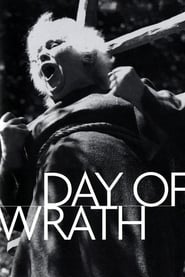
Day of Wrath (Day of Anger / Vredens dag) (Vredens dag)
Download English Subtitle
Release info
Tags
Download English Subtitle Files for Mobile (2)
English subtitle preview
The first 200 lines.
Day of wrath! O day of mourning! See fulfill'd the prophet's warning!
Heav'n and earth in ashes burning!
Loud, dramatic music begins the film,
sounding the crack of doom from the very first.
Dreyer wanted the music played at a thunderous volume.
He wrote a letter to the projectionists who ran the film at its premiere
where he said:
"In order that the overture may have the intended doomsday character,
"it is important that it is played at full volume,
"that is, at as loud a volume
"as the sound apparatus can possibly bear."
Along with the booming music,
Dreyer displays images of hellfire and damnation,
as well as the text of the Dies lrae hymn,
rewritten specifically for the film by the Danish poet, Paul La Cour,
who years before had worked as an assistant
on Dreyer's Passion of Joan of Arc.
As the volume of the soundtrack is turned down,
if the projectionist is following Dreyer's instructions,
we see a hand writing out an arrest warrant.
Whose hand?
The signature is Jens Uhlen,
but no character by that name appears elsewhere in the film.
The writing hand sets in motion the drama that follows,
in a way possible only in the cinema.
The image of a hand writing may seem a little uncinematic,
but it is in fact exactly the opposite.
Only the cinema can show us a hand writing
without it belonging to anyone, but nevertheless shaping the action.
Probably. It's herbs from beneath the gallows.
It's strange to think they are so powerful.
There is power in evil.
"There is power in evil," says the old, potion-brewing wise woman.
And this is a film about the power of evil,
the power of evil thoughts, evil intentions, evil appearances.
But is this an evil that belongs to the 17th century
or one that exists today?
Several expert historians have written
that Dreyer in his film portrays the age of the great witchcraft persecutions
of early modern Europe
with an insight that was decades ahead of the historical profession.
Other critics have emphasised the fact that the film was made in 1943,
when Denmark was occupied by Nazi Germany,
and suggested that the dark world of the film
is an allegorical reflection of that grim reality.
Later in this commentary, we shall look further at both ideas.
From outside, we hear the pealing of the tocsin sounding the alarm
and the hate-filled cries of the mob who have come to seize Herlofs Marte.
Most other filmmakers would have cut away from the scene here
to a shot of a crowd of angry extras,
shaking their fists and waving pitchforks.
Dreyer refuses to do so.
He had come to believe that cutaways like that,
even cross-cutting in general, was unsuitable for the sound film.
In the silent period, rapid cutting had made sense,
but in the sound film, its jittery agitation was undesirable.
Instead of cutting, Dreyer preferred to rely as much as possible
on following the characters with a fluidly mobile camera.
Dreyer's later films are sometimes accused of being stagy and stiff,
and in this first scene, the refusal to cut away to the angry mob
has certainly been regarded by some
as producing an unfortunate, noises-off-like effect.
Certainly, Day of Wrath, like both Master of the House
and his three later features, is based on a stage play,
and I think it is worth looking a little more closely
at how Dreyer went about adapting this story.
The screenplay was based on a play called Anne Pedersdaller
written by a Norwegian playwright named Hans Wiers-Jenssen
and first performed in 1908.
The extended scene we are watching now
corresponds roughly to the first act of the play,
which ends with the capture of Herlofs Marte.
On the stage, the scene took place outside
in the yard in front of the rectory,
but Dreyer prefers to remain indoors.
More importantly,
Dreyer has reshaped the personalities of the leading characters,
particularly Absalon, who enters here.
Dreyer wrote out pen portraits of the characters
to help the actors understand their roles.
Absalon he describes as follows:
"Absalon is loving and kind towards his wife, Anne,
"and his mother, Merete.
"A good son.
"Indeed, almost too good and too obedient,
"because he has never quite succeeded in freeing himself
"from his mother's sway over him.
"He is kind and credulous.
"Absalon is a dutiful clergyman, strict with himself as well as others.
"His mind-set is expansive in a time where narrow-mindedness is the rule.
"He is humane, lenient and sympathetic."
Dreyer's understanding of Absalon as a kindly man
is very clear in this scene,
where it is contrasted with the unremitting hostility
of Absalon's mother towards his new wife.
This is a change from the play,
where Merete's hatred of Anne does not really emerge
till after Anne has begun her adulterous and incestuous affair with her stepson.
Like a crow of ill omen, Herlofs Marte draws near,
still pursued by the alarm bell.
According to Dreyer's personality sketch,
there is initially "something undeveloped, almost childlike" about Anne.
The actress Lisbeth Movin brings a touch of unconscious feminine vanity
to the way Anne puts on the white collar of her austere, puritanical costume.
And as she steps forward to greet Martin,
a dark shadow passes across her face,
suggestive of the secret passions lurking within,
what Dreyer called "the woman in her" that Absalon cannot awaken.
Are you his son?
Are you his wife?
Dreyer's characterisation of Anne continues:
"In general, she is quiet, perhaps a little shy."
In defence against the pinpricks from her mother-in-law,
she has made up a world of her own,
where she comforts herself with her private thoughts.
In this world she carries a dream with her without really being aware of it.
When Martin arrives at the rectory, she becomes conscious of the dream,
and when he takes her in his arms, the dream becomes reality,
and in the same moment the child becomes a woman.
The dialogue at this point becomes strange and unsettling.
Anne and Martin repeatedly refer to themselves as mother and son.
But Anne's blooming youth
as well as the evident erotic charge of the moment
she and Martin first lay eyes on each other
makes the very idea that they should relate to each other as parent and child
seem unnatural.
This also colours our view of Anne's marriage to Absalon.
It just doesn't seem right that this beautiful young woman
should be the wife of the desiccated, abstemious Absalon.
The Absalon Dreyer shows us is guileless and unworldly.
His attitude towards Anne is almost grandfatherly -
kind, but without any evident erotic interest.
In this, he is very different from the Absalon of the stage play.
In the play, it is made very clear that he married Anne
because she was beautiful and he desired her sexually.
At one point he says of his first wife: "She gave me no joy."
He continues, speaking to Anne:
"But you were young and beautiful,
"my blood was on fire every time I saw you."
This Absalon gave in to carnal desire,
knowing very well what he was doing.
Even worse, he deliberately concealed his knowledge
that Anne's mother practised witchcraft in order to marry her daughter.
Dreyer's Absalon, on the other hand,
has never been conscious of any illicit emotions.
His encouragement of a kiss between Anne and Martin,
despite his mother's warning,
shows how trusting and innocent Absalon is.
He believes that he has helped Anne's mother
out of the kindness of his heart.
He also thinks of his marriage to Anne as an unselfish act,
taking a friendless orphan into his house.
It is only later, when exhorting Herlofs Marte to confess her sins,
that her accusations make him realise
that his motives for protecting Anne's mother and marrying the girl
were far less pure than he imagined.
Herlofs Marte is frightened and desperate,
and Anna Svierkier's extraordinary performance
brings out the depths of her fear.
Anne, you must help me. Hide me.
They'll burn me if they catch me.
You've been named as a witch?
The tone of Anne's reply reveals that she is not entirely surprised
that the old woman has been accused of witchcraft.
And note that Herlofs Marte herself never claims to be innocent.
Instead, she reveals her knowledge that Anne's mother was a witch.
In the play, Herlofs Marte only invokes her friendship with Anne's mother,
and Anne remains ignorant of her family's dark secret for much longer.
By having her, and the audience, learn of it at this point,
Dreyer not only enhances the tension and the structure of the story
by introducing at a much earlier point
the threat against Anne that she too might well be accused of witchcraft.
Dreyer also ensures that Anne learns of her dark inheritance
at almost the same time
as she experiences the first stirrings of erotic desire,
so that her discovery of her own sexuality comes to run almost exactly parallel
to her discovery of her powers of magic.
Merete's harsh rebuke of Anne for leaving the cupboard door open
underscores her hostility towards Anne
and contributes to what Dreyer called:
"the latent tension, the smouldering dread lying beneath the everyday life
"of the family in the rectory."
And that tension, that dread
was something he felt was essential to bring out.
The drama, to Dreyer, is above all psychological.
In a lecture he gave a few weeks after the opening of Day of Wrath,
he said:
"In the artistic film, it is human beings that we want to see
"and their psychological experiences we want to experience.
"We wish to get close to and inside the human beings we see on the screen.
"We wish that the film may open a door slightly for us
"leading onto the world of the inexplicable.
"We wish to be put in a state of suspense
"caused not so much by the external action
"as by the development of the psychological conflicts.
"There is no lack of psychological conflicts in Day of Wrath.
"On the other hand, one will rarely find a subject matter
"that so invites outward dramatics.
"I, and I dare say my actors, too, have chosen to resist this temptation."
There's blood here.
Day of Wrath (Day of Anger / Vredens dag) subtitles in other languages
More English subtitles for Day of Wrath (Day of Anger / Vredens dag)
- Criterion · 60 downloads · 2012-09-02
- Vredens DagsDay of Wrath · 72 downloads · 2010-10-03
- Day of Wrath (Day of Anger / Vredens dag) · 65 downloads · 2006-06-01
- Day of Wrath (Day of Anger / Vredens dag) · 57 downloads · 2006-02-21
Comments
No comments yet. Be the first to leave one.