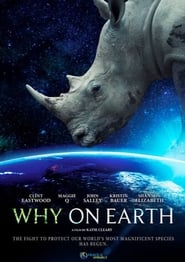
Why On Earth
Download English Subtitle
Release info
Tags
English subtitle preview
The first 200 lines.
I'm an animal person.
I appreciate the beauty of 'em.
I dunno, I was just an animal lover when I was a kid.
Dogs and cats and snakes and lizards
and whatever I could find.
It started when my dad went deer hunting.
And shot this deer.
And he said, "You know, when I shot the deer?"
He says, "The deer wasn't quite dead.
And, it looked up, with its head, and looked at me."
And he said it was almost like saying, "Why did you shoot me?"
He was intelligent in a very natural way.
And he said, "I just never could do it after that."
And then you realize we've been put
on here for something, and the best thing we can do
is manage what we have and the beautiful things we have.
And animals fit right into that category.
Mustang horses are gonna become extinct if we don't save 'em,
and, uh, so I just sort of house them.
And you can have a place to live out their existence.
I just like seeing things, everything live.
I like, uh, living things.
They come in and bulldoze everything.
The topsoil's gone,
the ground water table changes...
the orangutans are in dire straights right now.
United States, when you look at the back of any product,
about 50% of the products contain palm oil.
And it's anywhere, you know, from shampoos,
to lotions, to cookies.
Do you think that that female orangutan that, uh, approached
you, do you think that she knew that you were gonna be the one?
Alright, so we've just arrived at the orangutan
- information center-- - Welcome to our office.
Thanks for having us, umm, and umm, Paul,
of course, organizing this whole adventure.
So tell me, what are you guys...
you're about to go out on an orangutan rescue.
Used to be an orangutan habitat,
but then converted to become palm oil plantations.
And that's why some of the orangutans still live there,
and been isolated from their own habitat.
And that's why we need to rescue them.
So, I was just here in 2012.
I was invited to come and document
the palm oil expansion and the forest destruction.
And also the wildlife trade and what was going on.
Yeah, I remember just photographing
the orangutan rescue.
He just made eye-contact and that was it.
I just, you know, the world needed to know
about this issue, and that was it.
I've been coming back ever since.
So, you're rescuing the orangutan
and then now where are you going to trans-locate them?
If they are in a good condition, we are going to release them at
the same day, but if they're in, like, a condition that
need medical services, so we work together with
SOCP Quarantine Center, and we are going to send
them to be rehabilitated before they going to
be released one day when they are ready.
Wow! Alright. Well, I know you guys have to get going.
Thank you for your amazing work. Thank you so much.
- You're welcome. - Thank you.
Good luck.
We'll hopefully see you in the next day or so.
We'll be catching up with you soon. Thank you.
Community and plantation workers shoot the orangutans initially,
and if that doesn't work, then, sadly,
then they're calling OIC or SOCP to extract these orangutans.
So, you can imagine there's a lot of wild orangutans
out there with bullet wounds.
It's incredibly sad that this even has to take place.
Rescuing an orangutan from where it, you know,
should be its home, to trans-locate it to a place,
like, a lesser eco-system where it's going to be protected.
How long does it usually take
for the dart to take affect?
She's pregnant?
Is this gonna affect the baby?
She was shot by people? Oh no.
Can you take the bullet out? Are you removing it?
Yeah. Yeah. Aww.
Yeah, I see.
I hope not.
For me, it's just another image,
a tool to influence issues and influence people, and how,
you know, we interact with the planet at times like this.
It, uh, strong imagery can really
influence people's choices and I think that's important
right now to show 'em what's going on.
The reason, talk about why it's going on and hopefully,
un, things can change in the future.
They will go extinct. So, it's not enough.
So, we really need to build these, corridors.
Secure land and build corridors between them
so the orangutans can move.
When they first arrive,
every orangutan is given a full medical check-up.
So, they get chest x-rays to check for TBC,
they get blood samples taken and tested for things like
hepatitis, herpes virus, and stuff.
They get a full check over.
When an orangutan has been through its quarantine,
and done all its medical checks and pronounced fit
and healthy, then it'll be brought here.
So, usually we don't just open the door and throw 'em in.
We put them in this shut off case, so they can see
each other for a couple of days.
And then gradually introduced to groups.
On the left here, is Chriswan.
He was in a cage that was barely bigger than
his shoulder width, you know.
I think I have a picture somewhere.
He came out of it a couple of years ago.
He could barely stand. He barely had the use of his legs.
We actually trained him so that we could move him around
to get his food. So we got him climbing.
Can these people be prosecuted for keeping a wild orangutan?
That particular case, in theory, yes.
But, there's never been a case.
By a long way, you find a lot more
illegal pet orangutans being kept in areas where
the palm oil concession is out actively clearing forest.
I see, Okay.
So there is a strong connection there.
In front of you now, Allosa.
He was shot sixty-two times with an air rifle.
He's totally blind.
He's still got two pellets in one eye and one in the other.
That's the one I saw a picture of, yeah.
We took the pellets out that
we could palpate through the skin,
but he's still got forty-eight pellets inside him.
But, he's doing very well.
He's fit and strong, but totally blind.
He'll never be a wild orangutan again.
At a place called Orangutan Haven,
we're building these nice islands surrounded by water,
where they'll be trees and ropes and long grass and bamboo.
And, he's one of the candidates to go over there.
You know, after many, many years,
I still get a massive thrill,
just seeing some of the orangutans we've released
in the forest behaving like wild orangutans and looking down
at me and they couldn't care less if I'm there or not.
That's the goal.
When did the tourism, um, really start happening here?
Well, it started happening
after the turn of the century.
I always say, "If you want to help the great apes,
the first thing that you can do is go to the habitat countries.
Vote with your dollars, vote with your feet."
And, because if you go there, you tell the people,
the local people, the national governments of those countries
that you consider the great apes important.
Come to see orangutans. And that's my message.
An orangutan used to be able to go from here, you know,
a hundred miles into the mountains, into the foothills,
and then, you know, ten years later come back.
'Cause the males do roam.
- Now, he can't get back. - He can't?
And the reason he can't get back because he has to
go through a hundred miles of palm oil.
Kind of explain to me the Oil Find Nursery
and what you guys do here.
So, pretty much the Oil Find Nursery
is where we receive the orangutan orphans.
We usually get 'em from the forestry police,
or locals as well.
And, most of these orangutans are orphans because they have
killed their mothers and they've left the babies
either to be kept as pets, or to be sold as pets.
- As pets? - Yeah.
We care for them, and then hopefully one day,
they'll be back in the wild.
I think it's really important for these NGOs
to really work with the community
and the plantation owners to really bring them up to speed
on conservation and the value of these species.
It's a huge asset for Indonesia and the planet.
Let's hope they realize that before it's all gone.
The sad truth is much of the world does not share
my belief that all sentient beings have just as much a right
to a part of this planet,
and when you look at those animals,
and you interact with them,
you see how magnificent and special they are.
As a child, I grew up on the wild coast of South Africa,
where some of the most abundant sea life you could imagine
came by my shores every year.
My connection with sharks started when I was six.
I went to the sharks board where they collect
all the dead sharks out of the nets.
And I remember walking through this freezer room
piled with these magnificent blue sharks and Mako sharks,
and something inside of my heart said this is very wrong.
I don't believe there's any animal on the planet
that has ever been wiped out in such significant
numbers as sharks have.
Comments
No comments yet. Be the first to leave one.