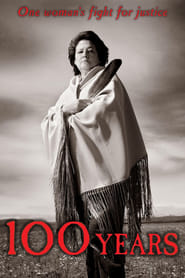
100 Years
Download English Subtitle
Release info
Tags
English subtitle preview
The first 200 lines.
What a glorious day the Grandfather Spirit
and Creator of all things has given us.
I am reminded of the stanzas from the Navajo chant
of the Beauty Way.
"In the house of long life, there I wander.
In the house of happiness, there I wander.
Beauty is before me, beauty is behind me.
Beauty is above me, and beauty is below me.
Beauty is all around me.
With it, I wander.
In old age, traveling, with it, I wander."
How much we can learn from them...
and yet, with all their collective wisdom,
could not have known that Earth Mother would be
someday called "real estate."
The government always wanted the Indians
to be good little Indians
and behave like we were children.
And they always wanted control over us,
that they could lease your land out to oil companies
and timber companies and make sweetheart deals
and nobody held them accountable.
And the more that Indian people were dependent,
the more control they had.
I used to raise hell at the B.I.A.
And one of my cousins, he said, "You're a mad dog."
I said, "I know I'm a mad dog."
I said, "My great grandfather was a mad dog."
We had 330 acres, my dad did.
And they all got wells on them.
Now, I'm going to show you oil and gas payment, uh, report.
This one here, it's ridiculous.
They're supposed to pay us a going rate,
Indian land estate,
and what did I get?
See this column right here, right there.
Eighty-nine bucks over $6,000 worth of oil
taken out of there, and I get 89 bucks.
America said, "We will manage these lands for you,
and we will make you farmers,
and we will lease them, and we will give you that check
as long as the grass grows,
the water flows, and the wind blows."
They basically told the Indian people that,
you know, "You're all really stupid
and you can't manage your trust,
so we will manage your trust for you."
She says nobody's ever approached her about that.
People do not understand what I live like.
This is what we use to watch TV at night.
The outlet goes inside.
We hook this to the battery right there.
I do not have electricity,
I do not have running water, and I do not have gas.
I gotta use propane for my gas.
See, I have a gas line going through the land.
It would be nice if they could just run a free gas line to me
if they're going to use the land.
The Navajo Reservation, for example, they're living
on one of the largest gas reserves,
not only in this country, but the world.
Yet they are among the poorest people in this country.
Abject poverty. How can that be?
Who's getting rich? It's not them.
I was the treasurer
for the Blackfeet Indian Tribe for 13 years.
And early on is when I started recognizing
these serious problems with the trust accounts.
I've tried for years and years, and I couldn't get any answers,
but I just continued to beat on all the doors,
and I remember the government
called all the treasurers and finance officers
from every tribe that had accounts
and brought us all to Albuquerque.
They were telling us, "This is the way that
we're going to be accounting for the tribal trust accounts."
So, then, they said, "Does anybody have any questions?"
And I said, "Yes, I have a question. I... You know, I...
There's problems with this trust account that I don't understand."
And I told him what it was, and the fellow just looked at me
and said, "Well, you don't know how to read a report."
So, I was a little embarrassed, you know.
It was like I don't know how to read a report.
But, after the meeting was over,
there were several of the tribal people who came over
and said, "Elouise, we're having the same problem."
And then, we banded together. There was a small group of us.
It was the chief financial officer from Red Lake.
It was the finance officer
from Jicarilla Apache,
and the CPA from Turtle Mountain,
the White Mountain Apache, their finance officer,
and it was through that process that we were able
to get hearings with the Congress.
We need your support
to stand up for the many individual Indian beneficiaries,
like Mary Johnson, a Navajo grandmother,
who relies almost exclusively on a few dollars in her allotment
to receive support for her family.
She receives pennies
of what a non-Indian is paid for gas from her land.
The Department of Interior is responsible for managing
56 million acres of individual Indian land and tribal land,
and, on average, about $3 billion in cash
and about a billion dollars of throughput
from leasing activities.
They want to be able to dictate
what happens to Indian lands, when to sell oil and to whom,
but they don't want the responsibilities to ensure that there's accountability.
I've always called it a "trust me" trust.
They have a self-reporting mechanism
with the Mineral Management Service,
so oil companies report themselves
how much they have extracted from Indian lands.
They then pay based on how much they say they extracted.
That's an extraordinary situation for a trustee
not to figure out on its own
how much has been taken from the land.
And then, I found out from my cousin,
who worked down in the oil fields and stuff for the tribe.
He said, "Mad Dog, you know what's happening?"
I said, "No."
He said, "They're coming in at nighttime,
emptying that tank.
And just drive out. Nobody there to catch them."
And I go out there, and you can see the tire tracks of the truck.
This is a quarter...
little over a quart of oil in this one.
There's no meter on this.
We have no idea how much is being pumped out of this.
See? They can take what they want, you know,
and get away with it.
And the B.I.A. won't do nothing.
It's like talking to a post when I talk to them.
My parents lived quite a ways out in the country, a rural area.
So, all of our neighbors and relatives would come to visit,
and stories would always come out about,
"I can't get my money from the Indian agent,"
and I would think, in my mind, "This must be
an awful mean person, this Indian agent."
All the money from the oil company
went to the superintendent,
which he kept a ledger sheet
that showed how much money you had,
but, every time you wanted to spend some money,
you had to go and ask him if you could spend this.
If you heard he was in a good mood,
he'd be going around whistling,
and they figured, when they'd go through the door,
if they heard that, it was gonna be a good day for them.
But, if it was all quiet...
If you wanted to buy a cow,
you had to go to the person that owned the cow.
You made the deal.
You found out the price of the cow.
You went to the agency, you said,
"I want to buy this cow, this milk cow,
to help my family."
It was just awful, and that was his own money.
Like he said, my grandmother begging for her own money,
so she could set a good Christmas table for the kids.
Dear Mr. Hector,
I'm writing you a few lines,
asking if you would send us $25 for Christmas.
Our children are coming to eat dinner with us.
Now, I want you to be sure and mail it to us
so we will get it Friday, if you please.
Yours truly, Mr. & Mrs. Mose Bruno.
And right here, this is the famous Grisso Mansion.
This was built in the 1920s,
or around the same time that oil was found also
on my great grandfather's land.
While my great grandfather was being swindled out of his money,
you can see what that family was able to do with their oil money.
I've never been this close to it.
It makes me even more angry
to be this close to it.
The Blackfeet people call this "Ghost Ridge."
Right in this particular area,
over 500 Blackfeet died from starvation.
There was an old agency, where the Indian agent was housed
to make sure the Indians didn't get off the reservation,
and that was right down... right down here a ways.
So, as time went by, they would not allow the Indian people
to carry arms or hunt
because they wanted them to be very dependent
on the Indian agent.
People were made to just hang around and wait for rations.
And the story goes that the Indian agent
was selling off the rations
that were supposed to come to women and children
and the men that had to stay confined to this area
without any means to hunt.
And so, as a result, we ended up with
which is called "the Starvation Winter."
Right in this particular area, over 500 Blackfeet died,
and all the people that died,
they just threw them into these open pit graves.
But the Blackfeet always
used to bury their dead above the ground.
More English subtitles for 100 Years
- 100 Years One Womans Fight For Justice 2016 1080p WEB x264-AMRAP · 40 downloads · 2018-03-20
Comments
No comments yet. Be the first to leave one.