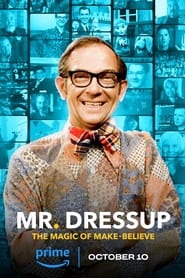
Mr. Dress-Up: The Magic of Make Believe
Download English Subtitle
Release info
Tags
English subtitle preview
The first 198 lines.
Oh, here you are. Well, that was pretty good timing.
You're here and we're here. Casey and Finnegan and I
have just come back from a walk around the block.
We had a very nice walk, too.
Having been Mr. Dressup for 20 years has probably made me a better person.
Tell us what the secret is to 30 years on the air.
I'm a child at heart.
It's all doing things that I always liked to do when I was a kid.
What does Mr. Dressup mean to you?
Mr. Dressup has brought imagination to the nation.
Ladies and gentlemen, one of the great Canadians, Mr. Dressup.
It didn't matter what race you were, what color you were,
what religion you were, what language you spoke. You watched Mr. Dressup.
Ernie Coombs, Mr. Dressup, he was just so kind and gentle.
Ernie never forgot the child within him.
And that informs everything that he does with children.
When you tell people that Fred Rogers and Ernie Coombs came to Canada together,
most people don't even realize that they were very close friends.
I'm making a book. You're just in time to see how I made it.
His warmth radiated through the screen.
You didn't just learn... "Here, learn this."
There was, "What's over here?"
I've got a good bat costume here to show you.
That's where the adventures would start. As soon as he opened that lid,
something was gonna happen. Something fun, something magical.
This is one of my favorite dress up costumes.
That signature moment every episode. Maybe it was a cape,
and there was nothing on it. But he'd cut out shapes,
"Is it gonna be a wizard? Oh, no, he's a dinosaur."
The endless possibility of that.
One of the reasons I became an actor was, because very early age
this person on television who was an adult, but not an adult...
...taught me that it was okay to let my freak flag fly.
- Casey, are you in... - Ha-ha-ha!
I didn't know if Casey was a boy or a girl.
Oh, my. What a lovely day.
Can I say gender ambiguous?
Because I was never sure if Casey was a boy or a girl.
Way ahead of its time. Not a little bit, way ahead of its time.
Four thousand episodes, thirty years.
There are not that many shows that last that long.
Hello!
The power of a word. The power of a drawing. The power of dressing up.
What wisdom have I acquired during 30 years
of making various objects out of toilet paper rolls?
Is doing crafts on TV a source of wisdom?
Apparently not.
And may I remind you for the last time,
keep an open mind, and an open heart.
Don't take life too seriously, because it doesn't last forever, you know.
And keep your crayons sharp.
Don't get your sticky tape tangled and always put the caps on your markers.
- Finnegan? -
Finnegan, where are you? Oh, there you are.
You want me to tell you a story? Oh, you want to hear the story, too?
In that case, I think I'd better tell it.
A long time ago, in the United States, in Maine,
a boy was born and his name was Ernie Coombs.
What, did I say something wrong? What?
Ernest Coombs. Oh, okay. I'll start again, then.
A long time ago, in the United States, in Maine, a boy was born,
and his name was Ernest Coombs. I got it right this time.
Dad was born right before the Depression in Lewiston, Maine.
Twin Cities, Lewiston and Auburn.
I was influenced a lot by my mother
because she was the kind of a person that found something great
and wonderful in everything.
Having that influence when I grew up was good because
it gave me an outlook on life that there is something nice wherever you are.
Way, way, way, way back, before I was in school,
I had a hat that I thought was a policeman's hat,
and I actually jumped off my tricycle and ran in the middle of the street
to stop traffic. And I got heck for it.
There was a screech of brakes, I guess. My mother came running out of the house,
"Ernest, what are you doing in the middle of the street?"
So , you know, I had delusions then of dressing up and being another person.
So when he was a young man, he was drafted eventually into the military
where he was a weatherman, served in the Air Force as a weatherman.
Going into the Philippines post-war after victory must have been,
you know, an incredibly enlightening period of his life.
After the military, Coombs comes back to the United States,
but it's a tough time financially.
So, he has to start following in the work, essentially.
["I've Been Everywhere" by Geoff Mack playing]
And he starts following his brother around
as they move through the Eastern United States
down and as far as Florida
and eventually making their way back up North.
I was going to be an artist, a cartoonist or a commercial artist,
so I went to art school and never thought that I would get into showbiz at all.
But I went into theater through painting scenery
and eventually got work in a touring children's theater
where I acted as well.
I'd been doing a little bit of acting along at the same time.
Dad found himself at WQED in Pittsburgh, Pennsylvania,
where he was a jobbing actor, taking just about anything he could get.
That's where he met Fred Rogers.
Fred Rogers was a seasoned TV producer when he met Ernie.
Fred had experience as a floor manager at NBC
and had been working at WQED in Pittsburgh from its inception.
Fred, in the mid-fifties, started a program called The Children's Corner,
and it was extremely successful, not just in Pittsburgh,
it got syndicated in other parts of the country.
Dad became involved in that as a sort of a member of the cast.
These two people coming together, in terms of children's shows,
is like Lennon and McCartney.
Fred really was the innovator who developed this program,
but he was also deeply disappointed in it, because it was very successful
on the level of entertainment, but not so much on the level of education.
And Ernie and Fred were talking about what kind of television could be made.
And it was after that that my father moved on
to a show called Dimple Depot.
And that's where he worked with my mother, who was a puppeteer.
Marlene, whom everybody called Lynn, knocked Ernie's socks off immediately.
I was the ingenue and he was the juvenile.
- I was a juvenile at one time. - Yes, he was, once.
Handsome prince.
And we spent all of our courting time sitting in the studio.
I sat on the ladder watching him paint the sets.
That was a typical date for us. I'd go over and paint and we'd talk,
and then we'd go out to have a coffee afterwards. That was a cheap date.
I had a hound dog in those days, a beautiful old dog named Pip,
and he fell in love with Lynn. He used to go over to her apartment.
He'd stay there for overnight, sometimes couple of days.
So, I had to marry her to get the dog back.
Fred Rogers was the best man at my parents' wedding,
so they had a connection beyond a professional connection.
Maybe something brought two people together
that had something to give to children.
There was a creative intensity and seriousness about Ernie Coombs
that was matched by Fred Rogers. They were both very creative,
but both very capable of being focused and intense about their work.
He was making money, not a ton, but he was earning a living
doing what he wanted to do. And then they just had my sister Cathie.
Things seem to be going pretty well, but his contract runs out.
And now he finds himself married, he has a daughter,
and he doesn't have any work.
And that's when CBC,
who had been developing their own children's department,
approached Fred Rogers and offered him complete creative control
and a chance to create a show with more resources than he had ever had before.
Fred knew that I was unemployed when he had this chance
to come up to Toronto and asked me if I'd come along
because he knew he needed an extra puppeteer.
So, we all came up to Toronto.
This is the CBC Television Network.
When the Canadian Broadcasting Corporation
began broadcasting, almost immediately, television became
the country's number one pastime.
There was no tablet, there was no video games,
so it was a very different role.
The public broadcaster at that time was really the network of choice.
CBC did something that no other market was doing.
They started developing shows directly for children.
Oh, and how are you this fine day?
Very well, sir.
The concept at that time was one of, uh, an educational component.
CBC was the epitome of quality children's television
in the '50s, '60s and beyond.
The children's department was a remarkable part of the CBC.
It wasn't really high on the radar of the programmers,
and that allowed something remarkable to happen.
The children's programmers didn't have to worry too much about the politics.
They didn't have to worry about revenue.
They could just create good shows and that's what they did.
We do have a staff of 20 or 25 people who work patiently from day to day,
developing standards for children's programs.
We are proud that we have, perhaps,
the only children's television department in North America.
Fred Rogers was a particularly savvy choice of Rainsbury's
to bring up and help develop a show with.
He said, "You know, Fred, I've watched you talk with children.
I'd like you to translate that into television."
If it hadn't been for Fred Rainsbury,
I probably would never have been on camera.
Well, it turned out to be a good day after all.
When you tell people that Fred Rogers and Ernie Coombs came to Canada together,
most people don't even realize that Fred Rogers was ever here,
or that CBC gave him a start.
Mister Rogers was developed in Canada out of Studio One.
Not only was he on camera for the first time,
but there was a wonderful set that was developed with him.
That wonderful trolley that came by King Friday the 13th
and all of the wonderful characters that came about.
And it was on that first show for the CBC,
which at that point was called Mister Rogers,
where Fred really came into his own and started the long journey
to becoming the famous Mr. Rogers we know today.
And watching Fred perfect his on screen persona had an immediate effect on Ernie.
I prescribe several smiles each and every day
and an occasional chuckle to be taken after each "Please" and "Thank you."
That'll be signed, Dr. Frank Lee Frogg, with two G's.
- Remember that. - Two G's.
The CBC had far, far more resources to support the kind of vision
Rogers was developing than WQED had. Well, you know, just one example,
the carpentry shop was huge and could fashion anything
Rogers could think of for children's television.
And he had a really clear vision.
Mr. Dress-Up: The Magic of Make Believe subtitles in other languages
Comments
No comments yet. Be the first to leave one.