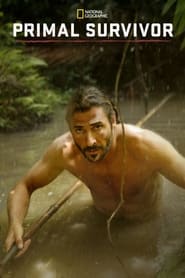
Primal Survivor
Download English Subtitle
Release info
Tags
Download English Subtitle Files for Mobile (6)
English subtitle preview
The first 200 lines.
This is definitely the best way of getting through this place.
Every hour I'm on this river
saves me a day of chopping through all that.
But late rains have swollen the river.
My easy ride will soon be quite a rollercoaster.
The water's starting to pick up now.
Time to bail.
I'll try to reach those overhanging tree branches.
There's no way I could have gone any longer on this river.
It's flooding.
No banks, no eddies.
There's nothing I could have done except for jump off.
I got everything I need.
From here on out...
...it's over land.
See what else this place can throw at me.
I'm Hazen Audel, wilderness explorer.
I'm embarking on the longest and most challenging expedition
I've ever attempted,
something I've dreamt about since my youth.
When I was younger,
I spent many years of my life in the Amazon,
and the great Andes Mountains were always in the far, far distance
and were always intriguing to me.
And now, that's right where I'm going.
My journey to and over the Andes
will take me through some of the toughest environments
in South America.
Starting in hostile jungle,
I'll cross sun-scorched savannas and wild wetlands,
then climb through brutal cloud forest
to the frozen high plains and snow-capped peaks of the high Andes,
before descending into the infamous Atacama Desert
and my ultimate destination at the Pacific coast.
I'm here during the autumn equinox.
That means the duration of day and night are the same.
But every day after this, as I get closer to the Andes,
the days are gonna get shorter and shorter.
I'll be racing the sun west,
trying to cross the high mountains before the winter snows.
But it'll be worth it.
Now is the time of harvest and ritual.
The chance for me to experience some unique festivals and traditions
that few outsiders get to see.
Crossing the Andes during this time of the year is full of challenges.
And it'll take everything I've got as far as survival skills,
knowledge, endurance.
But if I complete this,
it'll be one of the biggest feats of my life.
And my challenge starts here in the Atlantic Forest
where I must first find a route west
through thousands of square miles of harsh jungle,
swamps, and wild waterfalls
to a remote Guarani village.
At this time of year,
the community marks the changing of the seasons
with a special annual forest hunt
and festival feast.
If I can make it through the jungle in time,
I have a chance to experience this unique tradition for myself.
There are remote Guarani settlements throughout the Atlantic Forest.
But this place is also home to other residents
including caiman,
jaguar, and deadly vipers.
But these are not the only hazards in this jagged jungle.
Wow.
You know, I'm not the only thing trying to survive here.
Everything that's living is trying to do the same thing I'm doing.
And as far as all the animals that are here,
they're trying to eat and they're trying not to get eaten,
and the same thing goes with plants.
Plants are trying to get as much sun as they possibly can and not get eaten.
So they're either full of poisons
or they arm themselves.
Look at the barbs and spines on this plant.
This is not an easy place to get through.
It's tough going.
And it's only gonna get tougher.
It's hard to find a route through this place.
This forest is very dense, very wild.
But if you know where to look,
this place is full of survival scores.
Cool.
Meliponini bees.
They are a little small stingless bee,
and they make lots of honey.
Meliponines often construct their hives deep inside hollow trees
protecting themselves from predators.
I can hear the hive is right in here.
So if I just make a little opening,
try to be as discreet as I can,
get a little bit of honey,
and then close up their home,
I'll get a really good hit of sugar.
But the bees won't give up their honey without a fight.
They may be stingless, but meliponines bite hard.
Some even secrete formic acid, like adding salt to the wound.
It's really bad when they get inside your ears
because it's like when they get deep inside,
it's like they're scraping at the insides of your brain.
Not the nicest.
There we go.
Yeah. There's the hive.
It's in there. If I can just reach.
Oh yeah. They're crawling all over.
Ah!
Ah. There's honey.
You can use this moss like a sponge.
Okay, shove that in and just wipe it in there.
Oh yeah. (laughing)
Mm.
Oh my god.
That is so delicious.
Hmm.
Oh my god.
There is nothing sweeter in the jungle than that right there.
Mm. Oh. (slurps).
I don't want to overdo it.
Boy, we are all buzzing right now.
I'll take only what I need.
The bees have to have their winter food.
I can plug up the hole that's there,
and then these bees will just seal up
any leaks in their nest with beeswax,
and they'll be back to normal in no time.
Phew.
I am very sticky.
Those sweet calories are a much-needed energy boost
for the hard miles ahead.
It's almost impossible to cover any ground in here.
It's slow going.
Look at that.
Any clearing is a welcome break from the thick jungle...
...but all the rains have created a new challenge.
See how flat it is?
The water doesn't have any place to go, so it turns into swamp.
It might not look like it, but the best route is just
to beeline it across sometimes.
Circumnavigating this swamp will burn time and energy
and take me off track.
But crossing it is a calculated risk.
Yeah. You never quite know exactly what's in water like this.
So...
...yet another adventure.
Still, stagnant water is a draw for many creatures
including the broad-snouted caiman,
which can grow to over 10 feet.
Okay, I'm up to my bellybutton now.
I need to get through here without attracting any unwanted attention.
That's the point of no return.
Okay.
So right now, it feels like it's just me and the swamp
and the... hundreds of other kinds of things that could be living in here.
I don't exactly know.
Okay. Okay.
Definitely... halfway across.
Good so far.
But there's one final obstacle in my way.
Sawgrass.
You gotta go through this stuff real gently
because it slices you right open.
And cuts along with this water,
that's a horrible combination,
a recipe for big time infections.
Waterlogged grass is an ideal place where alligator species build their nests,
I need to be on the lookout.
Okay.
Oh, okay, good deal.
Okay.
It's kind of gross, but... it could have been a lot worse.
But the dangers here...
Hold on.
...don't just lie beneath the water.
Where is your head?
Ooh hoo hoo hoo!
Yes, I know exactly what this is.
Come here.
This is where you find these kind of snakes.
This is called a spilotes.
When they're around people,
a common name for these snakes are called chicken snakes
because they love to eat chickens.
Chicken snakes also eat small mammals and lizards.
And adults can grow to almost nine feet.
They can sense movement, and they are pursuit predators.
So, when they see something that they want to eat,
they will chase after it through the grass,
up through the branches, down holes,
through the chicken cages
and once they grab a hold of their prey,
they're a really powerful constrictor, almost like a boa constrictor.
Oh here, look at this. It does not want to let go.
It's like having another arm at the very end of their body.
Yeah, (laughs) it's very strong. It's like a prehensile tail on a monkey.
But that's another telltale sign
that this is a tree-living snake.
I think we both had a good look at each other.
I'll just leave it just like how I found it.
I'm glad to leave the swamps behind me
and I've lucked out
Primal Survivor subtitles in other languages
More English subtitles for Primal Survivor
- Primal Survivor S09 DSNP WEB-DL DD+5 1 H 264-playWEB · 22 downloads · 2024-08-29
- Primal Survivor S09 720p DSNP WEB-DL DD+5 1 H 264-playWEB · 12 downloads · 2023-10-18
- Primal Survivor S09 720p DSNP WEB-DL DD+5 1 H 264-playWEB · 12 downloads · 2023-10-18
Comments
No comments yet. Be the first to leave one.