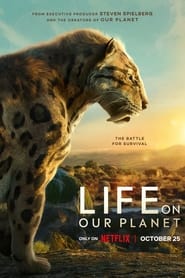
Life on Our Planet
Download English Subtitle
Download English Subtitle Files for Mobile (8)
English subtitle preview
The first 132 lines.
Two million years ago, and our planet is a very different place.
A saber-toothed cat, the Smilodon.
A fearsome predator of its age.
Standing in the way, a giant terror bird, two meters tall.
Both sides are armed...
and prepared for a fight.
This is the story of the great battles for survival
and the dynasties that would take over the world.
This is the story of life.
If you know where to look,
you can still find clues to the origins of life on our planet.
This is not just a gathering of marine predators.
It is a coming together of ancient bloodlines.
Sharks, living fossils,
virtually unchanged for hundreds of millions of years.
Dolphins, air-breathing mammals
whose ancestors once roamed on land.
Whales, bigger than any other animals that have ever lived.
Birds,
the last survivors of the dinosaurs...
the world's greatest dynasty.
All predators,
all hunting the same prey,
but all with totally different origins.
There are more than ten million species of plant and animals alive today.
And yet, they are just 1% of all species that have ever existed.
By traveling back in time,
we'll meet many of the 99% that have gone extinct...
...to reveal the most extraordinary story of all,
the story of life on our planet.
Life and all its incredible variety had to start somewhere.
The first spark appeared four billion years ago.
Perhaps uniquely, our planet had just the right conditions.
Liquid water, energy from the Sun,
and the perfect chemistry for life to take hold.
The exact process is lost in the mists of time.
But what it produced was a tiny single living cell.
LUCA,
the Last Universal Common Ancestor...
from which all life, everything, is descended.
From these humble beginnings,
life took billions more years to develop real complexity.
A feat it first achieved in the oceans.
The earliest animals to attain supremacy
were simple life forms.
These invertebrates,
animals without backbones,
ruled the seas for many millions of years.
Throughout history, life has been waging an unending war.
One dynasty rising,
only to be vanquished by the next.
Plants were among the first to conquer the land...
creating conditions that, in time,
allowed the invertebrates to follow
and take over.
But the invertebrates could not rule forever.
A new dynasty would surpass them.
One that also came from the water.
The amphibians...
...whose novel body plan of four limbs and a backbone
would prove an enduring blueprint for success.
Their reach was limited by their ties to water.
But they spawned another dynasty with no such binds.
The reptiles.
Able to exploit even the driest regions,
their sprawling gait carried them around the world.
For the first time in history, there was a global power.
From these early reptiles
came the most iconic dynasty of them all.
The dinosaurs.
They were to rule for over 150 million years.
A group of astonishing variety,
whose absolute dominion
was only cut short by calamitous bad luck.
Out of their shadows
rose the last great bloodline.
The mammals.
One of whom would go on to change our planet
like nothing before.
The rise and fall of these dynasties,
over four billion years,
has not just been a matter of chance.
The whole journey,
from the beginning of life to the infinite variety we know today,
has been driven by certain fundamental principles.
The rules of life.
The first rule is the best adapted will always win through.
Every one of these butterfly eggs looks identical.
But each has a different combination of genes
that makes them, individually, completely unique.
Some will have genetic qualities that help them survive.
Qualities that will pass from generation to generation...
until eventually,
one will be so different to its predecessors
that it becomes an entirely new species,
better adapted to its environment.
This is evolution.
- -
But the caterpillars aren't the only ones evolving.
Everything in this forest is fighting for survival...
... including the plants.
Unchecked, the caterpillars would strip them bare.
But this plant has evolved its own adaptations for survival.
Poison in its leaves,
capable of killing anything that eats them.
It's chemical warfare.
Then a new species of caterpillar evolves...
that can eat the otherwise poisonous leaves,
along with any eggs that might be on them.
In response,
other butterflies adapt to only lay on plants
that are free of eggs...
...ensuring their young have the best possible start.
But the plants retaliate...
... forming growths on their leaves
that mimic butterfly eggs...
deterring any females from laying there.
What's more, the fake eggs produce a sweet nectar that attracts ants...
that feed on caterpillars.
The first rule of life, that the best adapted will win through...
...has produced the huge diversity that exists today.
The next rule of life
is that competition drives adaptation.
And the most acute competition comes from one's own kind.
A male terror bird.
His territory is the lakeshore.
- - But he's not alone.
A younger male wants this prime spot.
- -
The older one can't ignore the threat.
The youngster refuses to back down.
He needs a territory of his own.
Life on Our Planet subtitles in other languages
More English subtitles for Life on Our Planet
- Life On Our Planet S01 720p WEB H264-EDITH · 48 downloads · 2023-10-27
- Life On Our Planet S01 720p WEB H264-EDITH · 49 downloads · 2023-10-27
- Life on Our Planet S01 2023 Netflix WEB-DL 1080p x264 DDP-HDCTV · 69 downloads · 2023-10-27
- Life on Our Planet S01 720p NF WEBRip DDP5 1 Atmos x264-EDITH · 72 downloads · 2023-10-25
- Life on Our Planet S01 720p NF WEBRip DDP5 1 Atmos x264-EDITH · 48 downloads · 2023-10-25
Comments
No comments yet. Be the first to leave one.