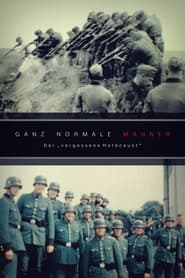
Ordinary Men: The "Forgotten Holocaust"
Ganz normale Männer - Der "vergessene Holocaust"
Download English Subtitle
Release info
Tags
Download English Subtitle Files for Mobile (2)
English subtitle preview
The first 200 lines.
German policemen in the occupied East, 1942.
They're here to enforce German rule in the conquered territories.
Diligently, they carry out their orders.
They have a special assignment:
To shoot Jews by the hundreds and thousands.
At point-blank range.
Historians and other experts have done extensive studies
into the men who pulled these triggers.
They want to know how a mass murder like this could happen.
And they make an astounding discovery.
Those men didn't have to kill.
They didn't have to obey the order.
If you had the courage to say, "I can't shoot,"
you may have been considered a coward,
you may have gotten a bad letter in your file,
but you were not punished in any severe way.
20 years after the war, there's a trial
for the murders committed by a Hamburg police unit.
So, what was their motivation?
Why did they shoot?
They aren't ideologically-motivated,
willing executioners.
They're not trained killers.
They're people with civilian jobs, like taxi drivers or plumbers.
In every respect they were completely ordinary men.
- -
Hamburg in the summer of 1942.
Three years into the war.
The regime is recruiting men for a special assignment.
By 1942, you're really at the bottom of the manpower pool
because of the casualties, of course,
that the army is suffering in Russia
and the growing manpower they need
to occupy the ever-growing German empire.
They want every person they can get their hands on
simply to fill the manpower shortage.
Older family men, who are no longer suitable for the German Wehrmacht,
are also called up. Many are not Nazi sympathizers,
nor are they overly hostile towards Jews.
But rather, they come from historically social democratic backgrounds.
They ranged from bakers and craftsmen
to carpenters and tradesmen with office jobs.
That police battalion basically reflected
the average working population of Hamburg.
They're drafted as reserve police officers.
Their training, however, hardly allows them enough time
to prepare them for what awaits.
On June the 21st, 1942,
they say goodbye to their families and leave home.
They were given a fairly abstract description of their mission,
which consisted of securing the German-occupied areas.
They're taken to Poland.
On June 25th, Reserve Police Battalion 101 arrives
in the southern part of the district Lublin.
We know there was then no preparation.
They didn't know they were going to do this when they're sent to Poland.
The officers didn't know. Trapp really doesn't...
Major Trapp doesn't learn what he's going to do until the day before.
It is July 13th, 1942,
and the battalion has to report early in the morning.
Major Trapp, who delivers the order, is an older man
who is very popular with his men
because he's not the typical authoritarian commander.
The men call him "Papa" Trapp.
That indicates what kind of relationship they have.
Major Trapp stands in front of the battalion and says,
"I have a terrible order to give you today."
His voice is choking, he has tears streaming down his cheeks.
He's physically, you know, struggling visibly to control himself physically.
This was, for him, a very terrible and difficult thing to do,
to explain to his men what he was going to ask them to do.
They are to shoot 1,500 Jewish men, women and children.
And that's when he then makes this offer:
"If any of the rank and file don't feel up to it,
you can step out and you don't have to take part."
Telling people to step out if they don't want to participate
requires them to take action.
But when we are faced with a decision
and we don't know exactly what the right thing is to do,
we usually do nothing.
One man does step out.
The captain of his company, who's very embarrassed
that one of his men would be the first "coward," uh,
to not take part, starts to yell at him.
And Trapp cuts him off, takes the man under his protection.
And then about a dozen people follow his example.
Attention! Dismiss!
From a historical perspective, it's an incredibly interesting situation
because the orders are documented
and it's clear from the way they were issued that the men did not have to kill.
Part of the post-war narrative was that you had to take part,
otherwise you would have been shot yourself.
Here we can clearly show that no, that was not the case.
They could decide.
The same was apparently true for all killing units.
To this day, not a single case has been found
where a subordinate's life was in danger if he refused to shoot unarmed civilians.
It all starts in September 1939: the German Wehrmacht invades Poland.
In just a few weeks, the country is defeated.
Millions of Poles fall into German hands and should now be kept under watch.
For this, the regime needs security forces.
In the German Reich, tens of thousands of men enlist
to become policemen in the occupied territories.
They hope to avoid military service on the front lines.
With so many applicants, the regime has the luxury to be very selective.
160,000 men applied to volunteer for the police,
and only 26,000 to 30,000 could be accepted.
They were then trained for six months
and, most crucially, received ideological training
which made it fairly clear to them what would be expected of them.
They were told that, as the master race,
they should ensure that National Socialist policies
were established and executed in the occupied territories.
After their training, the men find out what that means in reality.
Their job is to help implement
the brutal Nazi policies in the occupied territories.
Which is why the regime pick men who are sympathetic to the Nazi cause.
Grouped into police battalions, they are sent to Poland.
There they will oppress, persecute, and murder civilians,
in particular Jews.
As early as October or November 1939,
those units began shooting civilians:
Polish resistance fighters, clergy, intellectuals, even Jews,
driving people out, deporting them.
All in all, you could say that those units
put the National Socialist extermination policy into practice.
Just two years later, the attack on the Soviet Union.
It is a war of conquest and annihilation.
According to Germany's plans,
30 million Soviets should die in order to free up space to live.
Mobile killing units comprised of police and SS task forces,
called "Einsatzgruppen," back up the troops in combat.
On June the 27th, 1941, Police Battalion 309 enters Bialystok.
The ideologically-programmed men lock 800 Jews in the synagogue
and set it on fire.
And then they kill even more.
The next day, the policemen are honored for "securing" the city, as they call it.
Altogether, 18,000 men advance behind the front into the villages and towns,
where the mostly young and indoctrinated gunmen
shoot all the Jewish men, women and children dead.
Now the Holocaust begins, the systematic mass murder of the Jews.
Many of the shooters are traumatized by the killings,
which is one reason why large extermination camps
like Auschwitz emerge at the end of 1941.
The process of mass murder needs to be made more effective
and more gentle on the perpetrators.
If we try to figure out
the proportions of Holocaust victims
in terms of how they perished,
the best estimate, I think, is that
about a half, close to three million,
died in the death camps, in the gas chambers.
That close to a million died in what we might call conditions of incarceration:
Starving in epidemics, in the ghettos, the death marches at the end of the war.
Which means that over two million died by firing squad,
died in these mass executions.
Over two million people murdered, face-to-face with their killers.
A little-known fact even today, it is the "forgotten Holocaust."
Liepaja, summer 1941,
in Einsatzgruppe A's area of operation.
This is the only film discovered
that shows a shooting of Jews on the Eastern Front.
Officially, filming is forbidden,
because the killing is supposed to remain a secret.
They only made two mistakes.
One, they kept a record of everything.
And it was sent to Berlin,
where it was consolidated with all the other from B, C and D.
And it gave a comprehensive picture of whom they had killed in which cities,
in which town, in which unit, which command at what time.
That was the first mistake, to keep the record.
The second was that I found them.
Nuremberg after the war.
The so-called "Thousand-Year Reich" lies in ruins.
In the city where the Nazis once held their Nazi Party Rallies,
the Allies want to bring German crimes to justice.
In the Nuremberg Palace of Justice, the major war criminals are put on trial.
They ordered the crimes and will be prosecuted accordingly.
But who carried out the murders?
The 27-year-old lawyer Benjamin Ferencz is tasked with finding out
and sets off to look for clues.
In early 1947, his investigation team makes a significant find.
One day, one of my researchers came.
He said, "Look what I found."
And he handed me a bunch of papers, " Ereignismeldungen aus der UDSSR. "
These are death lists from the mobile killing units,
the SS Einsatzgruppen.
The murder of hundreds of thousands of people was documented
as a record of achievement.
I took a little adding machine
and I began to add up Einsatzgruppe A reports.
10,000 killed here. 15,000 killed here. 20,000 killed here.
And I started to add them up.
When I added over a million, I said, "That's enough."
Ferencz wants to put the SS men responsible on trial.
But his superior refuses.
They don't have the budget or the time.
I got a little bit furious and said,
"You can't let these guys go!
I have a million murders in my hand, you're not going let them go!"
Ordinary Men: The "Forgotten Holocaust" subtitles in other languages
Comments
No comments yet. Be the first to leave one.