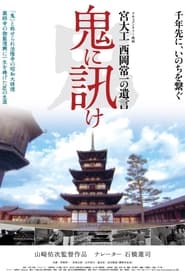
An Artisan's Legacy: Tsunekazu Nishioka (鬼に訊け 宮大工 西岡常一の遺言)
Download English Subtitle
Release info
Tags
English subtitle preview
The first 200 lines.
Hey!
Stop that.
Put this right on there.
Right there.
See? This touches here and that touches there.
How about here?
This handle.
It's touching.
Is it?
Then how about over here?
It's touching, a little.
Right? It shouldn't be.
When you carve deeper, it'll get in the way.
Yes, sir.
So it must...
It must be flat to the tip.
Real flat.
Be careful when using the back, too.
When you dig through, raise the chisel.
Leave a slight gap in the corners of the hole.
Chisel deeper and forward.
Don't just work on one spot.
Once at a certain depth, pound harder.
Make sure you don't use such a wide chisel.
Use the 15mm or 18mm one.
You can't work efficiently
when you use a wider one.
There once was a man feared as a Oni.
Tsunekazu Nishioka,
born in Nara Prefecture in 1908.
Respected the trees and built architectures that last 1000 years.
Passed away in 1995.
What did Nishioka want to leave behind as his legacy?
We started filming again.
The Last Words of Miyadaiku Tsunekazu Nishioka
Yakushiji, a Hosso Buddhist temple,
has been praying for world peace for 1300 years,
and to save people from the sea of agony.
Hoin Yamada
Suffering from a massive fire and high winds,
it was a dilapidated temple until the Showa period.
"At least restore the Kondo enshrining the principle image."
Their earnest wish started taking shape by
offering 1000 yen sutra transcripts 40 years ago.
This movement was led by superintendent priest Koin Takada.
Which timber should be used? Can it be restored from scratch?
It was all in a fog.
It was Nishioka who stepped up to the plate.
He left Horyuji to engage in the reconstruction of Yakushiji.
Japan used to heavily rely on trees.
The Garan style came into Japan and the local artisans adapted it for
the local weather and climate.
Nishioka was one of the established artisans.
He needed to build structures that would last 1000 years like the East Pagoda.
He was all humbled by the task.
Horyuji was built just as Buddhism came in.
There was this strong urge to fight back, not the religious...
...but the cultural aspects of the mainland.
So became spartan.
Whereas Buddhism was more accepted when this was built.
Emperor Tenmu built a Garan for his child, who later became Empress Jito,
so this one is extremely religious.
Emperor Tenmu was succeeded by Empress Jito,
so I felt there is a feminine softness to this Garan.
I've been working on Yakushiji believing religious faith should be at its core.
The basic concept was... the East Pagoda.
The only one left from the Hakuho period, so I studied it extensively.
On the suien of the East Pagoda is Onjo Bodhisattva,
a celestial being playing the flute, drum and lute.
Instead of ascending, it is descending onto our world.
So this Garan was built to bring the Pure Land down to our world.
That has been at the basis of this project.
And the height of the building is vital when determining the size of the Garan.
In this case, draw four circles with the radius equivalent to
the height of the East Pagoda and the West Pagoda.
It is designed to fit the corridors and the Daikodo.
We did extensive research and drew up a restoration blueprint.
We heard the roof is the determining factor in a wooden structure.
How was the inclination and length of the roof determined?
I based it on the East Pagoda.
Determined based on the inclination of the roof of the East Pagoda.
So accurate measurements of the East Pagoda serves as the basis.
How long did that take you?
Two years.
The Kondo of Yakushiji was completed in 1976.
The Hakuho-style Kondo was finally restored
after 531 years since it collapsed in a high wind in 1445.
Nishioka had turned 68 that spring.
After the Kondo was restored, the West Pagoda was restored in 1981,
and the Chumon in 1984,
a Hakuho-style Garan gradually started to take form.
Koin Takada
In 1991, Genjo Sanzo-in Garan was newly established in honor of
Genjo Sanzo-hoshi, the founder of Hosso-shu.
Yakushiji Woodworking Workshop
When we started recording in 1990, they were working on
the timberwork for Genjo Sanzo-in and
timber preparation for the first stage of the corridors.
Not bad.
Do the same in the other direction.
Yes, sir.
Tilt it a bit more.
Yes, like that.
Less friction, right?
You get less splinters.
How many miyadaiku ?
We have another workshop, so we're slip into two teams,
but we have around 13 in total.
They came because of your fame?
I think it was Yakushiji that fascinated them.
In general, they work in pairs here.
Nishioka's idea to enhance efficiency while training rookies on the job.
Words can only go so far,
but Nishioka tries to teach the subtle touch through words.
Use your entire body.
Or the wood shavings will break off.
They don't simply apply their skills on just any type of timber.
The timber comes first.
Tools are made according to the traits and required shape of the timber.
Nishioka believes skills only matter and come after that.
They get hands-on experience by repeating the same steps,
learning the traits of each timber.
Their job is to learn the traits of each timber,
build halls and pagodas by assembling them together,
and acquire Nishioka's style.
Horyuji Temple
When Buddhism came in from the mainland in the mid-6th century,
a number of large-scale temples were built mainly in Asuka.
Horyuji dates back to that period.
Its style resembling a palace from ancient Korea is
a sign of nostalgia for homeland by the builders of this temple.
This world's oldest wooden structure,
a temple with a history of 1400 years is
where Nishioka started.
Its major reconstruction over 20 years in the Showa period trained him well.
Nishisato of Horyuji ,
where carpenters, tilers and plasterers dwelled,
protecting temples through repair and reconstruction.
Born to be a third-generation miyadaiku,
becoming the master miyadaiku of Horyuji was his inescapable destiny.
Tsunekazu Nishioka, Master Miyadaiku
I was my grandfather's apprentice rather than my father's.
I was told to learn about the soil in order to know my timber.
For that, I was told to go to an agricultural school.
My father wanted to put me in an engineering school,
but grandfather got his say.
So my father put me in an agricultural school against his will.
I didn't think it would help me become a miyadaiku either,
but soon enough we started growing rice and vegetables in class.
Ikoma Agricultural School (former)
We were given a plot of land for practical training.
We sowed seeds, flowers bloomed, then harvest...
I understood what my grandfather meant by "the power of soil".
I got interested.
I graduated from an agricultural school and became a miyadaiku .
But now, when I check timber,
I can identify the type of timber and even where they're from.
Grandfather was right for sending me to an agricultural school.
Tsunekichi Nishioka
When Tsunekazu was a child, his grandfather gave his position to
Tsunekazu's father Naramitsu to teach Tsunekazu the fundamental values.
Passing down the teaching "Do not speak of Garan without respecting the gods"
and other secrets of Horyuji miyadaiku family by word of mouth.
A special education to become the next master miyadaiku.
When you first became the master miyadaiku of the Raido at 27,
your grandfather who trained you had passed away.
Yes, he had.
So in a sense you lost your backing, I mean, your biggest mentor.
Were you nervous?
Well, yes.
I believed I will be able to deliver,
but I had doubts nonetheless, you know, uncertainties.
Like whether I'd be able to deliver or give up midway.
I'm afraid it's a very typical question,
Kondo of Horyuji (after restoration)
but how many years can wooden buildings last before it needs a repair?
It lasts about 200 years after a repair.
And the kawara tiles?
Well, kawara ...Old kawara tiles tend to last longer, but...
Hirakudarimune Ukin
I think they last about 200 years.
After the Meiji period... Kawara tiles these days, 50 years.
How about wakugi ?
Wakugi ...must be wrought nails.
Wakugi used at Horyuji
Not those steel molten in a furnace shaped into a nail.
They rot in no time.
The major reconstruction of Horyuji over 20 years before and after the war.
Nishioka went to war as a dutiful citizen,
but always thought of his hometown, Nishisato.
"Hometown is always beautiful. I want to go back to Horyuji."
"I miss my family"... His heart was torn into pieces.
My father used to... Every time he went to serve our country,
Taro Nishioka
he paid a visit to Horyuji and prayed, "I am going to war today."
"If you still need me, please bring me back."
"If not, I am ready to die serving my country."
Clasping his hands together, he'd pray to the gods like that.
Then come home and tell us,
"Maybe the next time I'd see you will be at Yasukuni in Tokyo."
An Artisan's Legacy: Tsunekazu Nishioka subtitles in other languages
Comments
No comments yet. Be the first to leave one.